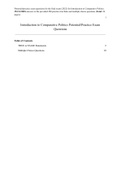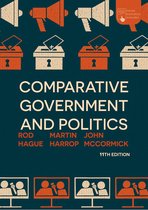
Potential/practice exam questions for the final exam (2022) for Introduction to Comparative Politics.
INCLUDES answers to the provided 200 practice true/false and multiple choice questions (Total: 24
pages).
1
Introduction to Comparative Politics Potential/Practice Exam
Questions
Table of Contents
TRUE or FALSE Statements 2
Multiple Choice Questions 10
, 2
TRUE or FALSE Statements
1. The practice of lobbying strengthens the principle of equality which underpins democracy.
● FALSE, lobbying can contribute to effective political communication, HOWEVER, it does
have troubling practical limitations (i.e. legal bribery).
2. An electoral system is a majority system if it is designed to regularly deliver a majority government.
● TRUE, majoritarian systems ensure that a winning candidate always has a majority.
HOWEVER, other systems can still deliver a majority government (NOT designed to).
3. According to Duverger’s characterization, in a semi-presidential system, the president possesses quite
considerable powers.
● TRUE, the president is directly elected by universal suffrage and possesses certain powers
which exceed those of a head of state in a normal parliamentary regime:
○ Appoints the prime minister and can dissolve the legislature.
○ Serves a limited number of fixed-length terms.
○ Serves as head of state and shares the responsibilities of being head of government
with the prime minister.
4. The larger the district magnitude, the more responsiveness of the electoral system will be achieved.
● TRUE, the larger the district, the more proportional the election outcomes are.
5. Judges of constitutional courts are appointed for long tenures.
● FALSE, constitutional court judges face a normal tenure of 1 non-renewable term (6-9 years),
while supreme court judges’ tenure is generally until retirement age.
6. In a sultanistic regime, channels of political participation are often subject to despotic intervention.
● TRUE, some existence of pluralism, but subject to unpredictable despotic intervention.
7. According to Duverger’s characterization, in a semi-presidential system, the president can dismiss
ministers.
● TRUE, the president decides the composition of the cabinet of ministers, thereby having the
authority to dismiss ministers by a vote of no confidence.
8. A Mixed Member Majoritarian (MMM) System is a mixed electoral system which is not designed to
secure proportional results.
● TRUE, MMM contains NO mechanism to secure a proportional result. It is designed to
maximise their respective advantages and minimise their disadvantages (= prospect of
unbalanced results).
9. Political participation in totalitarian regimes is often mobilised by the state.
● TRUE, there is extensive political mobilisation (e.g. military parades), mobilising the masses
to show support for the regime.
10. A two-party system is associated with full alternation in government.
● TRUE, there is a clear alternation in the office.
11. A plurality electoral system favours the representation of minorities.
● FALSE, plurality systems lead to disproportionality and underrepresentation of minority
groups.
12. Corporatist forms of interest group representation are often found in post-communist countries.
● FALSE, few post-communist countries have a good record regarding interest groups.
Throughout the communist era, NO independent groups were permitted in the communist
world, with communist rulers seeking to harness all organisations into ‘transmission belts’ for
party policy.
● Corporatism = an arrangement where selected interests in society are formally involved in
government and provide support in return for access.
13. Legitimacy arises when a rule was made correctly by following formal procedures.
● FALSE, legitimacy is based on authority, where those subject to its rule (residents + other
states) recognize its right to make decisions.
14. Legitimacy describes authority based solely on appeal to legal-rational norms.
● FALSE, according to Max Weber (1922), 3 ways of validating political power:
1. Tradition (accepted way of doing things).
INCLUDES answers to the provided 200 practice true/false and multiple choice questions (Total: 24
pages).
1
Introduction to Comparative Politics Potential/Practice Exam
Questions
Table of Contents
TRUE or FALSE Statements 2
Multiple Choice Questions 10
, 2
TRUE or FALSE Statements
1. The practice of lobbying strengthens the principle of equality which underpins democracy.
● FALSE, lobbying can contribute to effective political communication, HOWEVER, it does
have troubling practical limitations (i.e. legal bribery).
2. An electoral system is a majority system if it is designed to regularly deliver a majority government.
● TRUE, majoritarian systems ensure that a winning candidate always has a majority.
HOWEVER, other systems can still deliver a majority government (NOT designed to).
3. According to Duverger’s characterization, in a semi-presidential system, the president possesses quite
considerable powers.
● TRUE, the president is directly elected by universal suffrage and possesses certain powers
which exceed those of a head of state in a normal parliamentary regime:
○ Appoints the prime minister and can dissolve the legislature.
○ Serves a limited number of fixed-length terms.
○ Serves as head of state and shares the responsibilities of being head of government
with the prime minister.
4. The larger the district magnitude, the more responsiveness of the electoral system will be achieved.
● TRUE, the larger the district, the more proportional the election outcomes are.
5. Judges of constitutional courts are appointed for long tenures.
● FALSE, constitutional court judges face a normal tenure of 1 non-renewable term (6-9 years),
while supreme court judges’ tenure is generally until retirement age.
6. In a sultanistic regime, channels of political participation are often subject to despotic intervention.
● TRUE, some existence of pluralism, but subject to unpredictable despotic intervention.
7. According to Duverger’s characterization, in a semi-presidential system, the president can dismiss
ministers.
● TRUE, the president decides the composition of the cabinet of ministers, thereby having the
authority to dismiss ministers by a vote of no confidence.
8. A Mixed Member Majoritarian (MMM) System is a mixed electoral system which is not designed to
secure proportional results.
● TRUE, MMM contains NO mechanism to secure a proportional result. It is designed to
maximise their respective advantages and minimise their disadvantages (= prospect of
unbalanced results).
9. Political participation in totalitarian regimes is often mobilised by the state.
● TRUE, there is extensive political mobilisation (e.g. military parades), mobilising the masses
to show support for the regime.
10. A two-party system is associated with full alternation in government.
● TRUE, there is a clear alternation in the office.
11. A plurality electoral system favours the representation of minorities.
● FALSE, plurality systems lead to disproportionality and underrepresentation of minority
groups.
12. Corporatist forms of interest group representation are often found in post-communist countries.
● FALSE, few post-communist countries have a good record regarding interest groups.
Throughout the communist era, NO independent groups were permitted in the communist
world, with communist rulers seeking to harness all organisations into ‘transmission belts’ for
party policy.
● Corporatism = an arrangement where selected interests in society are formally involved in
government and provide support in return for access.
13. Legitimacy arises when a rule was made correctly by following formal procedures.
● FALSE, legitimacy is based on authority, where those subject to its rule (residents + other
states) recognize its right to make decisions.
14. Legitimacy describes authority based solely on appeal to legal-rational norms.
● FALSE, according to Max Weber (1922), 3 ways of validating political power:
1. Tradition (accepted way of doing things).