Percentage yield
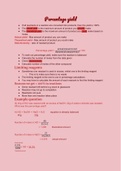
● If all reactants in a reaction are converted into products, then the yield is 100%
● The actual yield is the maximum amount of product you actually make
● The theoretical yield is the maximum amount of product you could make based on
moles
Actual yield - Max amount of product you can make
Theoretical yield - Max amount of product you could make
Stoichiometry - ratio of reactant:product
actual amount ∈mol
Percentage yield = x 100
theoretical amount∈mol
● To work out percentage yield, make sure the reaction is balanced
● Calculate the number of moles from the data given
● Check stoichiometry
● Calculate number of moles of the other compound
Limiting reagents
● Sometimes one reactant is used in excess, whilst one is the limiting reagent
○ This is to make sure there is no waste
● The limiting reagent is the one to use in percentage calculations
● You may have to calculate the amount of each reactant to find the limiting reagent
Reasons we get < 100% in reactions
● Some reactant left behind e.g stuck to glassware
● Reaction may not go to completion
● Reactants not pure
● More than one reaction takes place
Example question
Q) 40g of HCl was reacted with an excess of NaOH. 22g of sodium chloride was isolated.
What was the percentage yield?
A) HCl + NaOH -> NaCl + H2O equation is already balanced
40g 22g
40
Number of moles in HCl =
35.5+1
= 1.095 theoretical amount
22
Number of moles in NaCl =
23+35.5
= 0.376 actual amount
Actual amount
0.376
x 100 = 34.3%
1.095
Theoretical amount
● If all reactants in a reaction are converted into products, then the yield is 100%
● The actual yield is the maximum amount of product you actually make
● The theoretical yield is the maximum amount of product you could make based on
moles
Actual yield - Max amount of product you can make
Theoretical yield - Max amount of product you could make
Stoichiometry - ratio of reactant:product
actual amount ∈mol
Percentage yield = x 100
theoretical amount∈mol
● To work out percentage yield, make sure the reaction is balanced
● Calculate the number of moles from the data given
● Check stoichiometry
● Calculate number of moles of the other compound
Limiting reagents
● Sometimes one reactant is used in excess, whilst one is the limiting reagent
○ This is to make sure there is no waste
● The limiting reagent is the one to use in percentage calculations
● You may have to calculate the amount of each reactant to find the limiting reagent
Reasons we get < 100% in reactions
● Some reactant left behind e.g stuck to glassware
● Reaction may not go to completion
● Reactants not pure
● More than one reaction takes place
Example question
Q) 40g of HCl was reacted with an excess of NaOH. 22g of sodium chloride was isolated.
What was the percentage yield?
A) HCl + NaOH -> NaCl + H2O equation is already balanced
40g 22g
40
Number of moles in HCl =
35.5+1
= 1.095 theoretical amount
22
Number of moles in NaCl =
23+35.5
= 0.376 actual amount
Actual amount
0.376
x 100 = 34.3%
1.095
Theoretical amount