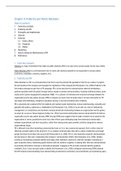
Chapter 11: Ethics
Table of contents
1. Some key concepts
2. Ethical decision making models and rules
3. Unethical communication practices
4. Regulation of communication practices
5. References
1. Some key concepts
Morals are beliefs or principles that individuals hold concerning what is right and wrong
Ethics are principles that serve as operational guidelines for both individuals and organisations
2. Ethical decision making models and rules
Different views can be held on how to apply ethical decision making in marketing communications (Pickton & Broderick,
2005). The caveat emptor rule puts forward that everything is allowed within legal rules, it if gives profit, while the
ethics code strives for standards on the basis of which companies and industries ethical performance is judged further
than standards prescribed by law. In the consumer sovereignty approach ethics is based on three questions: is the target
vulnerable? Are his expectations likely to be realized and do they have sufficient information to judge? Would they incur
substantial costs or inconvenience by transferring their loyalty? The caveat venditor approach is a maximization of
consumer satisfaction and hence the most ethical approach of the above mentioned approaches (De Pelsmacker et al.,
2018).
To be ethical, marketing decisions should be legal or allowed under the regulations and laws, decent (= not containing
anything that causes distress) and honest and truthful. Marketing communication should not exploit inexperience or lack
of knowledge of consumers, no claims should be made which are inaccurate or ambiguous (De Pelsemacker et al., 2018).
When facing an ethical dilemma, the following rules of thumb apply: Golden rule, professional ethics, categorical
imperative, outcomes and TV test (De Pelsemacker et al., 2018). The golden rule says that when faced with a decision
that appears to have ethical implications, you should act in a way that you would expect other to act towards you.
Professional ethics state that you should take only actions that would be viewed as proper by an objective panel of your
professional colleagues. The categorical imperative puts forward that one should act in such a way that the action taken
under circumstances could be a universal law of behaviour for everyone facing those same circumstances. Furthermore, a
manager should always ask himself is he would be comfortable explaining this action on TV to the general public. Finally,
the outcomes rule judges the ethical quality of a decision in terms of performance, rewards, satisfaction and feedback
(De Pelsemacker et al., 2008).
3. Unethical communication practices
Several unethical marketing communication practices exist. First of all stereotyping depicts specific gender, age or
cultural groups in a stereotypical way. Stereotyping is an automatic perceptual bias enabling people to construct
simplified images of reality (De Pelsemacker et al., 2018). Men and women are often shown in a supporting conservative
gender role or elderly are depicted as helpless. Other ethnic groups are sometimes portrayed in a stereotypical way that
offend them. These stereotypes are often used in a more subtle. Even when used in a subtle way, stereotyping can
affects how people think of themselves. It can make people believe for example that their happiness is related to how
good they look.
Controversial messages like shock advertising are communicated to get attention by evoking negative emotions. shock
advertising is advertising that deliberately rather than inadvertently startles and offends its audience, by means of
deliberate norm violation, transgression of law or custom or moral/social code, or by showing things that outrage the
Table of contents
1. Some key concepts
2. Ethical decision making models and rules
3. Unethical communication practices
4. Regulation of communication practices
5. References
1. Some key concepts
Morals are beliefs or principles that individuals hold concerning what is right and wrong
Ethics are principles that serve as operational guidelines for both individuals and organisations
2. Ethical decision making models and rules
Different views can be held on how to apply ethical decision making in marketing communications (Pickton & Broderick,
2005). The caveat emptor rule puts forward that everything is allowed within legal rules, it if gives profit, while the
ethics code strives for standards on the basis of which companies and industries ethical performance is judged further
than standards prescribed by law. In the consumer sovereignty approach ethics is based on three questions: is the target
vulnerable? Are his expectations likely to be realized and do they have sufficient information to judge? Would they incur
substantial costs or inconvenience by transferring their loyalty? The caveat venditor approach is a maximization of
consumer satisfaction and hence the most ethical approach of the above mentioned approaches (De Pelsmacker et al.,
2018).
To be ethical, marketing decisions should be legal or allowed under the regulations and laws, decent (= not containing
anything that causes distress) and honest and truthful. Marketing communication should not exploit inexperience or lack
of knowledge of consumers, no claims should be made which are inaccurate or ambiguous (De Pelsemacker et al., 2018).
When facing an ethical dilemma, the following rules of thumb apply: Golden rule, professional ethics, categorical
imperative, outcomes and TV test (De Pelsemacker et al., 2018). The golden rule says that when faced with a decision
that appears to have ethical implications, you should act in a way that you would expect other to act towards you.
Professional ethics state that you should take only actions that would be viewed as proper by an objective panel of your
professional colleagues. The categorical imperative puts forward that one should act in such a way that the action taken
under circumstances could be a universal law of behaviour for everyone facing those same circumstances. Furthermore, a
manager should always ask himself is he would be comfortable explaining this action on TV to the general public. Finally,
the outcomes rule judges the ethical quality of a decision in terms of performance, rewards, satisfaction and feedback
(De Pelsemacker et al., 2008).
3. Unethical communication practices
Several unethical marketing communication practices exist. First of all stereotyping depicts specific gender, age or
cultural groups in a stereotypical way. Stereotyping is an automatic perceptual bias enabling people to construct
simplified images of reality (De Pelsemacker et al., 2018). Men and women are often shown in a supporting conservative
gender role or elderly are depicted as helpless. Other ethnic groups are sometimes portrayed in a stereotypical way that
offend them. These stereotypes are often used in a more subtle. Even when used in a subtle way, stereotyping can
affects how people think of themselves. It can make people believe for example that their happiness is related to how
good they look.
Controversial messages like shock advertising are communicated to get attention by evoking negative emotions. shock
advertising is advertising that deliberately rather than inadvertently startles and offends its audience, by means of
deliberate norm violation, transgression of law or custom or moral/social code, or by showing things that outrage the