Unit 10: Biological Molecules and Metabolic Pathways
C Explore the factors that can affect the pathways and the rate of photosynthesis in plants.
Introduction
The conversion of light energy to chemical energy in the form of sugars is known as photosynthesis. Glucose molecules (or other sugars) are made from water and carbon
dioxide in a light-driven process, with oxygen emitted as a by-product. Glucose molecules provide two essential services to organisms: electricity and fixed organic carbon.
Photosynthesis is a procedure in which light energy is used to break the strong bonds between water molecules in a process known as photolysis (water splitting), allowing
hydrogen and carbon dioxide to be combined to make glucose as a fuel.
This process produces oxygen, which is discharged into the atmosphere as a waste product.
Carbon dioxide content, light intensity, and temperature all influence photosynthetic rates.
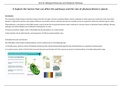
Chloroplast structure and function
The chloroplast is the location of photosynthesis, and it is suited to do so in the following ways:
• It includes grana, which are stacks of thylakoid membranes that contain photosynthetic pigments like chlorophyll that are organised as photosystems.
• It contains stroma, which is the fluid that surrounds the grana and includes all of the enzymes necessary for photosynthesis in the light-independent stage.
, Unit 10: Biological Molecules and Metabolic Pathways
Pigments and chlorophyll
Pigments absorb and reflect different wavelengths of light, which gives them their colour.
Plants seem green because chlorophyll absorbs mostly red and blue light and reflects green.
Many pigments absorb light, such as chlorophyll a, chlorophyll b, xanthophyll, and carotenoids, and absorb various wavelengths, causing the leaves to change colour. The
thylakoid membrane contains chlorophyll b, xanthophyll, and carotenoids, which together create a light harvesting mechanism (along with other proteins and pigments)
This mechanism absorbs and transmits light energy of various wavelengths to the reaction centre. Chlorophyll a is in the reaction centre – this is where photosynthesis
occurs. Photosynthesis takes place in the reaction centre, which contains chlorophyll a.
, Unit 10: Biological Molecules and Metabolic Pathways
Photosynthesis is divided into two stages:
Photophosphorylation is a light-dependent reaction in which electrons are excited to a higher energy level by the energy trapped by chlorophyll molecules in thylakoid
membranes. • Electrons are then passed down the electron transport chain from one electron carrier to the next, generating ATP from ADP and inorganic phosphate.
• In the light-dependent step, reduced NADP is produced when electrons and a proton are transferred to NADP (NADPH).
• In the light-independent stage of photosynthesis, both ATP and decreased NADP are consumed.
The Calvin cycle, also known as the light-independent process, is the final stage of photosynthesis that produces glucose using ATP (energy source) and decreased NADP
(reducing power).
1. RuBP reacts with carbon dioxide in a process known as carbon fixation, which is catalysed by the enzyme RUBISCO.
2. RuBP is split into two molecules of glycerate 3-phosphate (GP).
3. GP is converted to triose phosphate using reduced NADP and ATP (TP)
4. Some TP molecules are utilised to generate glucose, which is subsequently transformed into polysaccharides, lipids, amino acids, and nucleic acids, which are all
necessary chemical substances.
5. With the support of ATP, the remaining TP molecules are utilised to reconstruct RuBP.
C Explore the factors that can affect the pathways and the rate of photosynthesis in plants.
Introduction
The conversion of light energy to chemical energy in the form of sugars is known as photosynthesis. Glucose molecules (or other sugars) are made from water and carbon
dioxide in a light-driven process, with oxygen emitted as a by-product. Glucose molecules provide two essential services to organisms: electricity and fixed organic carbon.
Photosynthesis is a procedure in which light energy is used to break the strong bonds between water molecules in a process known as photolysis (water splitting), allowing
hydrogen and carbon dioxide to be combined to make glucose as a fuel.
This process produces oxygen, which is discharged into the atmosphere as a waste product.
Carbon dioxide content, light intensity, and temperature all influence photosynthetic rates.
Chloroplast structure and function
The chloroplast is the location of photosynthesis, and it is suited to do so in the following ways:
• It includes grana, which are stacks of thylakoid membranes that contain photosynthetic pigments like chlorophyll that are organised as photosystems.
• It contains stroma, which is the fluid that surrounds the grana and includes all of the enzymes necessary for photosynthesis in the light-independent stage.
, Unit 10: Biological Molecules and Metabolic Pathways
Pigments and chlorophyll
Pigments absorb and reflect different wavelengths of light, which gives them their colour.
Plants seem green because chlorophyll absorbs mostly red and blue light and reflects green.
Many pigments absorb light, such as chlorophyll a, chlorophyll b, xanthophyll, and carotenoids, and absorb various wavelengths, causing the leaves to change colour. The
thylakoid membrane contains chlorophyll b, xanthophyll, and carotenoids, which together create a light harvesting mechanism (along with other proteins and pigments)
This mechanism absorbs and transmits light energy of various wavelengths to the reaction centre. Chlorophyll a is in the reaction centre – this is where photosynthesis
occurs. Photosynthesis takes place in the reaction centre, which contains chlorophyll a.
, Unit 10: Biological Molecules and Metabolic Pathways
Photosynthesis is divided into two stages:
Photophosphorylation is a light-dependent reaction in which electrons are excited to a higher energy level by the energy trapped by chlorophyll molecules in thylakoid
membranes. • Electrons are then passed down the electron transport chain from one electron carrier to the next, generating ATP from ADP and inorganic phosphate.
• In the light-dependent step, reduced NADP is produced when electrons and a proton are transferred to NADP (NADPH).
• In the light-independent stage of photosynthesis, both ATP and decreased NADP are consumed.
The Calvin cycle, also known as the light-independent process, is the final stage of photosynthesis that produces glucose using ATP (energy source) and decreased NADP
(reducing power).
1. RuBP reacts with carbon dioxide in a process known as carbon fixation, which is catalysed by the enzyme RUBISCO.
2. RuBP is split into two molecules of glycerate 3-phosphate (GP).
3. GP is converted to triose phosphate using reduced NADP and ATP (TP)
4. Some TP molecules are utilised to generate glucose, which is subsequently transformed into polysaccharides, lipids, amino acids, and nucleic acids, which are all
necessary chemical substances.
5. With the support of ATP, the remaining TP molecules are utilised to reconstruct RuBP.