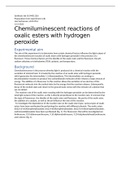
Synthesis lab 1b (MOL126)
Preparation form experiment 4.4b
Lisa Verhoeven, s1014716
13-3-2022
Chemiluminescent reactions of
oxalic esters with hydrogen
peroxide
Experimental aim
The aim of this experiment is to determine how certain chemical factors influence the light output of
the chemiluminescent reaction of oxalic esters with hydrogen peroxide in the presence of a
fluorescer. These chemical factors are the identity of the oxalic ester and the fluorescer, the pH,
sodium salicylate or triethylamine (TEA) catalysis, and temperature.
Background
Chemiluminescence is the process whereby light is produced via a chemical reaction with the
evolution of minimal heat. It is fueled by the reaction of an oxalic ester with hydrogen peroxide,
which generates the intermediate 1,2-dioxetanedione. This intermediate can undergo a
decarboxylation reaction to produce two carbondioxide molecules which releases a large amount of
energy. The addition of a fluorescer to this reaction allows the excitation of an electron of this
fluorescent molecule into the excited state by the energy that the reaction releases. Subsequently,
decay of the excited state and return to the ground state comes with the emission of a photon that
we can detect.
The reaction rate of the oxalic ester reacting with the hydrogen peroxide can be determined by the
total light output of the reaction, as this is directly proportional to the reaction rate. It is known that
the type of flueorescer, the identity of the oxalic ester and fluorescer, the purity of the oxalic ester,
the addition of a catalyst, as well as the pH influence the rate of this reaction.
To investigate the dependence of the reaction rate on the oxalic ester type, various types of oxalic
esters have been synthesised by performing the reaction with different phenols. The oxalic esters
bis(2,4,6-trichlorophenyl)oxalate, bis(2,4-dichlorophenyl)oxalate, bis(2,4,6-tribromophenyl)oxalate,
and bis(vanillyl)oxalate have been synthesised (fig. 1). The fluorescers that will be investigated are
Anthracene, 9,10-dibromoanthracene, 9,10-diphenylanthracene, 9,10-bis(phenylethynyl)anthracene
and rubrene (fig. 1).
, Figure 1. Oxalic esters and fluorescers used.
Hydrogen peroxide reacts with oxalic esters to produce the high energy intermediate (HEI) 1,2-
dioxetanedione. As mentioned previously, 1,2-dioxetanedione can rapidly undergo a decarboxylation
reaction to yield two carbondioxide molecules (fig. 2). This decomposition of the HEI is very
exothermic because it is accompanied by the release of a lot of ring strain, and because
carbondioxide is very low in free energy. The exact mechanism of fluorescer excitation has been
debated quite extensively, and has been implicated to vary per type of HEI formed. However, for 1,2-
dioxetanedione, it is almost certain that it excites the fluorescer via the chemically initiated electron
exchange luminescence (CIEEL) mechanism.
Figure 2. Mechanism of the fluorescent reaction, with bis(2,4,6-trichlorophenyl)oxalate as an example.
Experimental
1. Prepare a solution of oxalic ester in dimethylphtalate (DMP) (1.25mL, 0.05M) and a solution
of fluorescer in DMP (0.5mL, 1gL-1)
2. Mix the oxalic ester solution with the fluorescer solution
3. Add to this solution a solution of hydrogen peroxide in t-butanol (0.5mL, 10%) to start the
reaction perform this under various conditions; see scheme
4. Monitor the light output of each reaction, as well as the chemiluminescence lifetime and the
time it takes to initiate chemiluminescence
Preparation form experiment 4.4b
Lisa Verhoeven, s1014716
13-3-2022
Chemiluminescent reactions of
oxalic esters with hydrogen
peroxide
Experimental aim
The aim of this experiment is to determine how certain chemical factors influence the light output of
the chemiluminescent reaction of oxalic esters with hydrogen peroxide in the presence of a
fluorescer. These chemical factors are the identity of the oxalic ester and the fluorescer, the pH,
sodium salicylate or triethylamine (TEA) catalysis, and temperature.
Background
Chemiluminescence is the process whereby light is produced via a chemical reaction with the
evolution of minimal heat. It is fueled by the reaction of an oxalic ester with hydrogen peroxide,
which generates the intermediate 1,2-dioxetanedione. This intermediate can undergo a
decarboxylation reaction to produce two carbondioxide molecules which releases a large amount of
energy. The addition of a fluorescer to this reaction allows the excitation of an electron of this
fluorescent molecule into the excited state by the energy that the reaction releases. Subsequently,
decay of the excited state and return to the ground state comes with the emission of a photon that
we can detect.
The reaction rate of the oxalic ester reacting with the hydrogen peroxide can be determined by the
total light output of the reaction, as this is directly proportional to the reaction rate. It is known that
the type of flueorescer, the identity of the oxalic ester and fluorescer, the purity of the oxalic ester,
the addition of a catalyst, as well as the pH influence the rate of this reaction.
To investigate the dependence of the reaction rate on the oxalic ester type, various types of oxalic
esters have been synthesised by performing the reaction with different phenols. The oxalic esters
bis(2,4,6-trichlorophenyl)oxalate, bis(2,4-dichlorophenyl)oxalate, bis(2,4,6-tribromophenyl)oxalate,
and bis(vanillyl)oxalate have been synthesised (fig. 1). The fluorescers that will be investigated are
Anthracene, 9,10-dibromoanthracene, 9,10-diphenylanthracene, 9,10-bis(phenylethynyl)anthracene
and rubrene (fig. 1).
, Figure 1. Oxalic esters and fluorescers used.
Hydrogen peroxide reacts with oxalic esters to produce the high energy intermediate (HEI) 1,2-
dioxetanedione. As mentioned previously, 1,2-dioxetanedione can rapidly undergo a decarboxylation
reaction to yield two carbondioxide molecules (fig. 2). This decomposition of the HEI is very
exothermic because it is accompanied by the release of a lot of ring strain, and because
carbondioxide is very low in free energy. The exact mechanism of fluorescer excitation has been
debated quite extensively, and has been implicated to vary per type of HEI formed. However, for 1,2-
dioxetanedione, it is almost certain that it excites the fluorescer via the chemically initiated electron
exchange luminescence (CIEEL) mechanism.
Figure 2. Mechanism of the fluorescent reaction, with bis(2,4,6-trichlorophenyl)oxalate as an example.
Experimental
1. Prepare a solution of oxalic ester in dimethylphtalate (DMP) (1.25mL, 0.05M) and a solution
of fluorescer in DMP (0.5mL, 1gL-1)
2. Mix the oxalic ester solution with the fluorescer solution
3. Add to this solution a solution of hydrogen peroxide in t-butanol (0.5mL, 10%) to start the
reaction perform this under various conditions; see scheme
4. Monitor the light output of each reaction, as well as the chemiluminescence lifetime and the
time it takes to initiate chemiluminescence