LECTURE 5. FAMILY
THE FAMILY/PARENT-ADOLESCENT RELATIONSHIP
What is a ‘family’?
● Mother + father + child(ren).
● Mother + father + children + uncles + aunts + cousins + grandparents.
● Dictionary definition: married, 2 parent, biological offspring.
○ Families appear in different forms and sizes.
○ Answers may be culture-dependent.
● Structures more common ‘historically’ are not as common today.
○ E.g. in terms of structure and size.
○ Also culture-dependent.
● In all societies, the family fulfill similar functions:
○ Socialization of children/adolescents.
○ Enduring source of (practical/economic & emotional/social) support.
○ Continuity of relationships across the life course = social embedding.
The family as a system
● Focus traditionally on mother-child/adolescent relationships.
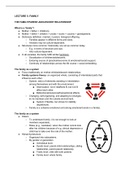
● Family systems theory: an organized whole, consisting of interrelated parts that
influence each other.
○ System: set(s) of elements standing in interrelation
among themselves and with the environment.
■ Interrecation: not A relaffects B, but A & B
affect each other.
■ Bidirectional/reciprocal/transactional effects.
○ Changing, self-organizing, and adapting to (changes
in) its members and the outside environment.
■ System if flexible, but strives for stability
(equilibrium).
○ Family is a cohesive emotional unit (strong emotional bonds in a family).
The family as a system
● Holism
○ To understand family, it is not enough to look at
members separately.
○ Roles (e.g., caretaker): when the mother cannot look
after her children because of e.g. clinical depression a
child has to take over the role of the mother.
● Hierarchy/structure
○ Organized into subsystems.
○ By gender or generation
■ Indivdidual level.
■ Dyadic level: parent-child relationships, sibling
relationship, parent-parent relationsip.
■ Tradic level: child with both parents.
■ Family level: whole family.
, ● Boundaries
○ At every level (subsystems, inside/outside).
○ Permeability varies across families.
○ Permeability evolves over time.
The family as a system: boundaries
● Spillover (what happens in one system affects what happens in another system) vs.
compensation (what happens or does not happen in a system is compensated in
another system): when there are loose boundaries between subsystems.
○ Association between dyadic relationships within the family.
● Longitudinal study by Sherrill et al. (2017) in the USA.
○ Sample of 60 parents with young adolescents between 10-14 years old.
○ Parent-reports (telephone interviews within and across days).
■ Interparental conflict: did you experience conflict with your spouse?
■ Parent-adolescent conflict: did you experience conflict with your child?
○ Results: whenever there was
interparental conflict there was a
2.26x times higher change of parent-
adolescent conflict later that day.
The same effect (2.00x) was found a
day later. Interestingly, when parents
reported higher parent-adolescent
conflict they were also likely to report
interparental conflict one day later:
○ Conclusion: presence of
interparental conflict increases the odds of parent-adolescent conflict at a
later moment in time, and vice versa (= spillover).
● Longitudinal study of Mastrotheodoros et al. (2020) in NL: why spillover?
○ Sample of 443 Dutch adolescents and mothers.
○ Results: interparental conflict was associated with higher levels of mother and
adolescent
anger, this in turn
was associated
with higher
mother-adolescent conflict. This was a vicious cycle.
● Longitudinal study by Kouros et al. (2014) in USA: spillover ‘bad’?
○ Sample of 203 early adolescents.
○ Mother and father reports.
■ Marital quality and parent-
adolescent relationship
quality.
○ Results: higher levels of marital
quality is associated with parent-
adolescent relationship quality on
the same day. They also found
where there were lower levels of
marital quality, mothers reported
higher levels of mother-adolescent relationship quality a day later.
, ○ Conclusion: “spillover” can be positive as well and some evidence for
“compensation” in the family system.
● Adolescence = disruption of homeostasis.
○ New balance/eliquibrin needs to be found.
○ Process of (family) adaptation.
Keep in mind!
Adolescent in a system: 3 influences.
● Genotype.
● Shared environment.
● Unshared environment.
Family system should be embedded into a larger influential context.
PARENTING STYLES AND ADOLESCENT DEVELOPMENT
Parenting styles
● Authoritative: high levels of responsiveness and demandingness.
○ Engage adolescent in decision making (e.g., rules).
○ Encourage autonomy and independence.
○ Involved and monitoring parents.
○ Open communication and trust.
● Authoritarian: high levels of demandingness and lower levels of responsiveness.
○ Strict rules and high expectations.
○ Discourage autonomy and independence.
○ Punishment-hevy.
○ Low open communication and trust.
● Indulgent: high levels of responsiveness and low demandingness.
○ Very responsive to the needs of children.
○ Insufficient parental guidance.
○ No behavioral expectations = no control or punishment.
○ Adolescents require little self-regulation.
● Indifferent: low levels of responsiveness and demandingness.
○ Not responsive to the needs of children.
○ Insufficient parental guidance.
○ Provide basic needs, not more.
○ Uninvolved, detached and disengaged.
○ No communication and trust.
Stability across time/development,
specific behaviors change!
Parenting styles and adolescent
functioning
● Authoritarian
○ Individuation
interfered.
○ Dependent and
obedient.
○ Low confidence.
, ○ Low social competence.
○ Rebelliousness.
○ Passivity and lack of school interest.
● Authoritative: most positive adolescent functioning.
○ Independent and autonomous.
○ Responsible.
○ High confidence.
○ Strong emotional parent-adolescent bond maintained.
○ Problem solving and critical thinking.
● Indifferent: least positive parenting style in relation to adolescent functioning.
○ Impulsive (less self-regulation).
○ Delinquent.
○ Early experimentation with sex, drugs and alchol.
○ Mature earlier (provide for themselves, no parent-role).
○ Academic underachievement.
● Indulgent: not as bad as the authoritarian parents.
○ Less mature and responsible.
○ Conforming to peers.
○ High confidence, but misbehavior.
○ Impulsive (less self-regulation).
○ But: could be emotionally secure and independent.
Important methodological considerations
Control vs. control
● Control in the context of high support/involvement vs. low support/involvement.
● Monitoring (behavioral control): control in high support situations. Positive: lower
levels of externalizing behaviors.
● Psychological control: parents want to know what their kids are doing and with who
they are doing it. Negative: higher levels of internalizing behaviors.
● Parental control in different environments.
Cultural considerations
● Are Asian parents authoritarian? (or protective/”strict-affectione”?).
● Correlation between ethnic (minority) background and family environment.
● Still: even though authoritative parenting is less common in ethnic minority families,
its effects on adolescent development are beneficial in all ethnic groups.
Parenting styles and adolescent functioning
Cross-cultural comparison on:
● Substance use.
● Self-esteem.
● School performance.
● Personal disturbances (internalizing and externalizing behavior).
Overall conclusion: parenting styles relate to substance use and other outcomes in the same
way in different countries explored.
CHANGES IN (THE DYNAMIC OF THE) PARENT-ADOLESCENT RELATIONSHIP
Parents and adolescents?
Teenagers are mostly portrayed as a time of survival for parents.
THE FAMILY/PARENT-ADOLESCENT RELATIONSHIP
What is a ‘family’?
● Mother + father + child(ren).
● Mother + father + children + uncles + aunts + cousins + grandparents.
● Dictionary definition: married, 2 parent, biological offspring.
○ Families appear in different forms and sizes.
○ Answers may be culture-dependent.
● Structures more common ‘historically’ are not as common today.
○ E.g. in terms of structure and size.
○ Also culture-dependent.
● In all societies, the family fulfill similar functions:
○ Socialization of children/adolescents.
○ Enduring source of (practical/economic & emotional/social) support.
○ Continuity of relationships across the life course = social embedding.
The family as a system
● Focus traditionally on mother-child/adolescent relationships.
● Family systems theory: an organized whole, consisting of interrelated parts that
influence each other.
○ System: set(s) of elements standing in interrelation
among themselves and with the environment.
■ Interrecation: not A relaffects B, but A & B
affect each other.
■ Bidirectional/reciprocal/transactional effects.
○ Changing, self-organizing, and adapting to (changes
in) its members and the outside environment.
■ System if flexible, but strives for stability
(equilibrium).
○ Family is a cohesive emotional unit (strong emotional bonds in a family).
The family as a system
● Holism
○ To understand family, it is not enough to look at
members separately.
○ Roles (e.g., caretaker): when the mother cannot look
after her children because of e.g. clinical depression a
child has to take over the role of the mother.
● Hierarchy/structure
○ Organized into subsystems.
○ By gender or generation
■ Indivdidual level.
■ Dyadic level: parent-child relationships, sibling
relationship, parent-parent relationsip.
■ Tradic level: child with both parents.
■ Family level: whole family.
, ● Boundaries
○ At every level (subsystems, inside/outside).
○ Permeability varies across families.
○ Permeability evolves over time.
The family as a system: boundaries
● Spillover (what happens in one system affects what happens in another system) vs.
compensation (what happens or does not happen in a system is compensated in
another system): when there are loose boundaries between subsystems.
○ Association between dyadic relationships within the family.
● Longitudinal study by Sherrill et al. (2017) in the USA.
○ Sample of 60 parents with young adolescents between 10-14 years old.
○ Parent-reports (telephone interviews within and across days).
■ Interparental conflict: did you experience conflict with your spouse?
■ Parent-adolescent conflict: did you experience conflict with your child?
○ Results: whenever there was
interparental conflict there was a
2.26x times higher change of parent-
adolescent conflict later that day.
The same effect (2.00x) was found a
day later. Interestingly, when parents
reported higher parent-adolescent
conflict they were also likely to report
interparental conflict one day later:
○ Conclusion: presence of
interparental conflict increases the odds of parent-adolescent conflict at a
later moment in time, and vice versa (= spillover).
● Longitudinal study of Mastrotheodoros et al. (2020) in NL: why spillover?
○ Sample of 443 Dutch adolescents and mothers.
○ Results: interparental conflict was associated with higher levels of mother and
adolescent
anger, this in turn
was associated
with higher
mother-adolescent conflict. This was a vicious cycle.
● Longitudinal study by Kouros et al. (2014) in USA: spillover ‘bad’?
○ Sample of 203 early adolescents.
○ Mother and father reports.
■ Marital quality and parent-
adolescent relationship
quality.
○ Results: higher levels of marital
quality is associated with parent-
adolescent relationship quality on
the same day. They also found
where there were lower levels of
marital quality, mothers reported
higher levels of mother-adolescent relationship quality a day later.
, ○ Conclusion: “spillover” can be positive as well and some evidence for
“compensation” in the family system.
● Adolescence = disruption of homeostasis.
○ New balance/eliquibrin needs to be found.
○ Process of (family) adaptation.
Keep in mind!
Adolescent in a system: 3 influences.
● Genotype.
● Shared environment.
● Unshared environment.
Family system should be embedded into a larger influential context.
PARENTING STYLES AND ADOLESCENT DEVELOPMENT
Parenting styles
● Authoritative: high levels of responsiveness and demandingness.
○ Engage adolescent in decision making (e.g., rules).
○ Encourage autonomy and independence.
○ Involved and monitoring parents.
○ Open communication and trust.
● Authoritarian: high levels of demandingness and lower levels of responsiveness.
○ Strict rules and high expectations.
○ Discourage autonomy and independence.
○ Punishment-hevy.
○ Low open communication and trust.
● Indulgent: high levels of responsiveness and low demandingness.
○ Very responsive to the needs of children.
○ Insufficient parental guidance.
○ No behavioral expectations = no control or punishment.
○ Adolescents require little self-regulation.
● Indifferent: low levels of responsiveness and demandingness.
○ Not responsive to the needs of children.
○ Insufficient parental guidance.
○ Provide basic needs, not more.
○ Uninvolved, detached and disengaged.
○ No communication and trust.
Stability across time/development,
specific behaviors change!
Parenting styles and adolescent
functioning
● Authoritarian
○ Individuation
interfered.
○ Dependent and
obedient.
○ Low confidence.
, ○ Low social competence.
○ Rebelliousness.
○ Passivity and lack of school interest.
● Authoritative: most positive adolescent functioning.
○ Independent and autonomous.
○ Responsible.
○ High confidence.
○ Strong emotional parent-adolescent bond maintained.
○ Problem solving and critical thinking.
● Indifferent: least positive parenting style in relation to adolescent functioning.
○ Impulsive (less self-regulation).
○ Delinquent.
○ Early experimentation with sex, drugs and alchol.
○ Mature earlier (provide for themselves, no parent-role).
○ Academic underachievement.
● Indulgent: not as bad as the authoritarian parents.
○ Less mature and responsible.
○ Conforming to peers.
○ High confidence, but misbehavior.
○ Impulsive (less self-regulation).
○ But: could be emotionally secure and independent.
Important methodological considerations
Control vs. control
● Control in the context of high support/involvement vs. low support/involvement.
● Monitoring (behavioral control): control in high support situations. Positive: lower
levels of externalizing behaviors.
● Psychological control: parents want to know what their kids are doing and with who
they are doing it. Negative: higher levels of internalizing behaviors.
● Parental control in different environments.
Cultural considerations
● Are Asian parents authoritarian? (or protective/”strict-affectione”?).
● Correlation between ethnic (minority) background and family environment.
● Still: even though authoritative parenting is less common in ethnic minority families,
its effects on adolescent development are beneficial in all ethnic groups.
Parenting styles and adolescent functioning
Cross-cultural comparison on:
● Substance use.
● Self-esteem.
● School performance.
● Personal disturbances (internalizing and externalizing behavior).
Overall conclusion: parenting styles relate to substance use and other outcomes in the same
way in different countries explored.
CHANGES IN (THE DYNAMIC OF THE) PARENT-ADOLESCENT RELATIONSHIP
Parents and adolescents?
Teenagers are mostly portrayed as a time of survival for parents.