Addiction
Case 4
Addiction is a choice
Problem statement: “?”
Learning goals:
I. What are the different theories on addiction seen as a choice?
II. What influences the remission of a drug?
III. Can incentives (monetary, e.g.) help you to quit addiction?
IV. What are counter arguments against the brain disease model?
What are the different theories on addiction seen as a choice? i
Addiction depends on general principles of choice, the behavioral effects of drugs, and individual and
environmental factors that affect decision making.
3 principles of choice:
1. Preferences and dynamic.
o Choice and value are dependent and interact dynamically.
Outcome-values influence the choices and choices influence the outcome-value.
2. Given a series of choices, there is more than 1 way to frame the possible options.
o Global-choice approach = multiple day strategy
Looking at its future values and the overall value
Deciding between sequences composed of both Chinese and Italian
meals
o Local-choice approach = day-by-day strategy
Looking at its value at the moment of choice current value approach.
Deciding each night which meal is better.
3. Individuals always choose the better option.
o In local choice the better option = the item with currently the highest value.
o In global choice the better option = the collection of sequence of items with the
highest value.
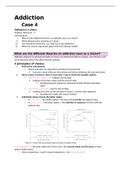
Local equilibrium = the point where the 2 lines cross the current values are the same for both
options (both meals).
Choice proportions ‘match’ reward proportions = the “matching law”.
, o Choosing Chinese food 5x and Italian food 1x the reward of Chinese food is 5 times
the reward of Italian food. So, Chinese food has a bigger reward than Italian.
Global equilibrium = the value of an option is at its maximum value this shows the overall stable
choice proportion, because there is no better way of assigning choices/options.
Implications of figure 6.1:
Voluntary behavior does NOT necessarily lead to the best outcome: The best outcome
would mean stopping at the global equilibrium, which is the suboptimal equilibrium, but
most people stop at the local equilibrium.
o The global equilibrium = 4 Chinese for every 6 Italian meals, the local equilibrium = 7
Chinese meals for every 3 Italian meals overconsumption of Chinese meals.
So, choosing to stop at the local equilibrium leads to overconsumption.
The implications differ from the understanding of choice in the light of addiction.
o The implication shows that choice can stabilize at a suboptimal level of benefits, that
suboptimal yet voluntary outcomes involve overconsumption of at least one of the
options, and that the contingencies that guide choice are ambiguous.
Graphing addiction
Main statement: the essential feature of addiction is the continued use of drugs despite “significant
substance-related problems.”
Local choice in addiction the decision to get high or not get high on a day-by-day basis.
“Should I get high today?”
Local choice leads to an all-out binge and persistent drug-use: every choice was a drug-
choice because the value of the drug was always higher that the value of no-drugs.
o This perspective leads to immediate positive rewards.
o The process stabilized at exclusive preference for the drug around day 30.
X-as = number of days an individual chose to use a drug in the last 30 days.
o This is a moving window, showing the most recent 30 choices.
Y-as = the current value of each day.
o The decrease in the value of the drug (upper line) represents tolerance.
o The decrease in the value of nondrug (lower line) represents drug-related problems.
This person is self-destructive and excessive; the everyday-drug-use lead to a 60% decrease
in overall welfare. But for this person it was the best choice.
o There is a misleading bias in the relationship between perceived costs and
perceived benefits The future and indirect consequences of current choices do not
count; benefits are immediate but negative consequences lag far behind.
Case 4
Addiction is a choice
Problem statement: “?”
Learning goals:
I. What are the different theories on addiction seen as a choice?
II. What influences the remission of a drug?
III. Can incentives (monetary, e.g.) help you to quit addiction?
IV. What are counter arguments against the brain disease model?
What are the different theories on addiction seen as a choice? i
Addiction depends on general principles of choice, the behavioral effects of drugs, and individual and
environmental factors that affect decision making.
3 principles of choice:
1. Preferences and dynamic.
o Choice and value are dependent and interact dynamically.
Outcome-values influence the choices and choices influence the outcome-value.
2. Given a series of choices, there is more than 1 way to frame the possible options.
o Global-choice approach = multiple day strategy
Looking at its future values and the overall value
Deciding between sequences composed of both Chinese and Italian
meals
o Local-choice approach = day-by-day strategy
Looking at its value at the moment of choice current value approach.
Deciding each night which meal is better.
3. Individuals always choose the better option.
o In local choice the better option = the item with currently the highest value.
o In global choice the better option = the collection of sequence of items with the
highest value.
Local equilibrium = the point where the 2 lines cross the current values are the same for both
options (both meals).
Choice proportions ‘match’ reward proportions = the “matching law”.
, o Choosing Chinese food 5x and Italian food 1x the reward of Chinese food is 5 times
the reward of Italian food. So, Chinese food has a bigger reward than Italian.
Global equilibrium = the value of an option is at its maximum value this shows the overall stable
choice proportion, because there is no better way of assigning choices/options.
Implications of figure 6.1:
Voluntary behavior does NOT necessarily lead to the best outcome: The best outcome
would mean stopping at the global equilibrium, which is the suboptimal equilibrium, but
most people stop at the local equilibrium.
o The global equilibrium = 4 Chinese for every 6 Italian meals, the local equilibrium = 7
Chinese meals for every 3 Italian meals overconsumption of Chinese meals.
So, choosing to stop at the local equilibrium leads to overconsumption.
The implications differ from the understanding of choice in the light of addiction.
o The implication shows that choice can stabilize at a suboptimal level of benefits, that
suboptimal yet voluntary outcomes involve overconsumption of at least one of the
options, and that the contingencies that guide choice are ambiguous.
Graphing addiction
Main statement: the essential feature of addiction is the continued use of drugs despite “significant
substance-related problems.”
Local choice in addiction the decision to get high or not get high on a day-by-day basis.
“Should I get high today?”
Local choice leads to an all-out binge and persistent drug-use: every choice was a drug-
choice because the value of the drug was always higher that the value of no-drugs.
o This perspective leads to immediate positive rewards.
o The process stabilized at exclusive preference for the drug around day 30.
X-as = number of days an individual chose to use a drug in the last 30 days.
o This is a moving window, showing the most recent 30 choices.
Y-as = the current value of each day.
o The decrease in the value of the drug (upper line) represents tolerance.
o The decrease in the value of nondrug (lower line) represents drug-related problems.
This person is self-destructive and excessive; the everyday-drug-use lead to a 60% decrease
in overall welfare. But for this person it was the best choice.
o There is a misleading bias in the relationship between perceived costs and
perceived benefits The future and indirect consequences of current choices do not
count; benefits are immediate but negative consequences lag far behind.