MATH 110 - Techniques of Calculus I Various Tests Module 10.
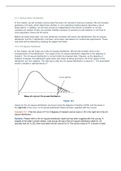
MATH 110 - Techniques of Calculus I Various Tests Module 10. In this module, we will consider various tests that were not covered in previous modules. We will consider goodness of fit tests, which determines whether or not a statistical model properly describes a set of observations. In addition, we will look at tests for independence that will tell us whether or not two variables are related. Finally, we consider ANOVA (analysis of variance) to test whether or not three or more population means are the same. Before we study these tests, we must familiarize ourselves with some new distributions (the chi-square distribution and the F distribution) and learn some basic calculations for multinomial experiments. These new skills will be attained by studying the pages that follow. 10.2: Chi-Square Distribution In this module, we will make use of the chi-square distribution. We should consider some of the characteristics of that distribution. The shape of the chi-square distribution depends on the degrees of freedom. The chi-square distribution is not symmetric but skewed right. However, as the degrees of freedom increases, this distribution gets closer and closer to being symmetric. All of the values of this distribution are non-negative. The total area under the chi-square distribution is equal to 1. The associated random variable is represented by X2 . Figure 10.1 Values for the chi-square distribution are found using the degrees of freedom (DOF) and the areas in the right tail of the curve. A chi-square distribution table has been supplied with this course. Example 10.1. Find the value of X2 for 9 degrees of freedom and an area of .05 in the right tail of the chisquare distribution. Solution. Please refer to the chi-square distribution table that has been supplied with this course. A snippet of the table is shown below. Look across the top of the chi-square distribution table for .05 (actually look for X2.05), then look down the left column for 9. The correct value of X2 is shown in bold. Table 10.1: Part of a Chi-square Distribution Table As can be seen in the table above, X2 =16.919. The following figure illustrates the relationship between the area and X2 . Figure 10.2: Figure for Example 10.1 Example 10.2. Find the value of X2 for 17 degrees of freedom and an area of .95 in the right tail of the chisquare distribution. Solution. Look across the top of the chi-square distribution table for .95 (actually look for X2 ,95), then look down the left column for 17. These two meet at X2 = 8.672. Figure 10.3: Figure for Example 10.2 Example 10.3. Find the value of X2 for 30 degrees of freedom and an area of .975 in the left tail of the chisquare distribution. Solution. Since the chi-square distribution table gives the area in the right tail of the curve, we must use 1 - .975 = .025. Look across the top of the chi-square distribution table for .025, then look down the left column for 30. These two meet at X2 = 46.979. Figure 10.4: Figure for Example 10.3 Example 10.4. Find the value of X2 for 9 degrees of freedom and an area of .990 in the left tail of the chisquare distribution. Solution. Since the chi-square distribution table gives the area in the right tail of the curve, we must use 1 - .990 = .01. Look across the top of the chi-square distribution table for .01, then look down the left column for 9. These two meet at X2 = 21.666. Figure 10.5: Figure for Example 10.4 Example 10.5. Find the value of X2 values that separate the middle 90% from the rest of the distribution for 15 degrees of freedom. Solution. In this case, we have an area of 1 - .90 = .10 outside of the middle portion or .10/2 = .05 in each of the tails: Figure 10.6: Figure for Example 10.5 Notice that the total area to the right of the first X2 is .90 + .05 = .95, so we use this value and a DOF of 15 to get X2 = 7.261. The area to the right of the second X2 is .05. So we use this value and a DOF of 15 to get X2 = 24.996. Practice Problems: 1. Find the value of X2 for 11 degrees of freedom and an area of .025 in the right tail of the chi-square distribution. Answer Key: 1. Look across the top of the chi-square distribution table for .025, then look down the left column for 11. These two meet at X2 =21.920. 10.3: F Distribution The F distribution will be utilized in some of the tests presented later in this module. The F distribution is different from the chi-square distribution in that it has two numbers for the degrees of freedom. It has degrees of freedom for the numerator and degrees of freedom for the denominator. Figure 10.7: A Typical F Distribution Usually, the degrees of freedom for the F distribution is represented by DOF = (Num,Denom) or df = (Num,Denom). The shape of the F distribution depends on the degrees of freedom. The F distribution is not symmetric but skewed right. However, as the degrees of freedom increases, this distribution gets closer and closer to being symmetric. All of the values of this distribution are non-negative. The associated random variable is represented by F. F distribution tables have been supplied with this course. Notice that there are several F distribution tables corresponding to different areas in the right tail. In order to find the values of F for the F distribution, we must first find the chart with the appropriate area in the right tail of the curve. Then, use the degrees of freedom for the numerator and degrees of freedom for the denominator. Example 10.6. Find the critical value of F for DOF = (4,19) and area in the right tail of .05. Solution. In order to solve this, we turn to the F distribution table that has an area of .05. DOF = (4,19) indicates that degrees of freedom for the numerator is 4 and degrees of freedom for the denominator is 19. We look up these values in the table: Table 10.2: F Distribution Table for area in right tail = .05 Here we find that F = 2.90.
École, étude et sujet
- Établissement
- California University Of Pennsylvania
- Cours
- MATH 110 - Techniques of Calculus I Various Tests (MATH110)
Infos sur le Document
- Publié le
- 12 avril 2022
- Nombre de pages
- 14
- Écrit en
- 2021/2022
- Type
- Examen
- Contient
- Questions et réponses
Sujets
-
math 1
-
math 110 techniques of calculus i various tests
-
techniques of calculus i various tests
-
math 110 techniques of calculus i various tests module 10
-
math 110 calculus i various tests module 10

Document également disponible en groupe