Accounting Summary - Financial Accounting
Overview
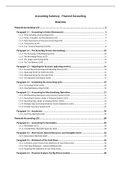
Financial Accounting 1/2 ................................................................................................... 3
Paragraph 1.1 – Accounting in Action (Statements).................................................................... 3
1.1.1: Three Activities of Accounting (LO1) ..................................................................................................... 3
1.1.2: Ethics, Principles, and Assumptions (LO2) ............................................................................................. 4
1.1.3: Basic Statements of Financial Accounting (LO3) ................................................................................... 5
1.1.4: Transactions (LO4) ................................................................................................................................. 7
1.1.5: Four Financial Statements (LO5)............................................................................................................ 8
Paragraph 1.2 – The Recording Process (Journalizing) .............................................................. 10
1.2.1: The Technique of Bookkeeping (LO1) .................................................................................................. 10
1.2.2: The Recording Process (LO2) ............................................................................................................... 11
1.2.3: The Ledger and Posting (LO3) .............................................................................................................. 12
1.2.4: The Trial Balance (LO4) ........................................................................................................................ 13
Paragraph 1.3 – Adjusting the Accounts (adjusting entries) ...................................................... 14
1.3.1: Accrual-Basis Accounting and Adjusting Entries (LO1) ........................................................................ 14
1.3.2: Adjusting Entries for Deferrals (LO2) ................................................................................................... 15
1.3.3: Adjusting Entries for Accruals (LO3) .................................................................................................... 16
1.3.4: The Adjusted Trial Balance (LO4) ......................................................................................................... 17
Paragraph 1.4 – Completing the Accounting Cycle.................................................................... 19
1.4.1: Correcting Entries (LO3)....................................................................................................................... 19
1.4.2: Classified Balance Sheet (LO4) ............................................................................................................. 19
Paragraph 1.5 – Accounting for Merchandising Operations ...................................................... 21
1.5.1: Merchandising Operations and Inventory Systems (LO1) ................................................................... 21
1.5.2: Recording Purchases Under a Perpetual System (LO2) ....................................................................... 22
1.5.3: Recording Sales Under a Perpetual System (LO3) ............................................................................... 23
1.5.4: Multiple-Step and Comprehensive Income Statements (LO5) ............................................................ 23
1.5.5: Periodic Inventory System (LO7) ......................................................................................................... 25
Paragraph 1.6 – Inventories .................................................................................................... 26
1.6.1: Cost Flow Methods (LO2) .................................................................................................................... 26
Financial Accounting 2/2 ................................................................................................. 28
Paragraph 2.1 – Accounting for Receivables............................................................................. 28
2.1.1: Receivables (LO1) ................................................................................................................................. 28
2.1.2: Uncollectibles, Bad Debt Expenses (LO2) ............................................................................................ 28
Paragraph 2.2 – Plant Assets, Natural Resources, and Intangible Assets ................................... 33
2.2.1: Depreciation Methods (LO2) ............................................................................................................... 33
Paragraph 2.3 – Statement of the Cash Flows .......................................................................... 35
2.3.1: Usefulness and Format of the Statement of Cash Flows (LO1) ........................................................... 35
2.3.2: Cash Flow Statement – Indirect Method (LO2) ................................................................................... 36
2.3.3: Analyzing the Statement of Cash Flows (LO3) ..................................................................................... 37
Paragraph 2.4 – Financial Analysis: the Big Picture (ratios) ....................................................... 38
, GO BACK BUTTON
2.4.1: Ratio Analysis (LO3) ............................................................................................................................. 38
Page 2 of 39 GO BACK BUTTON
, GO BACK BUTTON
Financial Accounting 1/2
Paragraph 1.1 – Accounting in Action (Statements)
Key topics: statements
(Chapter 1 | Lecture 1, 2 | LO 1, 2, 3, 4, & 5 | P1.2A)
Session 1 covers the first couple of chapters in accordance with the coursebook: statements,
journalizing, adjusting entries, corrections, purchases and sales, and FIFO/LIFO.
1.1.1: Three Activities of Accounting (LO1)
Accounting is the financial information system that provides numerical insights. Accounting
summarizes all kinds of activities, decisions, results, transactions into figures to steer
the business and inform stakeholders.
It consists of three activities with respect to the economic events of an organization to
interested users:
- Identification: economic events relevant to its business
- Recording: systematic, chronological diary of events
- Communication: collected information to interested users ––> accounting reports
(e.g. financial statements)
Accounting is information to:
• Make decisions as a firm, e.g.,
o Prices
o Investments yes/no
o Strategy, take-overs
• Make decisions as investors, as banks
• Determine tax payments
Important distinction between bookkeeping and accounting:
Accounting ≠ Bookkeeping
Bookkeeping: only involves the recording process of economic events.
Accounting involves the entire process of identifying, recording, and communicating
economic events
Managerial Accounting: external financial reporting and bookkeeping (stakeholders)
- Internal users: to help users make decisions about their companies (marketing
managers, finance directors, company officers)
- Internal information for decision-making, performance evaluation, and control
Financial Accounting:
- External users ––> financial accounting: external users outside a company seek
financial information about the company (investors and creditors).
o To evaluate risk or granting credit/lending money
- External financial reporting and bookkeeping (for stakeholders)
Page 3 of 39 GO BACK BUTTON
, GO BACK BUTTON
1.1.2: Ethics, Principles, and Assumptions (LO2)
Ethics: the standards of conduct by which actions are judged as right or wrong, honest or
dishonest, fair or not fair, are ethics.
Effective financial reporting depends on sound ethical behavior.
Why standards? Standard setters develop a rule based on how users of accounting obtain
the most relevant and reliable information. They indicate how to report economic events.
- US? U.S. GAAP – FASB
- Europe? IFRS – IASB
Primary accounting standard-setting in the USA: FASB
o SEC: agency that oversees U.S. financial markets.
International Financial Reporting Standards (IFRS)
- Outside US: International Accounting Standards Board (IASB)
Generally Accepted Accounting Principles (GAAP): these standards indicate how to report
economic events
Differences:
• What is the truth, what is the actual value of a machine you bought?
Convergence: process of reducing the differences between the U.S. GAAP and IFRS
Measurement Principles
• Historical Cost Principle: dictates that companies record assets at their cost. This is
true not only at the time the asset is purchased but also over the time the asset is
held.
• Fair Value Principle: states that assets and liabilities should be reported at fair value
(the price received to sell an asset or settle a liability). Fair value information may be
more useful than historical cost for certain types of assets and liabilities.
Assumptions: provide a foundation for the accounting process
• Monetary Unit Assumption: requires that companies include in the accounting records
only transaction data that can be expressed in money terms. This assumption enables
accounting to quantify (measure) economic events. The monetary unit assumption is
vital to applying the historical cost principle.
• Economic Entity Assumption: requires that the activities of the entity be kept separate
and distinct from the activities of its owner and all other economic entities
Three types of business entities are proprietorships (one owner), partnerships (two business
entities that are working together), and corporations (legal entity).
Page 4 of 39 GO BACK BUTTON
Overview
Financial Accounting 1/2 ................................................................................................... 3
Paragraph 1.1 – Accounting in Action (Statements).................................................................... 3
1.1.1: Three Activities of Accounting (LO1) ..................................................................................................... 3
1.1.2: Ethics, Principles, and Assumptions (LO2) ............................................................................................. 4
1.1.3: Basic Statements of Financial Accounting (LO3) ................................................................................... 5
1.1.4: Transactions (LO4) ................................................................................................................................. 7
1.1.5: Four Financial Statements (LO5)............................................................................................................ 8
Paragraph 1.2 – The Recording Process (Journalizing) .............................................................. 10
1.2.1: The Technique of Bookkeeping (LO1) .................................................................................................. 10
1.2.2: The Recording Process (LO2) ............................................................................................................... 11
1.2.3: The Ledger and Posting (LO3) .............................................................................................................. 12
1.2.4: The Trial Balance (LO4) ........................................................................................................................ 13
Paragraph 1.3 – Adjusting the Accounts (adjusting entries) ...................................................... 14
1.3.1: Accrual-Basis Accounting and Adjusting Entries (LO1) ........................................................................ 14
1.3.2: Adjusting Entries for Deferrals (LO2) ................................................................................................... 15
1.3.3: Adjusting Entries for Accruals (LO3) .................................................................................................... 16
1.3.4: The Adjusted Trial Balance (LO4) ......................................................................................................... 17
Paragraph 1.4 – Completing the Accounting Cycle.................................................................... 19
1.4.1: Correcting Entries (LO3)....................................................................................................................... 19
1.4.2: Classified Balance Sheet (LO4) ............................................................................................................. 19
Paragraph 1.5 – Accounting for Merchandising Operations ...................................................... 21
1.5.1: Merchandising Operations and Inventory Systems (LO1) ................................................................... 21
1.5.2: Recording Purchases Under a Perpetual System (LO2) ....................................................................... 22
1.5.3: Recording Sales Under a Perpetual System (LO3) ............................................................................... 23
1.5.4: Multiple-Step and Comprehensive Income Statements (LO5) ............................................................ 23
1.5.5: Periodic Inventory System (LO7) ......................................................................................................... 25
Paragraph 1.6 – Inventories .................................................................................................... 26
1.6.1: Cost Flow Methods (LO2) .................................................................................................................... 26
Financial Accounting 2/2 ................................................................................................. 28
Paragraph 2.1 – Accounting for Receivables............................................................................. 28
2.1.1: Receivables (LO1) ................................................................................................................................. 28
2.1.2: Uncollectibles, Bad Debt Expenses (LO2) ............................................................................................ 28
Paragraph 2.2 – Plant Assets, Natural Resources, and Intangible Assets ................................... 33
2.2.1: Depreciation Methods (LO2) ............................................................................................................... 33
Paragraph 2.3 – Statement of the Cash Flows .......................................................................... 35
2.3.1: Usefulness and Format of the Statement of Cash Flows (LO1) ........................................................... 35
2.3.2: Cash Flow Statement – Indirect Method (LO2) ................................................................................... 36
2.3.3: Analyzing the Statement of Cash Flows (LO3) ..................................................................................... 37
Paragraph 2.4 – Financial Analysis: the Big Picture (ratios) ....................................................... 38
, GO BACK BUTTON
2.4.1: Ratio Analysis (LO3) ............................................................................................................................. 38
Page 2 of 39 GO BACK BUTTON
, GO BACK BUTTON
Financial Accounting 1/2
Paragraph 1.1 – Accounting in Action (Statements)
Key topics: statements
(Chapter 1 | Lecture 1, 2 | LO 1, 2, 3, 4, & 5 | P1.2A)
Session 1 covers the first couple of chapters in accordance with the coursebook: statements,
journalizing, adjusting entries, corrections, purchases and sales, and FIFO/LIFO.
1.1.1: Three Activities of Accounting (LO1)
Accounting is the financial information system that provides numerical insights. Accounting
summarizes all kinds of activities, decisions, results, transactions into figures to steer
the business and inform stakeholders.
It consists of three activities with respect to the economic events of an organization to
interested users:
- Identification: economic events relevant to its business
- Recording: systematic, chronological diary of events
- Communication: collected information to interested users ––> accounting reports
(e.g. financial statements)
Accounting is information to:
• Make decisions as a firm, e.g.,
o Prices
o Investments yes/no
o Strategy, take-overs
• Make decisions as investors, as banks
• Determine tax payments
Important distinction between bookkeeping and accounting:
Accounting ≠ Bookkeeping
Bookkeeping: only involves the recording process of economic events.
Accounting involves the entire process of identifying, recording, and communicating
economic events
Managerial Accounting: external financial reporting and bookkeeping (stakeholders)
- Internal users: to help users make decisions about their companies (marketing
managers, finance directors, company officers)
- Internal information for decision-making, performance evaluation, and control
Financial Accounting:
- External users ––> financial accounting: external users outside a company seek
financial information about the company (investors and creditors).
o To evaluate risk or granting credit/lending money
- External financial reporting and bookkeeping (for stakeholders)
Page 3 of 39 GO BACK BUTTON
, GO BACK BUTTON
1.1.2: Ethics, Principles, and Assumptions (LO2)
Ethics: the standards of conduct by which actions are judged as right or wrong, honest or
dishonest, fair or not fair, are ethics.
Effective financial reporting depends on sound ethical behavior.
Why standards? Standard setters develop a rule based on how users of accounting obtain
the most relevant and reliable information. They indicate how to report economic events.
- US? U.S. GAAP – FASB
- Europe? IFRS – IASB
Primary accounting standard-setting in the USA: FASB
o SEC: agency that oversees U.S. financial markets.
International Financial Reporting Standards (IFRS)
- Outside US: International Accounting Standards Board (IASB)
Generally Accepted Accounting Principles (GAAP): these standards indicate how to report
economic events
Differences:
• What is the truth, what is the actual value of a machine you bought?
Convergence: process of reducing the differences between the U.S. GAAP and IFRS
Measurement Principles
• Historical Cost Principle: dictates that companies record assets at their cost. This is
true not only at the time the asset is purchased but also over the time the asset is
held.
• Fair Value Principle: states that assets and liabilities should be reported at fair value
(the price received to sell an asset or settle a liability). Fair value information may be
more useful than historical cost for certain types of assets and liabilities.
Assumptions: provide a foundation for the accounting process
• Monetary Unit Assumption: requires that companies include in the accounting records
only transaction data that can be expressed in money terms. This assumption enables
accounting to quantify (measure) economic events. The monetary unit assumption is
vital to applying the historical cost principle.
• Economic Entity Assumption: requires that the activities of the entity be kept separate
and distinct from the activities of its owner and all other economic entities
Three types of business entities are proprietorships (one owner), partnerships (two business
entities that are working together), and corporations (legal entity).
Page 4 of 39 GO BACK BUTTON