GO BACK TO OVERWIEW BUTTON
SCM in Emerging Economies Summary
Course name: Supply Chain Management in Emerging Economies
Vrije Universiteit Amsterdam
Academic year: 2021/2022 (written in 2020/2021, but slightly adjusted)
Period: 2.5
Course code: E_IBA2_SCMEE
Course coordinator: Dr. Markus Leitner ()
Assessment
• Written assignment (15%)
• Presentation (15%)
• Written exam (70%)
Material
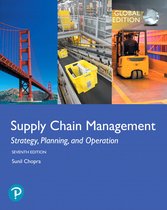
• Chopra, S., Meindl, P. (2016). Supply chain management. Strategy, planning, &
operation. 7th Global Edition
• Lee. H. L., & Lee, C. Y. (Eds.). (2007). Building supply chain excellence in emerging
economies (Vol. 98). Springer Science & Business Media
• Case studies
• Lectures
• Scientific articles
Exam focus:
• You will be assessed on your broad understanding of challenges that emerging
economies present (e.g., coordination and integration needs, cultural differences).
• You will be required to demonstrate that you have attained sufficient knowledge of
supply chain concepts and theories covered in the course (e.g., theory testing
questions about procurement strategies).
• You will be tested on your ability to analyze and evaluate operating policies by
applying principles and concepts of supply chain management
, GO BACK TO OVERWIEW BUTTON
Table of Contents
Week Coursebook: Lecture Topics Additional
Chopra & notes
Meindl (CM) or
Lee & Lee (LL)
Week 1 (13) CM: 5 L0, L1 Supply chain
network
LL: 2 design
Week 2 (14) CM: 5, 10 L2, L3 Supply chain
network
LL: 2 design &
supply chain
coordination
Week 3 (15) CM: 13 L4 Product
Availability
LL: 3
Week 4 (16) CM: 15, 16 L5 Sourcing
L6 Decisions &
Pricing and
revenue
management
Week 5 (17) CM: 16 L7 Pricing and
Revenue
LL: 16 Management
Week 6 and 7 CM: 17 N/a Sustainable
(18) Supply Chains
LL: 16
Week 9 (21) Exam
Topics:
• Supply Chain Network Design
• Excel Solver
• Supply Chain Coordination
• Product Availability
• Sourcing Decisions
• Pricing and Revenue Management
• Sustainable Supply Chains
, GO BACK TO OVERWIEW BUTTON
Week 1
• Lecture 0 – introduction
• CM: 5 - Network Design in the Supply Chain
• LL: 2
• Lecture 1: Supply Chain Network Design
• Lecture 2: Excel solver and Linear Programming
Lecture 0 – Introduction
This course Supply Chain Management in Emerging Economies (SCMEE) focuses on the
effective design and execution of global supply chains, with an emphasis on the
opportunities and challenges those emerging economies present. More specifically, this
course covers topics related to global supply chain strategies, global network optimization,
outsourcing & sourcing strategies and contract design. The course furthermore tackles
advanced supply chain concepts that are even more relevant in this context: supply chain
coordination and incentive alignment, pricing and revenue management and sustainability.
You are introduced to theoretical concepts with emphasis on key trade-offs and
phenomena, as well as best practice examples. We will pay particular attention to supply
chain challenges and applications in emerging markets. You are also exposed to models and
problem-solving tools, applicable to the design and planning of supply chains in emerging
economies. Upon completion, you should be able to look strategically at the full supply
chain and successfully operate in an international context.
Learning objectives:
• Analyze decisions related to international procurement, production and distribution
networks and evaluate their impact on coordination and pricing within a supply
chain and sustainability (Analysis)
• Recognize fundamental structures and to leave out irrelevant information, i.e.,
create the strategy, structure and planning of a supply chain in a fact-based and
structured manner (Abstraction)
• Put forward well-founded, substantiated points of view (Argumentation)
, GO BACK TO OVERWIEW BUTTON
Chopra and Meindl – Chapter 5 Network Design in the Supply Chain
This chapter identifies and discusses the various factors that influence the facility location,
capacity, and market allocation decisions.
CM – 5.1: The Role of Network Design in the Supply Chain
Supply chain network design decisions include the assignment of facility role; location of
manufacturing-, storage-, or transportation-related facilities; and the allocation of capacity
and markets to each facility.
1. Facility role
2. Facility location
3. Capacity allocation
4. Market and supply allocation
Facility location decisions have a long-term impact on a supply chain’s performance because
it is expensive to shut down a facility or move it to a different location. A good location
decision can help a supply chain be responsive while keeping its costs low.
Capacity allocation can be altered more easily than location, but capacity decisions do tend
to stay in place for several years. Allocating too much capacity to a location results in poor
utilization and, as a result, higher costs. Allocating too little capacity results in poor
responsiveness if demand is not satisfied or high cost if demand is filled from a distant
facility.
Network design decisions must be revisited as market conditions change or when two
companies merge.
CM – 5.2: Factors Influencing Network Design Decisions
• Strategic Factors
A firm’s competitive strategy has a significant impact on network design decisions within the
supply chain. Firms that focus on cost leadership tend to find the lowest cost location for
their manufacturing facilities, even if that means locating far from the markets they serve.
Convenience store chains aim to provide easy access to customers as part of their
competitive strategy. Convenience store networks thus include many stores that cover an
area, with each store being relatively small.
Global supply chain networks can best support their strategic objectives with facilities in
different countries playing different roles.
• Technological Factors
Characteristics of available production technologies have a significant impact on network
design decisions. If production technology displays significant economies of scale, a few
SCM in Emerging Economies Summary
Course name: Supply Chain Management in Emerging Economies
Vrije Universiteit Amsterdam
Academic year: 2021/2022 (written in 2020/2021, but slightly adjusted)
Period: 2.5
Course code: E_IBA2_SCMEE
Course coordinator: Dr. Markus Leitner ()
Assessment
• Written assignment (15%)
• Presentation (15%)
• Written exam (70%)
Material
• Chopra, S., Meindl, P. (2016). Supply chain management. Strategy, planning, &
operation. 7th Global Edition
• Lee. H. L., & Lee, C. Y. (Eds.). (2007). Building supply chain excellence in emerging
economies (Vol. 98). Springer Science & Business Media
• Case studies
• Lectures
• Scientific articles
Exam focus:
• You will be assessed on your broad understanding of challenges that emerging
economies present (e.g., coordination and integration needs, cultural differences).
• You will be required to demonstrate that you have attained sufficient knowledge of
supply chain concepts and theories covered in the course (e.g., theory testing
questions about procurement strategies).
• You will be tested on your ability to analyze and evaluate operating policies by
applying principles and concepts of supply chain management
, GO BACK TO OVERWIEW BUTTON
Table of Contents
Week Coursebook: Lecture Topics Additional
Chopra & notes
Meindl (CM) or
Lee & Lee (LL)
Week 1 (13) CM: 5 L0, L1 Supply chain
network
LL: 2 design
Week 2 (14) CM: 5, 10 L2, L3 Supply chain
network
LL: 2 design &
supply chain
coordination
Week 3 (15) CM: 13 L4 Product
Availability
LL: 3
Week 4 (16) CM: 15, 16 L5 Sourcing
L6 Decisions &
Pricing and
revenue
management
Week 5 (17) CM: 16 L7 Pricing and
Revenue
LL: 16 Management
Week 6 and 7 CM: 17 N/a Sustainable
(18) Supply Chains
LL: 16
Week 9 (21) Exam
Topics:
• Supply Chain Network Design
• Excel Solver
• Supply Chain Coordination
• Product Availability
• Sourcing Decisions
• Pricing and Revenue Management
• Sustainable Supply Chains
, GO BACK TO OVERWIEW BUTTON
Week 1
• Lecture 0 – introduction
• CM: 5 - Network Design in the Supply Chain
• LL: 2
• Lecture 1: Supply Chain Network Design
• Lecture 2: Excel solver and Linear Programming
Lecture 0 – Introduction
This course Supply Chain Management in Emerging Economies (SCMEE) focuses on the
effective design and execution of global supply chains, with an emphasis on the
opportunities and challenges those emerging economies present. More specifically, this
course covers topics related to global supply chain strategies, global network optimization,
outsourcing & sourcing strategies and contract design. The course furthermore tackles
advanced supply chain concepts that are even more relevant in this context: supply chain
coordination and incentive alignment, pricing and revenue management and sustainability.
You are introduced to theoretical concepts with emphasis on key trade-offs and
phenomena, as well as best practice examples. We will pay particular attention to supply
chain challenges and applications in emerging markets. You are also exposed to models and
problem-solving tools, applicable to the design and planning of supply chains in emerging
economies. Upon completion, you should be able to look strategically at the full supply
chain and successfully operate in an international context.
Learning objectives:
• Analyze decisions related to international procurement, production and distribution
networks and evaluate their impact on coordination and pricing within a supply
chain and sustainability (Analysis)
• Recognize fundamental structures and to leave out irrelevant information, i.e.,
create the strategy, structure and planning of a supply chain in a fact-based and
structured manner (Abstraction)
• Put forward well-founded, substantiated points of view (Argumentation)
, GO BACK TO OVERWIEW BUTTON
Chopra and Meindl – Chapter 5 Network Design in the Supply Chain
This chapter identifies and discusses the various factors that influence the facility location,
capacity, and market allocation decisions.
CM – 5.1: The Role of Network Design in the Supply Chain
Supply chain network design decisions include the assignment of facility role; location of
manufacturing-, storage-, or transportation-related facilities; and the allocation of capacity
and markets to each facility.
1. Facility role
2. Facility location
3. Capacity allocation
4. Market and supply allocation
Facility location decisions have a long-term impact on a supply chain’s performance because
it is expensive to shut down a facility or move it to a different location. A good location
decision can help a supply chain be responsive while keeping its costs low.
Capacity allocation can be altered more easily than location, but capacity decisions do tend
to stay in place for several years. Allocating too much capacity to a location results in poor
utilization and, as a result, higher costs. Allocating too little capacity results in poor
responsiveness if demand is not satisfied or high cost if demand is filled from a distant
facility.
Network design decisions must be revisited as market conditions change or when two
companies merge.
CM – 5.2: Factors Influencing Network Design Decisions
• Strategic Factors
A firm’s competitive strategy has a significant impact on network design decisions within the
supply chain. Firms that focus on cost leadership tend to find the lowest cost location for
their manufacturing facilities, even if that means locating far from the markets they serve.
Convenience store chains aim to provide easy access to customers as part of their
competitive strategy. Convenience store networks thus include many stores that cover an
area, with each store being relatively small.
Global supply chain networks can best support their strategic objectives with facilities in
different countries playing different roles.
• Technological Factors
Characteristics of available production technologies have a significant impact on network
design decisions. If production technology displays significant economies of scale, a few