Luke Farrar 30.11.2020
Disorders in the musculoskeletal system
Luke David Farrar
Introduction/Structure and function of the musculoskeletal system
The musculoskeletal system is both a phenomenal feat of natural engineering and the
most fragile apparatus to properly care for. Like any complex system, it is only as strong as
its weakest link. Therefore, information regarding treatments and prevention of these
disorders is necessary to reduce the likelihood of a vast array of minor issues becoming major
ones.
The effective clinical management of a select few common musculoskeletal disorders
will be further discussed and analysed to form an informative guide on these issues so to help
prevent them.
Support… is achieved thanks to 206 bones, held together by ‘things’ such as
tendons, ligaments; protected by ‘things’ such as cartilage, which help hold all of the body’s
important bits together. Especially regarding the activity of the muscles.
Tendons act as an intermediary/connective fibrous tissue that attach muscles to our
bones. Ligaments connect our bones to each other, while cartilage acts as the ‘barrier’
preventing our bones from grating against each other. Equally, as well as overall support, the
bones act as defensive walls to protect the vital organs. The spongy tissue inside of bones
called bone marrow produces red blood cells—regarding bone marrow, conditions such as
leukemia can cause the production of red blood cells to decrease as white blood cells are
made to target cancerous blood. This is just one disease that stems from bone marrow.
Minerals may also be stored in the bone—the most well-known being calcium, which
bones store 99% of the body’s store of—that can be used whenever the need arises. Another
important mineral is phosphorus which is
used in the formation of bones and teeth,
along with “protein for the growth,
maintenance, and repair of cells and
tissues.” (Phosphorus in diet:
MedlinePlus Medical Encyclopedia,
2020)
Movement… in the
musculoskeletal system is achieved via
joints which allow multiple planes of
movement. Here are some of the most
common planes of movement we use on a
daily basis.
Flexion and extension can be
noted in the elbow, knees, hips, waist,
and shoulders. The common theme is
that, in these joints, there is usually a
‘straight’ position of the joint—achieved
Examples of flexion and extension, abduction and
adduction, and rotation.
, Luke Farrar 30.11.2020
via extension/straightening of the limb—which can then bend via flexion, decreasing the
angle of the bones (an example of flexion would be touching your shoulder with your hand,
or the bend in your legs while seated in most positions).
Abduction and adduction are similar to flexion and extension in terms of the angle of
movement, though they differ somewhat. Abduction refers to any movement away from the
midline, which can simply refer to the middle of the joint’s full rotation, which can be
witnessed in the shoulder joint during upwards movement of the arm, away from the body.
Adduction is the opposite: a plane of movement towards the body.
Rotation is the movement around the longitudinal axis—looking left and right is an
example of rotation, as is twisting your arms and legs.
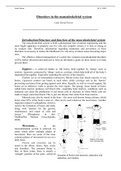
Diagram of the musculoskeletal system
Disorders in the musculoskeletal system
Luke David Farrar
Introduction/Structure and function of the musculoskeletal system
The musculoskeletal system is both a phenomenal feat of natural engineering and the
most fragile apparatus to properly care for. Like any complex system, it is only as strong as
its weakest link. Therefore, information regarding treatments and prevention of these
disorders is necessary to reduce the likelihood of a vast array of minor issues becoming major
ones.
The effective clinical management of a select few common musculoskeletal disorders
will be further discussed and analysed to form an informative guide on these issues so to help
prevent them.
Support… is achieved thanks to 206 bones, held together by ‘things’ such as
tendons, ligaments; protected by ‘things’ such as cartilage, which help hold all of the body’s
important bits together. Especially regarding the activity of the muscles.
Tendons act as an intermediary/connective fibrous tissue that attach muscles to our
bones. Ligaments connect our bones to each other, while cartilage acts as the ‘barrier’
preventing our bones from grating against each other. Equally, as well as overall support, the
bones act as defensive walls to protect the vital organs. The spongy tissue inside of bones
called bone marrow produces red blood cells—regarding bone marrow, conditions such as
leukemia can cause the production of red blood cells to decrease as white blood cells are
made to target cancerous blood. This is just one disease that stems from bone marrow.
Minerals may also be stored in the bone—the most well-known being calcium, which
bones store 99% of the body’s store of—that can be used whenever the need arises. Another
important mineral is phosphorus which is
used in the formation of bones and teeth,
along with “protein for the growth,
maintenance, and repair of cells and
tissues.” (Phosphorus in diet:
MedlinePlus Medical Encyclopedia,
2020)
Movement… in the
musculoskeletal system is achieved via
joints which allow multiple planes of
movement. Here are some of the most
common planes of movement we use on a
daily basis.
Flexion and extension can be
noted in the elbow, knees, hips, waist,
and shoulders. The common theme is
that, in these joints, there is usually a
‘straight’ position of the joint—achieved
Examples of flexion and extension, abduction and
adduction, and rotation.
, Luke Farrar 30.11.2020
via extension/straightening of the limb—which can then bend via flexion, decreasing the
angle of the bones (an example of flexion would be touching your shoulder with your hand,
or the bend in your legs while seated in most positions).
Abduction and adduction are similar to flexion and extension in terms of the angle of
movement, though they differ somewhat. Abduction refers to any movement away from the
midline, which can simply refer to the middle of the joint’s full rotation, which can be
witnessed in the shoulder joint during upwards movement of the arm, away from the body.
Adduction is the opposite: a plane of movement towards the body.
Rotation is the movement around the longitudinal axis—looking left and right is an
example of rotation, as is twisting your arms and legs.
Diagram of the musculoskeletal system