05/04
MN10500 Lecture 8: Debt Policy & Optimal Capital Structure
Lecture Summary
● The trade-off between debt and equity.
○ Benefits
○ Costs
● Alternative capital structure theories and empirical evidence.
● The (simplified) cost of capital model to determine the optimal debt-equity
combination that minimises WACC.
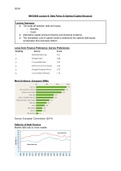
Long-Term Finance Preference: Survey Preferences
More Evidence: European SMEs
Source: European Commission (2014)
Patterns of Debt Finance
Market debt ratio is more volatile.
, 05/04
Costs & Benefits of Debt
● Costs of debt
○ Bankruptcy Costs
○ Agency Costs
○ Loss of Future Flexibility
● Benefits of debt
○ Tax Benefits
○ Adds discipline to management
○ Adds leverage to Capital Structure
Tax Benefits of Debt
● When you borrow money, you are allowed to deduct interest expenses from your
income to arrive at taxable income. This reduces your taxes. When you use equity,
you are not allowed to deduct payments to equity (such as dividends) to arrive at
taxable income.
● The dollar tax benefit from interest payment in any year is a function of your tax rate
and the interest payment.
● Proposition 1: Other things being equal, the higher the marginal tax rate of a
business, the more debt it will have in its capital structure.
Tax & WACC
● Recall the formula of WACC
● Example: Tc = 35%, D/E = 1.54, rD = 10%, rE = 15%, so D/(D+E) = (D/E) / [1 +
(D/E)] = 0.606, E/(D+E) = 1 – D/(D+E) = 0.394.
● WACC = (1–0.35) × 0.10 × 0.606 + 0.15 × 0.394 = 9.85%
● D/E = 1.54, recall from L7 (slide 14) that D/V = (D/E) / [1 + (D/E)] = 1.54 / (1 + 1.54) =
0.6063
● A shortcut: D/E = 1.54 so pretend D = 1.54 and E = 1 (we are calculating ratios, so
the real numbers of D and E don’t matter), so D/(D+E) = 1.54/(1.54+1), E/(D+E) =
1/(1.54+1).
Debt adds Discipline to Management
● If you are a manager of a firm with no debt, and you generate high income and cash
flows each year, you tend to become complacent. The complacency can lead to
MN10500 Lecture 8: Debt Policy & Optimal Capital Structure
Lecture Summary
● The trade-off between debt and equity.
○ Benefits
○ Costs
● Alternative capital structure theories and empirical evidence.
● The (simplified) cost of capital model to determine the optimal debt-equity
combination that minimises WACC.
Long-Term Finance Preference: Survey Preferences
More Evidence: European SMEs
Source: European Commission (2014)
Patterns of Debt Finance
Market debt ratio is more volatile.
, 05/04
Costs & Benefits of Debt
● Costs of debt
○ Bankruptcy Costs
○ Agency Costs
○ Loss of Future Flexibility
● Benefits of debt
○ Tax Benefits
○ Adds discipline to management
○ Adds leverage to Capital Structure
Tax Benefits of Debt
● When you borrow money, you are allowed to deduct interest expenses from your
income to arrive at taxable income. This reduces your taxes. When you use equity,
you are not allowed to deduct payments to equity (such as dividends) to arrive at
taxable income.
● The dollar tax benefit from interest payment in any year is a function of your tax rate
and the interest payment.
● Proposition 1: Other things being equal, the higher the marginal tax rate of a
business, the more debt it will have in its capital structure.
Tax & WACC
● Recall the formula of WACC
● Example: Tc = 35%, D/E = 1.54, rD = 10%, rE = 15%, so D/(D+E) = (D/E) / [1 +
(D/E)] = 0.606, E/(D+E) = 1 – D/(D+E) = 0.394.
● WACC = (1–0.35) × 0.10 × 0.606 + 0.15 × 0.394 = 9.85%
● D/E = 1.54, recall from L7 (slide 14) that D/V = (D/E) / [1 + (D/E)] = 1.54 / (1 + 1.54) =
0.6063
● A shortcut: D/E = 1.54 so pretend D = 1.54 and E = 1 (we are calculating ratios, so
the real numbers of D and E don’t matter), so D/(D+E) = 1.54/(1.54+1), E/(D+E) =
1/(1.54+1).
Debt adds Discipline to Management
● If you are a manager of a firm with no debt, and you generate high income and cash
flows each year, you tend to become complacent. The complacency can lead to