Marie C. 2021-2022
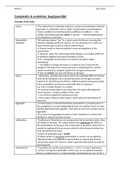
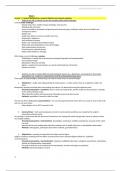
Complexity & evolution: begrippenlijst
Concepts of the index
Action *The system has to undertake actions to counter every deviation from the
goal state. In cybernetics, this is called “compensation of perturbations”
*Some condition X is transformed into a different condition Y -> this
change: the simplest possible action or process -> minimal building block
for evolutionary worldview
Adaptability/ *All evolving systems “aim” in a certain sense for fitness, meaning that
adaptivity selection implicitly prefers fit systems. It’s not necessary for a system to
have a built-in goal or plan in order to attain fitness
Fitness: based on internal stability & external adaptation to the
environment
However, when the environment itself changes, it no longer suffices to
be perfectly adapted to the given situation or niche
In a changeable environment, it is useful to be able to adapt
immediately
* = the ability to change the state of a system in such a way that the
changes in the state of the environment are compensated for, and the
system remains fit or adapted, despite the changed environment
form of control, but now with fitness as the goal
Agent = elementary, goal-directed system which can undertake different actions.
Goal can be (in)explicit, but it usually boils down to the agent trying to
maximise its ‘benefit/success/fitness’. Different agents same goals usually
enter competition, but they are potentially able to cooperate.
e.g. cells in a body, humans in a society
*In response to perceptions (incoming info), the agent will implement
certain actions -> simple condition-action rules
-> can evolve & adapt their behavioural rules
-> their actions influence other agents, which will react with actions of
their own
Aggregate *It is the bond or constraint that binds components in a (super)system. If
the components can vary independently from one another, there is in fact
nothing that keeps them together. Then they do not form a system, but an
aggregate.
e.g sand is an aggregate of grains of sand. Sandstone is a bond (and
therefore a system) of grains of sand.
anticipation *Feedforward: Disturbances are compensated for by reactions before they
can influence the goal. The control system thus anticipates the effect of
the perturbations on the goal. This is important in situations where time is
needed to implement the necessary actions & when the perturbation has
to be prevented at all costs.
*System of prediction rules = model
allows system to anticipate perturbation or events; not an objective
reflection/reality but subjective representation of aspects that directly
concern the system & it serves to allow a goal-directed system to reach its
personal goals
asymmetrical *Transitions are usually asymmetrical: a → b & b → a aren’t equivalent.
1 of the 2 is in general preferable. In this case, we can speak of selection:
there is a preference for a certain direction and therefore for one of the 2
, Marie C. 2021-2022
states. Imagine that a → b is easier than vice versa, then most systems will leave
a and end up in b. If there is no other state c, for which the preference would be b
→ c rather than c → b, then the systems will accumulate in b. State b functions as
an attractor, a region in the state space that “attracts” the system.
Attractor = a region that the system can enter easily, but out of which it cannot get
on its own
= a region in the state space that “attracts” the system
<-> repulsor: in a phase portait -> the region from where all arrows lead
away/ it drives the system away
basin *Initial state is located in the basin of an attractor (the region around the
attractor from where all arrows and trajectories lead towards
the attractor in a phase portrait)
= the points in the state space from where further evolution will normally
end up in the valley or attractor. The different basins are separated from
each other through “mountain ridges”: boundaries from which you will
either go down into the one valley/ attractor, or into the other
bifurcation *For nonlinear systems, there is generally more than 1 possible solution to
the system of equations that describes the system -> system can end up in
more then 1 stable situation -> the further from equilibrium, the more
solutions
The appearance of such choices when the system gets further away
from equilibrium is called a bifurcation
bit *The unit of variety, constraint, entropy, & information. If a system has a
variety of one bit, this means that the system has exactly two states or
possibilities (“1” or “0”, “yes” or “no”) to choose from. A variety of N bit
means 2N possibilities
the bit measure for info transmission were developed by Shannon to
enable the measurement of the capacity of communication channels (e.g.
telephone lines)
1 byte = 8 bits
Example: The answer to a binary “yes-no” question (e.g. “Is it raining?”)
provides 1 bit of info—assuming that the two answers have the same
probability
Blind variation In the theory of evolution: speak of “blind” or “random” variation =
variations don’t need to be directed to still produce directed evolution ->
variations don’t have “foreknowledge” about the right direction/evolution;
they’re “blind”
Doesn’t rule out that variations can be directed, as is the case in many
situations. The fundamental insight: evolution would work even if
variations were 100% blind
Other way to formulate “blindness”: variation doesn’t “know” what
selection’s preference is: variation & selection mechanisms are in general
independent of each other
bond *A joint, stable state = a bond
2 systems are bound together: the one cannot do anything without
pulling the other along with it. By definition, the one can no longer vary
independently of the other: if one varies, the other has to come along
e.g. If the one magnet is moved, it will pull the other magnet along with
it.
A bond is a relative constraint, that is, a restriction of the freedom of
variation in the shared state space, especially the freedom of movement
relative to each other. A bond thus reduces the freedom of the systems,
Complexity & evolution: begrippenlijst
Concepts of the index
Action *The system has to undertake actions to counter every deviation from the
goal state. In cybernetics, this is called “compensation of perturbations”
*Some condition X is transformed into a different condition Y -> this
change: the simplest possible action or process -> minimal building block
for evolutionary worldview
Adaptability/ *All evolving systems “aim” in a certain sense for fitness, meaning that
adaptivity selection implicitly prefers fit systems. It’s not necessary for a system to
have a built-in goal or plan in order to attain fitness
Fitness: based on internal stability & external adaptation to the
environment
However, when the environment itself changes, it no longer suffices to
be perfectly adapted to the given situation or niche
In a changeable environment, it is useful to be able to adapt
immediately
* = the ability to change the state of a system in such a way that the
changes in the state of the environment are compensated for, and the
system remains fit or adapted, despite the changed environment
form of control, but now with fitness as the goal
Agent = elementary, goal-directed system which can undertake different actions.
Goal can be (in)explicit, but it usually boils down to the agent trying to
maximise its ‘benefit/success/fitness’. Different agents same goals usually
enter competition, but they are potentially able to cooperate.
e.g. cells in a body, humans in a society
*In response to perceptions (incoming info), the agent will implement
certain actions -> simple condition-action rules
-> can evolve & adapt their behavioural rules
-> their actions influence other agents, which will react with actions of
their own
Aggregate *It is the bond or constraint that binds components in a (super)system. If
the components can vary independently from one another, there is in fact
nothing that keeps them together. Then they do not form a system, but an
aggregate.
e.g sand is an aggregate of grains of sand. Sandstone is a bond (and
therefore a system) of grains of sand.
anticipation *Feedforward: Disturbances are compensated for by reactions before they
can influence the goal. The control system thus anticipates the effect of
the perturbations on the goal. This is important in situations where time is
needed to implement the necessary actions & when the perturbation has
to be prevented at all costs.
*System of prediction rules = model
allows system to anticipate perturbation or events; not an objective
reflection/reality but subjective representation of aspects that directly
concern the system & it serves to allow a goal-directed system to reach its
personal goals
asymmetrical *Transitions are usually asymmetrical: a → b & b → a aren’t equivalent.
1 of the 2 is in general preferable. In this case, we can speak of selection:
there is a preference for a certain direction and therefore for one of the 2
, Marie C. 2021-2022
states. Imagine that a → b is easier than vice versa, then most systems will leave
a and end up in b. If there is no other state c, for which the preference would be b
→ c rather than c → b, then the systems will accumulate in b. State b functions as
an attractor, a region in the state space that “attracts” the system.
Attractor = a region that the system can enter easily, but out of which it cannot get
on its own
= a region in the state space that “attracts” the system
<-> repulsor: in a phase portait -> the region from where all arrows lead
away/ it drives the system away
basin *Initial state is located in the basin of an attractor (the region around the
attractor from where all arrows and trajectories lead towards
the attractor in a phase portrait)
= the points in the state space from where further evolution will normally
end up in the valley or attractor. The different basins are separated from
each other through “mountain ridges”: boundaries from which you will
either go down into the one valley/ attractor, or into the other
bifurcation *For nonlinear systems, there is generally more than 1 possible solution to
the system of equations that describes the system -> system can end up in
more then 1 stable situation -> the further from equilibrium, the more
solutions
The appearance of such choices when the system gets further away
from equilibrium is called a bifurcation
bit *The unit of variety, constraint, entropy, & information. If a system has a
variety of one bit, this means that the system has exactly two states or
possibilities (“1” or “0”, “yes” or “no”) to choose from. A variety of N bit
means 2N possibilities
the bit measure for info transmission were developed by Shannon to
enable the measurement of the capacity of communication channels (e.g.
telephone lines)
1 byte = 8 bits
Example: The answer to a binary “yes-no” question (e.g. “Is it raining?”)
provides 1 bit of info—assuming that the two answers have the same
probability
Blind variation In the theory of evolution: speak of “blind” or “random” variation =
variations don’t need to be directed to still produce directed evolution ->
variations don’t have “foreknowledge” about the right direction/evolution;
they’re “blind”
Doesn’t rule out that variations can be directed, as is the case in many
situations. The fundamental insight: evolution would work even if
variations were 100% blind
Other way to formulate “blindness”: variation doesn’t “know” what
selection’s preference is: variation & selection mechanisms are in general
independent of each other
bond *A joint, stable state = a bond
2 systems are bound together: the one cannot do anything without
pulling the other along with it. By definition, the one can no longer vary
independently of the other: if one varies, the other has to come along
e.g. If the one magnet is moved, it will pull the other magnet along with
it.
A bond is a relative constraint, that is, a restriction of the freedom of
variation in the shared state space, especially the freedom of movement
relative to each other. A bond thus reduces the freedom of the systems,