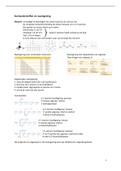
The goal of financial management is to maximize the current value per share of the existing equity
Accounting break-even; the sales level that results in zero project net income
Agency cost; the cost of the conflict of interest between shareholder and management
Amortized loans; the lender may require the borrower to repay parts of the loan amount over time
Arithmetic Average Return; the return earned in an average year of a multiyear period
Average Accounting Return (AAR); an investment’s average net income divided by its average book value - Easy to calculate - Needed information will usually be available. The Average
Accounting Return Disadvantages; - Not a true rate of return; time value of money is ignored - Uses an arbitrary cut-off rate - Instead of using cash flows and market values, it uses net
income and book value - As a result; an AAR doesn’t tell us what the effect on share price will be of taking an investment, so it doesn’t tell us what we really want to know
Auction: deze vorm van secondary market kent een fysieke locatie (bv. the London Stock Exchange) en verder bevat de auction geen dealer
Average tax rate; the percentage of your income that goes to pay taxes - Tax bill divided by your taxable income
Banks are generally not interest in making loans to start-up companies, especially ones; - With no assets (other than an idea) - Run by entrepreneurs with no track record - There is high
risk and a lot of search costs involved
Bearer form; the form of bond issue in which the bond is issued without record of the owner’s name
Best efforts underwriting; - The underwriter is legally bound to use ‘best efforts’ to sell the securities at the agreed upon offering price - The underwriter does not guarantee any
particular amount of money to the issuer
Beta coefficient; the amount of systematic risk present in a particular risky asset relative to that in an average risky asset. The beta of the risk-free asset is zero !!
Bonds could also be in bearer form: the form of bond issue in which the bond is issued without record of the owner’s name
Book value; its original purchase cost, adjusted for any subsequent changes (such as depreciation)
Call option; an option that gives the owner the right, but not the obligation, to buy an asset at a fixed price during a particular period
Call provisions; an agreement giving the corporation the option to repurchase a bond at a specific price, prior to maturity
Call premium; the amount by which the call price exceeds the par value of a bond
Call-protected bond; a bond that, during a certain period, cannot be redeemed by the issuer
Capital budgeting; the process of planning and managing a firm’s long-term investments.
Capital structure; the mixture of long-term debt and equity maintained by a firm.
Capital asset pricing model (CAPM); the equation of the SML showing the relationship between expected return and beta
Cash break-even; the sales level that results in a zero OCF
Cash flow identity; says that the cash flow from the firm’s assets is equal to the cash flow paid to suppliers of capital to the firm.
Cash flow from operating activities; the cash flow that results from the firm’s day-to-day activities of producing and selling
Cash flow from investing activities; money spent on non-current assets minus money received from the sale of non-current assets
Cash flow from financing activities; cash generated/expended as a result of its debt and equity choices
Clean price; the price of a bond net of accrued interest: Accrued interest; the coupon payment for the period times the fraction of the period that has passed since the last coupon
payment. Dirty price; the price of a bond including accrued interest
Collateral; general term that means securities (e.g. bonds, equities) that are pledged as security for payment of debt
Corporate bonds are usually in registered form: the form of bond issue in which the register of the company records ownership of each bond
Corporation; a business created as a distinct legal entity composed of one or more individuals/entities - Disadvantage; double taxes - Advantage; - ownership can be transferred, and
the life of the corporation is therefore not limited - the shareholders have limited liability for corporate debts (the most they can lose is what they have invested)
Cost of equity; the return that equity investors require on their investment in the firm
Cost of debt; the return that lenders require on the firm’s debt
Cross-hedging; hedging an asset with contracts written on a closely related, but not identical asset
Current liabilities; have a life of less than one year (they must be paid within the year), Non-current liabilities; a debt that is not due in the coming year
Dealer: kopen en verkopen voor hunzelf, op eigen risico. Denk hierbij aan een autodealer.
Deferred call provision; a call provision prohibiting the company from redeeming a bond prior to a certain date
Degree of operating leverage (DOL); the degree to which a firm or project relies on fixed costs
Depreciation tax shield; the tax saving that results from the depreciation deduction, calculated as depreciation multiplied by the corporate tax rate
Derivative securities; a financial asset that represent a claim to another financial asset
Dilution; loss in existing shareholders’ value in terms of ownership, market value, book value or EPS
Discounted cash flows (DCF) valuation; the process of valuing an investment by discounting its future cash flows
Discounted payback; the time it takes to break even in an economic/financial sense - Includes time value of money - Easy to understand - Does not accept negative estimated NPV
investments - Biased towards liquidity. The Discounted Payback Period Rule Disadvantages; - May reject positive NPV investments - Requires an arbitrary cut-off point - Cash flows
beyond that point are ignored - Thus, ignores cash flows beyond the cut-off date
Dutch Auction underwriting; - The underwriter does not set a fixed price for the share to be sold - Instead, the underwriter conducts an auction in which investors bid for shares - The
offer price is determined based on the submitted bids - Also known as a uniform price auction.
Economic exposure; long-term financial risk arising from permanent changes in prices or other economic fundaments
Efficient capital market; a market in which security prices reflect available information
Efficient markets hypothesis (EMH); the hypothesis that actual capital market are efficient Strong: Stock prices incorporate all information, public as well as private
Equivalent annual cost (EAC); the present value of a project’s costs, calculated on an annual basis
Expected return; the return on a risky asset expected in the future risk premium = expected return – risk free rate.
Excess return on the average risky asset; a comparison involves the virtually risk-free return on T-bills and government bonds with the very risky return on ordinary equity
Financial break-even; the sales level that results in a zero NPV
Financial manager in a corporation makes decisions for the shareholders of the firm.
Financial market brings buyers and sellers together, it is debt and equity securities that are bought and sold
Financing activities; cash generated/expended as a result of its debt and equity choices
First commitment underwriting; - The issuer sells the entire issue to the underwriters, who then attempt to resell it - The underwriter is full financial responsible for any unsold shares
Green shoe provision; a contract provision giving the underwriter the option to purchase additional shares from the issuer at the offering
Financial System: Bank-based and market-based countries Bank based systems
Fisher effect; the relationship between nominal returns, real returns and inflation 1 + X = (1 + r) × (1 + i)
Floating-rate bonds: de coupon payments zijn verstelbaar
Forecasting risk (estimation risk); the possibility that errors in projected cash flows will lead to incorrect decisions
Forward contract; a legally binding agreement between two parties calling for the sale of an asset/product in the future at a price agreed on today
Future contract; a forward contract with the feature that gains and losses are realized each day rather than only on the settlement date
Geometric Average Return; the average compounded return earned per year over a multiyear period
Government bonds: Nearly never any risk, and no tax
Gross spread; compensation to the underwriter determined by the difference between the underwriter’s buying price and the offering price
Hedging; reducing a firm’s exposure to price or rate fluctuations
Identure: the written agreement between the corporation (borrower) and the lender (the person making the loan) detailing the terms of the debt issue
Income statement; financial statement summarizing a firm’s performance over a period of time
Incremental cash flows; the difference between a firm’s future cash flows with a project and those without the project
Initial public offering (IPO); a company’s first equity issue made available to the public
Interest-only loans; The borrowers has to pay interest each period, and to repay the entire principal (the original loan amount) at some point in the future
Interest rate risk; the risk that arises for bond owners from fluctuating interest rates
Internal rate of return (IRR); the discount rate that makes the NPV of an investment 0. De voordelen van IRR - Sterk gerelateerd aan NPV, vaak leidt het tot dezelfde uitkomsten
- Makkelijk te begrijpen en communiceren. De nadelen van IRR - Er kunnen verschillende antwooreden zijn - Er kunnen onjuiste besluiten worden genomen m.b.t. wederzijdse
exclusieve investeringen
International Accounting Standards (IAS); the common set of standards and procedures by which audited financial statements are prepared in Europe and many other countries
Investing activities; money spent on non-current assets minus money received from the sale of non-current assets
Line of credit; an arrangement between a bank and a firm, typically for a short-term loan, whereby the bank authorizes the maximum loan amount, but not the interest rate, when
setting up the line of credit
Loan commitment; an arrangement that requires a bank to lend up to a maximum prespecified loan amount at a prespecified interest rate
Lock-up-agreement; the part of the underwriting contract that specifies how long insiders must wait after an IPO before they can sell equity
Marginal tax rate; tax you would pay if you earned one more unit of currency - Apply to the part of income in the indicated range only (not all income)
Accounting break-even; the sales level that results in zero project net income
Agency cost; the cost of the conflict of interest between shareholder and management
Amortized loans; the lender may require the borrower to repay parts of the loan amount over time
Arithmetic Average Return; the return earned in an average year of a multiyear period
Average Accounting Return (AAR); an investment’s average net income divided by its average book value - Easy to calculate - Needed information will usually be available. The Average
Accounting Return Disadvantages; - Not a true rate of return; time value of money is ignored - Uses an arbitrary cut-off rate - Instead of using cash flows and market values, it uses net
income and book value - As a result; an AAR doesn’t tell us what the effect on share price will be of taking an investment, so it doesn’t tell us what we really want to know
Auction: deze vorm van secondary market kent een fysieke locatie (bv. the London Stock Exchange) en verder bevat de auction geen dealer
Average tax rate; the percentage of your income that goes to pay taxes - Tax bill divided by your taxable income
Banks are generally not interest in making loans to start-up companies, especially ones; - With no assets (other than an idea) - Run by entrepreneurs with no track record - There is high
risk and a lot of search costs involved
Bearer form; the form of bond issue in which the bond is issued without record of the owner’s name
Best efforts underwriting; - The underwriter is legally bound to use ‘best efforts’ to sell the securities at the agreed upon offering price - The underwriter does not guarantee any
particular amount of money to the issuer
Beta coefficient; the amount of systematic risk present in a particular risky asset relative to that in an average risky asset. The beta of the risk-free asset is zero !!
Bonds could also be in bearer form: the form of bond issue in which the bond is issued without record of the owner’s name
Book value; its original purchase cost, adjusted for any subsequent changes (such as depreciation)
Call option; an option that gives the owner the right, but not the obligation, to buy an asset at a fixed price during a particular period
Call provisions; an agreement giving the corporation the option to repurchase a bond at a specific price, prior to maturity
Call premium; the amount by which the call price exceeds the par value of a bond
Call-protected bond; a bond that, during a certain period, cannot be redeemed by the issuer
Capital budgeting; the process of planning and managing a firm’s long-term investments.
Capital structure; the mixture of long-term debt and equity maintained by a firm.
Capital asset pricing model (CAPM); the equation of the SML showing the relationship between expected return and beta
Cash break-even; the sales level that results in a zero OCF
Cash flow identity; says that the cash flow from the firm’s assets is equal to the cash flow paid to suppliers of capital to the firm.
Cash flow from operating activities; the cash flow that results from the firm’s day-to-day activities of producing and selling
Cash flow from investing activities; money spent on non-current assets minus money received from the sale of non-current assets
Cash flow from financing activities; cash generated/expended as a result of its debt and equity choices
Clean price; the price of a bond net of accrued interest: Accrued interest; the coupon payment for the period times the fraction of the period that has passed since the last coupon
payment. Dirty price; the price of a bond including accrued interest
Collateral; general term that means securities (e.g. bonds, equities) that are pledged as security for payment of debt
Corporate bonds are usually in registered form: the form of bond issue in which the register of the company records ownership of each bond
Corporation; a business created as a distinct legal entity composed of one or more individuals/entities - Disadvantage; double taxes - Advantage; - ownership can be transferred, and
the life of the corporation is therefore not limited - the shareholders have limited liability for corporate debts (the most they can lose is what they have invested)
Cost of equity; the return that equity investors require on their investment in the firm
Cost of debt; the return that lenders require on the firm’s debt
Cross-hedging; hedging an asset with contracts written on a closely related, but not identical asset
Current liabilities; have a life of less than one year (they must be paid within the year), Non-current liabilities; a debt that is not due in the coming year
Dealer: kopen en verkopen voor hunzelf, op eigen risico. Denk hierbij aan een autodealer.
Deferred call provision; a call provision prohibiting the company from redeeming a bond prior to a certain date
Degree of operating leverage (DOL); the degree to which a firm or project relies on fixed costs
Depreciation tax shield; the tax saving that results from the depreciation deduction, calculated as depreciation multiplied by the corporate tax rate
Derivative securities; a financial asset that represent a claim to another financial asset
Dilution; loss in existing shareholders’ value in terms of ownership, market value, book value or EPS
Discounted cash flows (DCF) valuation; the process of valuing an investment by discounting its future cash flows
Discounted payback; the time it takes to break even in an economic/financial sense - Includes time value of money - Easy to understand - Does not accept negative estimated NPV
investments - Biased towards liquidity. The Discounted Payback Period Rule Disadvantages; - May reject positive NPV investments - Requires an arbitrary cut-off point - Cash flows
beyond that point are ignored - Thus, ignores cash flows beyond the cut-off date
Dutch Auction underwriting; - The underwriter does not set a fixed price for the share to be sold - Instead, the underwriter conducts an auction in which investors bid for shares - The
offer price is determined based on the submitted bids - Also known as a uniform price auction.
Economic exposure; long-term financial risk arising from permanent changes in prices or other economic fundaments
Efficient capital market; a market in which security prices reflect available information
Efficient markets hypothesis (EMH); the hypothesis that actual capital market are efficient Strong: Stock prices incorporate all information, public as well as private
Equivalent annual cost (EAC); the present value of a project’s costs, calculated on an annual basis
Expected return; the return on a risky asset expected in the future risk premium = expected return – risk free rate.
Excess return on the average risky asset; a comparison involves the virtually risk-free return on T-bills and government bonds with the very risky return on ordinary equity
Financial break-even; the sales level that results in a zero NPV
Financial manager in a corporation makes decisions for the shareholders of the firm.
Financial market brings buyers and sellers together, it is debt and equity securities that are bought and sold
Financing activities; cash generated/expended as a result of its debt and equity choices
First commitment underwriting; - The issuer sells the entire issue to the underwriters, who then attempt to resell it - The underwriter is full financial responsible for any unsold shares
Green shoe provision; a contract provision giving the underwriter the option to purchase additional shares from the issuer at the offering
Financial System: Bank-based and market-based countries Bank based systems
Fisher effect; the relationship between nominal returns, real returns and inflation 1 + X = (1 + r) × (1 + i)
Floating-rate bonds: de coupon payments zijn verstelbaar
Forecasting risk (estimation risk); the possibility that errors in projected cash flows will lead to incorrect decisions
Forward contract; a legally binding agreement between two parties calling for the sale of an asset/product in the future at a price agreed on today
Future contract; a forward contract with the feature that gains and losses are realized each day rather than only on the settlement date
Geometric Average Return; the average compounded return earned per year over a multiyear period
Government bonds: Nearly never any risk, and no tax
Gross spread; compensation to the underwriter determined by the difference between the underwriter’s buying price and the offering price
Hedging; reducing a firm’s exposure to price or rate fluctuations
Identure: the written agreement between the corporation (borrower) and the lender (the person making the loan) detailing the terms of the debt issue
Income statement; financial statement summarizing a firm’s performance over a period of time
Incremental cash flows; the difference between a firm’s future cash flows with a project and those without the project
Initial public offering (IPO); a company’s first equity issue made available to the public
Interest-only loans; The borrowers has to pay interest each period, and to repay the entire principal (the original loan amount) at some point in the future
Interest rate risk; the risk that arises for bond owners from fluctuating interest rates
Internal rate of return (IRR); the discount rate that makes the NPV of an investment 0. De voordelen van IRR - Sterk gerelateerd aan NPV, vaak leidt het tot dezelfde uitkomsten
- Makkelijk te begrijpen en communiceren. De nadelen van IRR - Er kunnen verschillende antwooreden zijn - Er kunnen onjuiste besluiten worden genomen m.b.t. wederzijdse
exclusieve investeringen
International Accounting Standards (IAS); the common set of standards and procedures by which audited financial statements are prepared in Europe and many other countries
Investing activities; money spent on non-current assets minus money received from the sale of non-current assets
Line of credit; an arrangement between a bank and a firm, typically for a short-term loan, whereby the bank authorizes the maximum loan amount, but not the interest rate, when
setting up the line of credit
Loan commitment; an arrangement that requires a bank to lend up to a maximum prespecified loan amount at a prespecified interest rate
Lock-up-agreement; the part of the underwriting contract that specifies how long insiders must wait after an IPO before they can sell equity
Marginal tax rate; tax you would pay if you earned one more unit of currency - Apply to the part of income in the indicated range only (not all income)