Case 1: nutritional epimediology
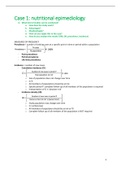
1) What kind of studies can be conducted?
a. How does the study work?
b. Advantages?
c. Disadvantages?
d. How can you apply this to the case?
e. How do you analyze the results? (RR, OR, prevalence, incidence)
MEASURES OF FREQUENCY
Prevalence = number of existing cases at a specific point in time or period within a population
- Point prevalence
- Period prevalence
- Life-time prevalence
Incidence = number of new cases
- Cumulative incidence (CI)
o Size of population does not change over time
o In %
o All members of populations should be at risk
o Specify period P: complete follow-up of all members of the population is required
o Interpretation of CI is ‘absolute risk’
- Incidence density (ID)
o Study population may change over time
o In number/year
o All members of population should be at risk at T0
o Complete follow-up of all members of the population is NOT required
1
,Meta-analysis = analyse and combine data of multiple studies. Meta-analysis can be based on rct or
mixture of rct and observational studies, compare.
Systematic literature review
RANDOMIZED CONTROL TRIAL
How does the study work?
Compare the effect of treatment with no treatment via randomizing participants to one of the
groups. You can determine cause and effect relationship.
- Random allocation ensures that differences between the results of the two groups at the end
of the study are actually due to the treatment and not something else.
- Ideally, the assignment to the various groups is done "double blinded," meaning that neither
the participants nor their doctors know who is in which group. No other factors should
influence the results.
You have to determine beforehand: how long the study should last, how many participants are
needed and how the effect of the treatment should be measured.
Steps:
- Randomization: randomize to a specific medicine
- Intervention: taking the medicine
- Follow-up: think about compliance
- Evaluation: see how much people get the disease
- Analysis
Types of RCT studies:
- Parallel-group design: participants are randomly assigned to receive either the intervention
or placebo.
- Crossover design: participants are randomly assigned to receive either the intervention and
later the placebo or the placebo and later the intervention. Crossover trials inherently have a
stronger statistical power because the test subject serves as their own control and thus
require a smaller sample size, but completion time is often longer relative to parallel group
studies because a washout period is needed between treatments and a carryover effect may
be encountered which may confound the clinical trial data.
- Cluster design: pre-existing groups of participants are randomly assigned to receive an
intervention or placebo. Looking between communities and not between individuals, a
cluster could be vegetarian diet. Jump to search. A cluster randomised controlled trial is a
2
, type of randomised controlled trial in which groups of subjects (as opposed to individual
subjects) are randomized.
- Factorial design: participants are randomly assigned to receive a particular combination of
interventions or placebos.
RCTs can be designed to test for:
- Superiority trials: one intervention is hypothesized to be superior to another in a statistically
significant way.
- Noninferiority trials: determine whether a new treatment is no worse than a reference
treatment
- Equivalence trials: the hypothesis is that two interventions are indistinguishable from each
other.
How do you analyze the results?
Advantages?
- Cause and effect relationship
- Not sensitive to (selection) bias
Disadvantages?
- Ethics
- Organization efforts are high
- Costs are high
- Low generalizability: due to specific research population
- Ecological fallacy confounding = looking at one big population, those people differ a lot from
each other. You have no data on individual level, but you can compare on population level.
Outcome: intention to treat, RR, number needed to treat
Difference intention to treat and number needed to treat
Number of subjects that need to be treated (intervention) to prevent an event, if a drug works well
then the number needed to treat is low (due to formula).
How to apply this to the case?
- 2 groups are randomized to eating whole grain and not eating whole grain
- They eat/ do not eat this for 5 years
- After 5 years there will be analyzed how many people got diabetes mellitus from each group
- Calculate RR
- Draw a conclusion
3
, COHORT STUDIES
How does the study work?
Two or more groups that are exposed to different things are compared with each other. The
researchers then observe how the health of the people in both groups develops over the course of
several years, whether they become ill, and how many of them pass away. Often include people who
are healthy at the start of the study.
2 kinds:
- Prospective (forward-looking) design: the result that the researchers are interested in (such
as a specific illness) has not yet occurred by the time the study starts. But the outcomes that
they want to measure and other possible influential factors can be precisely defined
beforehand. Exposure is measures at this moment and disease in the future.
- Retrospective (backward-looking) design: the result (the illness) has already occurred before
the study starts, and the researchers look at the patient's history to find risk factors.
Exposure is measured in the past and disease at this moment. Almost never done in
nutritional studies, very difficult because people don’t remember what they ate over the past
years.
Steps:
- Select a cohort
- Do some measurements
- Determine the exposure status (not randomized)
- Evaluate the outcome
- Analysis
How do you analyze the results?
4
1) What kind of studies can be conducted?
a. How does the study work?
b. Advantages?
c. Disadvantages?
d. How can you apply this to the case?
e. How do you analyze the results? (RR, OR, prevalence, incidence)
MEASURES OF FREQUENCY
Prevalence = number of existing cases at a specific point in time or period within a population
- Point prevalence
- Period prevalence
- Life-time prevalence
Incidence = number of new cases
- Cumulative incidence (CI)
o Size of population does not change over time
o In %
o All members of populations should be at risk
o Specify period P: complete follow-up of all members of the population is required
o Interpretation of CI is ‘absolute risk’
- Incidence density (ID)
o Study population may change over time
o In number/year
o All members of population should be at risk at T0
o Complete follow-up of all members of the population is NOT required
1
,Meta-analysis = analyse and combine data of multiple studies. Meta-analysis can be based on rct or
mixture of rct and observational studies, compare.
Systematic literature review
RANDOMIZED CONTROL TRIAL
How does the study work?
Compare the effect of treatment with no treatment via randomizing participants to one of the
groups. You can determine cause and effect relationship.
- Random allocation ensures that differences between the results of the two groups at the end
of the study are actually due to the treatment and not something else.
- Ideally, the assignment to the various groups is done "double blinded," meaning that neither
the participants nor their doctors know who is in which group. No other factors should
influence the results.
You have to determine beforehand: how long the study should last, how many participants are
needed and how the effect of the treatment should be measured.
Steps:
- Randomization: randomize to a specific medicine
- Intervention: taking the medicine
- Follow-up: think about compliance
- Evaluation: see how much people get the disease
- Analysis
Types of RCT studies:
- Parallel-group design: participants are randomly assigned to receive either the intervention
or placebo.
- Crossover design: participants are randomly assigned to receive either the intervention and
later the placebo or the placebo and later the intervention. Crossover trials inherently have a
stronger statistical power because the test subject serves as their own control and thus
require a smaller sample size, but completion time is often longer relative to parallel group
studies because a washout period is needed between treatments and a carryover effect may
be encountered which may confound the clinical trial data.
- Cluster design: pre-existing groups of participants are randomly assigned to receive an
intervention or placebo. Looking between communities and not between individuals, a
cluster could be vegetarian diet. Jump to search. A cluster randomised controlled trial is a
2
, type of randomised controlled trial in which groups of subjects (as opposed to individual
subjects) are randomized.
- Factorial design: participants are randomly assigned to receive a particular combination of
interventions or placebos.
RCTs can be designed to test for:
- Superiority trials: one intervention is hypothesized to be superior to another in a statistically
significant way.
- Noninferiority trials: determine whether a new treatment is no worse than a reference
treatment
- Equivalence trials: the hypothesis is that two interventions are indistinguishable from each
other.
How do you analyze the results?
Advantages?
- Cause and effect relationship
- Not sensitive to (selection) bias
Disadvantages?
- Ethics
- Organization efforts are high
- Costs are high
- Low generalizability: due to specific research population
- Ecological fallacy confounding = looking at one big population, those people differ a lot from
each other. You have no data on individual level, but you can compare on population level.
Outcome: intention to treat, RR, number needed to treat
Difference intention to treat and number needed to treat
Number of subjects that need to be treated (intervention) to prevent an event, if a drug works well
then the number needed to treat is low (due to formula).
How to apply this to the case?
- 2 groups are randomized to eating whole grain and not eating whole grain
- They eat/ do not eat this for 5 years
- After 5 years there will be analyzed how many people got diabetes mellitus from each group
- Calculate RR
- Draw a conclusion
3
, COHORT STUDIES
How does the study work?
Two or more groups that are exposed to different things are compared with each other. The
researchers then observe how the health of the people in both groups develops over the course of
several years, whether they become ill, and how many of them pass away. Often include people who
are healthy at the start of the study.
2 kinds:
- Prospective (forward-looking) design: the result that the researchers are interested in (such
as a specific illness) has not yet occurred by the time the study starts. But the outcomes that
they want to measure and other possible influential factors can be precisely defined
beforehand. Exposure is measures at this moment and disease in the future.
- Retrospective (backward-looking) design: the result (the illness) has already occurred before
the study starts, and the researchers look at the patient's history to find risk factors.
Exposure is measured in the past and disease at this moment. Almost never done in
nutritional studies, very difficult because people don’t remember what they ate over the past
years.
Steps:
- Select a cohort
- Do some measurements
- Determine the exposure status (not randomized)
- Evaluate the outcome
- Analysis
How do you analyze the results?
4