Types and explanations
AO1
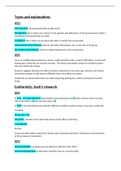
Internalisation- the group generally accepts norms
Identification-this is where we conform to the opinions and behaviours of the group because there is
something in that group that we value
Compliance-this is where we go along with others in public but not privately
Informational social influence-who has the better information, you, or the rest of the group
Normative social influence- what is a typical behaviour for your social group
A03
Lucas et al (2006) asked students to answer maths questions with a range of difficulties, it was found
that greater conformity on incorrect answers. This shows that people conform in situations where
they don’t know the answer.
Research suggests NSI does not affect everyone’s behaviour in the same way. McGhee and Teevan
found that students in high need of affiliation were more likely to conform.
Conformity is reduced when there are other dissenting participants, which was found in the Asch
study.
Conformity: Asch’s research
A01
In 1951, 123 male Americans were studied. Each participant saw 2 white cards on each trial, they
had to say which of 3 lines was the same as X.
In 1955 it was extended to test whether different variables would increase or decrease conformity.
Variables;
Group size: 2-16
Unanimity- whether non-conforming person would affect conformity.
Task difficulty
Results;
Group size didn’t affect conformity. Harder tasks increased conformity. Participants conformed less
in the presence of a dissenter.
A03
Not generalisable as people was more likely to conform in the 1950’s.
Demand characteristics as they knew that they were in a research task.
, Asch only used males, who was American, therefore not generalisable across gender and culture.
Conformity to social roles; Zimbardo
AO1
1973, Stanford prison experiment. 21 male students who volunteered, who tested as emotionally
stable. They were split into playing a prison guard or a prisoner. The guards took up roles
enthusiastically, where they enforced rules and punished prisoners. Behaviour became increasingly
brutal so it only lasted 6 days instead of 14. Social roles appeared to have a strong influence on
behaviour. People behaved as if they were in prison rather than a psychological study.
AO3
Increased validity as he had control over participants.
90% of conversations in the prison was about prison life therefore giving it high internal validity.
Only 1/3 of guards acted brutal,1/3 stuck to rules and 1/3 tried to help the prisoners. Therefore,
Zimbardo exaggerated his findings.
Obedience: Milgram
AO1
1963, 40 American men agreed to take part in a memory test. They drew lots to see who a teacher
or learner would be. The draw was fixed so the learner would always be a confederate. Each time
the learner got a question wrong the teacher would give them a shock from, 15V up to 450V, 12.5%
stopped at 300V, 65% continued to 450V. He predicted 3% would go to 450V. 84% said after that
they was glad to have participated.
AO3
Replicated in a French documentary which provided similar results.
There is low internal validity as participants were following demand characteristics as half of them
didn’t believe that the shock was real.
There was an alternative interpretation of findings as Milgram’s participants only obeyed the first 3
verbal prods. However, everyone who got to the 4 th prod, “you must go on” disobeyed.
There are also ethical issues as the participants are being lied to.
Obedience: social psychological factors
A01
Agentic state- a mental state where we feel no personal responsibility for our behaviour as we
believe ourselves to be acting for an authority figure.
Autonomous state- opposite of agentic state, we feel independent.
AO1
Internalisation- the group generally accepts norms
Identification-this is where we conform to the opinions and behaviours of the group because there is
something in that group that we value
Compliance-this is where we go along with others in public but not privately
Informational social influence-who has the better information, you, or the rest of the group
Normative social influence- what is a typical behaviour for your social group
A03
Lucas et al (2006) asked students to answer maths questions with a range of difficulties, it was found
that greater conformity on incorrect answers. This shows that people conform in situations where
they don’t know the answer.
Research suggests NSI does not affect everyone’s behaviour in the same way. McGhee and Teevan
found that students in high need of affiliation were more likely to conform.
Conformity is reduced when there are other dissenting participants, which was found in the Asch
study.
Conformity: Asch’s research
A01
In 1951, 123 male Americans were studied. Each participant saw 2 white cards on each trial, they
had to say which of 3 lines was the same as X.
In 1955 it was extended to test whether different variables would increase or decrease conformity.
Variables;
Group size: 2-16
Unanimity- whether non-conforming person would affect conformity.
Task difficulty
Results;
Group size didn’t affect conformity. Harder tasks increased conformity. Participants conformed less
in the presence of a dissenter.
A03
Not generalisable as people was more likely to conform in the 1950’s.
Demand characteristics as they knew that they were in a research task.
, Asch only used males, who was American, therefore not generalisable across gender and culture.
Conformity to social roles; Zimbardo
AO1
1973, Stanford prison experiment. 21 male students who volunteered, who tested as emotionally
stable. They were split into playing a prison guard or a prisoner. The guards took up roles
enthusiastically, where they enforced rules and punished prisoners. Behaviour became increasingly
brutal so it only lasted 6 days instead of 14. Social roles appeared to have a strong influence on
behaviour. People behaved as if they were in prison rather than a psychological study.
AO3
Increased validity as he had control over participants.
90% of conversations in the prison was about prison life therefore giving it high internal validity.
Only 1/3 of guards acted brutal,1/3 stuck to rules and 1/3 tried to help the prisoners. Therefore,
Zimbardo exaggerated his findings.
Obedience: Milgram
AO1
1963, 40 American men agreed to take part in a memory test. They drew lots to see who a teacher
or learner would be. The draw was fixed so the learner would always be a confederate. Each time
the learner got a question wrong the teacher would give them a shock from, 15V up to 450V, 12.5%
stopped at 300V, 65% continued to 450V. He predicted 3% would go to 450V. 84% said after that
they was glad to have participated.
AO3
Replicated in a French documentary which provided similar results.
There is low internal validity as participants were following demand characteristics as half of them
didn’t believe that the shock was real.
There was an alternative interpretation of findings as Milgram’s participants only obeyed the first 3
verbal prods. However, everyone who got to the 4 th prod, “you must go on” disobeyed.
There are also ethical issues as the participants are being lied to.
Obedience: social psychological factors
A01
Agentic state- a mental state where we feel no personal responsibility for our behaviour as we
believe ourselves to be acting for an authority figure.
Autonomous state- opposite of agentic state, we feel independent.