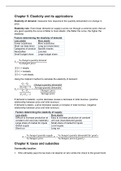
Chapter 5: Elasticity and its applications
Elasticity of demand: measures how responsive the quantity demanded is to change in
price.
Elasticity rule: if two linear demand (or supply) curves run through a common point, then at
any given quantity the curve is flatter is more elastic. (the flatter the curve, the higher the
elasticity)
Factors determining the elasticity of demand:
Less elastic More elastic
Fewer substitutes More substitutes
Short run (less time) Long run (more time)
Categories of product Specific brands
Necessities Luxuries
Small budget share Large budget share
% change∈quantity demand
Ed =
% change∈ price
|E|>1 = elastic
|E|<1 = inelastic
|E|=1 = unit elastic
Using the midpoint method to calculate the elasticity of demand:
Qa−Q b Change∈quantity demanded
( Q a+ Q b ) ∕ 2 Average quantity demanded
Ed = =
Pa−P b Change∈ price
( P a+ P b ) ∕ 2 Average price
If demand is inelastic, a price decrease causes a decrease in total revenue. (positive
relationship between price and total revenue)
If demand is elastic, a price decrease causes a increase in total revenue. (negative
relationship between price and total revenue)
Factors determining the elasticity of supply:
Less elastic More elastic
Difficult to increase production at Easy to increase production at constant
constant unit cost (raw materials) unit cost (manufactured goods)
Large share of market for inputs Small share of market for inputs
Global supply Local supply
Short run Long run
% change∈quantity supply % change∈quantity demanded for good x
E s= Ec =
% change∈ price % change∈ price of good y
Chapter 6: taxes and subsidies
Commodity taxation:
1. Who ultimately pays the tax does not depend on who writes the check to the government.
,Tax wedge = price paid by buyers – price received by sellers measures how much the
government ostensibly receives as a result of taxation.
2. Who ultimately pays the tax does depend on the relative elasticities of demand and
supply.
Elasticity = escape
A tax burden falls most heavily on the side of the market that is less elastic.
3. Commodity taxation raises revenue and creates dead weight loss (reduces the gains
from trade)
Deadweight loss: the reduction in total surplus caused by a market distortion or inefficiency.
Chapter 8: Price Ceilings and Floors
Price ceilings (maximum prices), create five important
effects:
1. Shortage:
When prices are below the market price,
the demand exceeds the supply.
2. Reductions in product quality:
, Sellers have more customers than they have goods, so normally they would raise their prices
but now the prices are controlled. sellers cut quality of their products.
3. Wasteful lines and other search costs:
Corruption and bribes are common, especially when price ceilings are long-lasting. Or
instead of competing by price, buyers competed by the willingness to wait in line.
Price controls does not eliminate competition, but they change the form of competition.
4. Lost gains from trade:
5. Misallocation of resources and random allocation:
Through price ceilings there is no incentive or signal to send the resource to were it is
needed the most.
Reasons for price ceilings:
1. Some people cannot afford the market price and are being left out. But price ceilings
is not the only way to help the poor. (vouchers)
2. To discipline monopolies.
3. The public does not see the consequences of price controls.
Price floors (minimum prices), create four important effects:
Elasticity of demand: measures how responsive the quantity demanded is to change in
price.
Elasticity rule: if two linear demand (or supply) curves run through a common point, then at
any given quantity the curve is flatter is more elastic. (the flatter the curve, the higher the
elasticity)
Factors determining the elasticity of demand:
Less elastic More elastic
Fewer substitutes More substitutes
Short run (less time) Long run (more time)
Categories of product Specific brands
Necessities Luxuries
Small budget share Large budget share
% change∈quantity demand
Ed =
% change∈ price
|E|>1 = elastic
|E|<1 = inelastic
|E|=1 = unit elastic
Using the midpoint method to calculate the elasticity of demand:
Qa−Q b Change∈quantity demanded
( Q a+ Q b ) ∕ 2 Average quantity demanded
Ed = =
Pa−P b Change∈ price
( P a+ P b ) ∕ 2 Average price
If demand is inelastic, a price decrease causes a decrease in total revenue. (positive
relationship between price and total revenue)
If demand is elastic, a price decrease causes a increase in total revenue. (negative
relationship between price and total revenue)
Factors determining the elasticity of supply:
Less elastic More elastic
Difficult to increase production at Easy to increase production at constant
constant unit cost (raw materials) unit cost (manufactured goods)
Large share of market for inputs Small share of market for inputs
Global supply Local supply
Short run Long run
% change∈quantity supply % change∈quantity demanded for good x
E s= Ec =
% change∈ price % change∈ price of good y
Chapter 6: taxes and subsidies
Commodity taxation:
1. Who ultimately pays the tax does not depend on who writes the check to the government.
,Tax wedge = price paid by buyers – price received by sellers measures how much the
government ostensibly receives as a result of taxation.
2. Who ultimately pays the tax does depend on the relative elasticities of demand and
supply.
Elasticity = escape
A tax burden falls most heavily on the side of the market that is less elastic.
3. Commodity taxation raises revenue and creates dead weight loss (reduces the gains
from trade)
Deadweight loss: the reduction in total surplus caused by a market distortion or inefficiency.
Chapter 8: Price Ceilings and Floors
Price ceilings (maximum prices), create five important
effects:
1. Shortage:
When prices are below the market price,
the demand exceeds the supply.
2. Reductions in product quality:
, Sellers have more customers than they have goods, so normally they would raise their prices
but now the prices are controlled. sellers cut quality of their products.
3. Wasteful lines and other search costs:
Corruption and bribes are common, especially when price ceilings are long-lasting. Or
instead of competing by price, buyers competed by the willingness to wait in line.
Price controls does not eliminate competition, but they change the form of competition.
4. Lost gains from trade:
5. Misallocation of resources and random allocation:
Through price ceilings there is no incentive or signal to send the resource to were it is
needed the most.
Reasons for price ceilings:
1. Some people cannot afford the market price and are being left out. But price ceilings
is not the only way to help the poor. (vouchers)
2. To discipline monopolies.
3. The public does not see the consequences of price controls.
Price floors (minimum prices), create four important effects: