Research methods
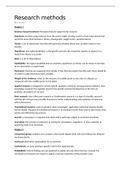
Key terms
Chapter 1
Evidence-based treatment: therapies that are supported by research.
Empricism: involves using evidence from the senses (sight, hearing, touch) or from instruments that
assist the sense (thermometers, timers, photographs, weight scales, questionnaires).
Theory: a set of statements that describes general principles about how variables relate to one
another.
Hypothesis: also called prediction, is the specific outcome the researcher expects to observe in a
study if the theory is accurate.
Data: is a set of observations.
Falsifiability: the logical possibility that an assertion, hypothesis, or theory can be shown to be false
by an observation or experiment.
Parsimony: theories are supposed to be simple. If two theories explain the data well, there should be
no need to make the theory more complex.
Weight of the evidence: refers to the measure of credible proof on one side of a dispute as
compared with the credible proof on the other.
Applied research: is designed to answer specific questions aimed at solving practical problems. New
knowledge acquired from applied research has specific commercial objectives in the form of
products, procedures or services.
Basic research: also called pure research or fundamental research, is a type of scientific research
with the aim of improving scientific theories for better understanding and prediction of natural or
other phenomena.
Translational research: seeks to produce more meaningful, applicable results that directly benefit
human health. The goal of translational research is to translate (move) basic science discoveries more
quickly and efficiently into practice.
Journal: a newspaper or magazine that deals with a particular subject or professional activity.
Journalism: the activity or profession of writing for newspapers, magazines, or news websites or
preparing news to be broadcast.
Chapter 2
Comparison group: enables us to compare what would happen both with and without the thing we
are interested in.
Confound: alternative explanations for an outcome.
Confederate: an actor playing a specific role for the experimenter.
Probabilistic: that its findings are not expected to explain all cases all of the time. Instead, the
conclusions of research are meant to explain a certain proportion of the possible cases.
, Availability heuristic: states that things that pop up easily in our mind tend to guide our thinking.
Present/present bias: a name for our failure to consider appropriate comparison groups.
Confirmation bias: is the tendency to look only at information that agrees with what we already
believe.
Bias blind spot: is the cognitive bias of recognizing the impact of biases on the judgment of others,
while failing to see the impact of biases on one's own judgment.
Empirical journal article: reports the results of a study that uses data derived from actual
observation or experimentation.
Review journal article: also called a literature review, is a survey of previously published research on
a topic. It should give an overview of current thinking on the theme and, unlike an original research
article, won't present new experimental results.
Meta-analysis: combines the results of many studies and gives a number that summarizes the
magnitude, or the effect size, of a relationship.
Effect size: is a quantitative measure of the magnitude of the experimental effect. The larger the
effect size the stronger the relationship between two variables. You can look at the effect size when
comparing any two groups to see how substantially different they are.
Chapter 4
Debriefed: the participants were carefully informed about the study’s hypotheses.
Principle of respect for persons: includes two provisions. First: individuals potentially involved in
research should be treated as autonomous agents: they should be free to make up their own minds
about whether they wish to participate in a research study. Applying this principle means that every
participant is entitled to the precaution of informed consent. Second: states that some people have
less autonomy, so they are entitled to special protection when it comes to informed consent. For
example, children, people with intellectual or developmental disabilities, and prisoners should be
protected.
Informed consent: each person learns about the research project, considers its risks and benefits and
decides whether to participate
Principle of beneficence: researches must take precautions to protect participants from harm and to
ensure their well-being.
Anonymous study: researches do not collect any potentially identifying information, including
names, birthdays, photos and so on. Anonymous online surveys will even strip away the identifiers of
the computers used.
Confidential study: researches collect some identifying information, but prevent it from being
disclosed. They may save data in encrypted form or store people’s names separately from their other
data.
Principle of justice: calls for a fair balance between the kinds of people who participate in research
and the kinds of people who benefit from it. For example, if a research study discovers that a
procedure is risky or harmful, the participants, unfortunately, ‘bear the burden’ of that risk, while
other people – those not in the study- are able to benefit from the research results. When the
Key terms
Chapter 1
Evidence-based treatment: therapies that are supported by research.
Empricism: involves using evidence from the senses (sight, hearing, touch) or from instruments that
assist the sense (thermometers, timers, photographs, weight scales, questionnaires).
Theory: a set of statements that describes general principles about how variables relate to one
another.
Hypothesis: also called prediction, is the specific outcome the researcher expects to observe in a
study if the theory is accurate.
Data: is a set of observations.
Falsifiability: the logical possibility that an assertion, hypothesis, or theory can be shown to be false
by an observation or experiment.
Parsimony: theories are supposed to be simple. If two theories explain the data well, there should be
no need to make the theory more complex.
Weight of the evidence: refers to the measure of credible proof on one side of a dispute as
compared with the credible proof on the other.
Applied research: is designed to answer specific questions aimed at solving practical problems. New
knowledge acquired from applied research has specific commercial objectives in the form of
products, procedures or services.
Basic research: also called pure research or fundamental research, is a type of scientific research
with the aim of improving scientific theories for better understanding and prediction of natural or
other phenomena.
Translational research: seeks to produce more meaningful, applicable results that directly benefit
human health. The goal of translational research is to translate (move) basic science discoveries more
quickly and efficiently into practice.
Journal: a newspaper or magazine that deals with a particular subject or professional activity.
Journalism: the activity or profession of writing for newspapers, magazines, or news websites or
preparing news to be broadcast.
Chapter 2
Comparison group: enables us to compare what would happen both with and without the thing we
are interested in.
Confound: alternative explanations for an outcome.
Confederate: an actor playing a specific role for the experimenter.
Probabilistic: that its findings are not expected to explain all cases all of the time. Instead, the
conclusions of research are meant to explain a certain proportion of the possible cases.
, Availability heuristic: states that things that pop up easily in our mind tend to guide our thinking.
Present/present bias: a name for our failure to consider appropriate comparison groups.
Confirmation bias: is the tendency to look only at information that agrees with what we already
believe.
Bias blind spot: is the cognitive bias of recognizing the impact of biases on the judgment of others,
while failing to see the impact of biases on one's own judgment.
Empirical journal article: reports the results of a study that uses data derived from actual
observation or experimentation.
Review journal article: also called a literature review, is a survey of previously published research on
a topic. It should give an overview of current thinking on the theme and, unlike an original research
article, won't present new experimental results.
Meta-analysis: combines the results of many studies and gives a number that summarizes the
magnitude, or the effect size, of a relationship.
Effect size: is a quantitative measure of the magnitude of the experimental effect. The larger the
effect size the stronger the relationship between two variables. You can look at the effect size when
comparing any two groups to see how substantially different they are.
Chapter 4
Debriefed: the participants were carefully informed about the study’s hypotheses.
Principle of respect for persons: includes two provisions. First: individuals potentially involved in
research should be treated as autonomous agents: they should be free to make up their own minds
about whether they wish to participate in a research study. Applying this principle means that every
participant is entitled to the precaution of informed consent. Second: states that some people have
less autonomy, so they are entitled to special protection when it comes to informed consent. For
example, children, people with intellectual or developmental disabilities, and prisoners should be
protected.
Informed consent: each person learns about the research project, considers its risks and benefits and
decides whether to participate
Principle of beneficence: researches must take precautions to protect participants from harm and to
ensure their well-being.
Anonymous study: researches do not collect any potentially identifying information, including
names, birthdays, photos and so on. Anonymous online surveys will even strip away the identifiers of
the computers used.
Confidential study: researches collect some identifying information, but prevent it from being
disclosed. They may save data in encrypted form or store people’s names separately from their other
data.
Principle of justice: calls for a fair balance between the kinds of people who participate in research
and the kinds of people who benefit from it. For example, if a research study discovers that a
procedure is risky or harmful, the participants, unfortunately, ‘bear the burden’ of that risk, while
other people – those not in the study- are able to benefit from the research results. When the