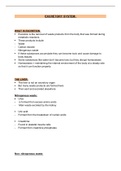
EXCRETORY SYSTEM:
WHAT IS EXCRETION:
Excretion is the removal of waste products from the body that was formed during
metabolic reactions.
These products include:
- Water
- Carbon dioxide
- Nitrogenous waste
If these substances accumulate they can become toxic and cause damage to
body tissues.
Some substances like water don’t become toxic but they disrupt homeostasis
Homeostasis = maintaining the internal environment of the body at a steady rate
so that it can function properly.
THE LIVER:
The liver is not an excretory organ
But many waste products are formed here
Then sent and excreted elsewhere
Nitrogenous waste:
Urea
- is formed from excess amino acids
- Main waste excreted by the kidney
Uric acid:
- Formed from the breakdown of nucleic acids
Creatinine:
- Found in skeletal muscle cells
- Formed from creatinine phosphates
Non- nitrogenous waste:
, Toxins and drugs
- Painkillers
- Nicotine
- Tranquilizers
Alcohol
- Toxic to cells
- Causes permanent damage to the liver cells (cirrhosis)
Other excretory products:
bile pigments
- formed from breakdown of red blood cells
- stored in gall bladder
cholesterol
- formed from breakdown of bile salts
to maintain homeostasis it is important to rid of any waste products which can
diffuse into the blood stream
They are carried to the excretory organs where they will be expelled.
EXCRETORY ORGANS:
1. Kidneys:
- Excrete all of the nitrogenous waste products formed in liver
- Mostly urea
- Also excrete non-nitrogenous waste such as CO2, excess water, ions ,
hormones, poisons and drugs
- Anything that can be diffused into the blood stream
2. Lungs:
- Excretes all CO2 produced from respiration in the body
- Exhaled when breathing out
- Small amounts of water is also excreted
3. Skin:
- Water, salts and small amounts of urea is excreted in form of sweat
WHAT IS EXCRETION:
Excretion is the removal of waste products from the body that was formed during
metabolic reactions.
These products include:
- Water
- Carbon dioxide
- Nitrogenous waste
If these substances accumulate they can become toxic and cause damage to
body tissues.
Some substances like water don’t become toxic but they disrupt homeostasis
Homeostasis = maintaining the internal environment of the body at a steady rate
so that it can function properly.
THE LIVER:
The liver is not an excretory organ
But many waste products are formed here
Then sent and excreted elsewhere
Nitrogenous waste:
Urea
- is formed from excess amino acids
- Main waste excreted by the kidney
Uric acid:
- Formed from the breakdown of nucleic acids
Creatinine:
- Found in skeletal muscle cells
- Formed from creatinine phosphates
Non- nitrogenous waste:
, Toxins and drugs
- Painkillers
- Nicotine
- Tranquilizers
Alcohol
- Toxic to cells
- Causes permanent damage to the liver cells (cirrhosis)
Other excretory products:
bile pigments
- formed from breakdown of red blood cells
- stored in gall bladder
cholesterol
- formed from breakdown of bile salts
to maintain homeostasis it is important to rid of any waste products which can
diffuse into the blood stream
They are carried to the excretory organs where they will be expelled.
EXCRETORY ORGANS:
1. Kidneys:
- Excrete all of the nitrogenous waste products formed in liver
- Mostly urea
- Also excrete non-nitrogenous waste such as CO2, excess water, ions ,
hormones, poisons and drugs
- Anything that can be diffused into the blood stream
2. Lungs:
- Excretes all CO2 produced from respiration in the body
- Exhaled when breathing out
- Small amounts of water is also excreted
3. Skin:
- Water, salts and small amounts of urea is excreted in form of sweat