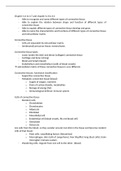
Chapter 4.4 to 4.7 and chapter 6.3 to 6.6
- Able to recognize and name different types of connective tissue.
- Able to explain the relation between shape and function of different types of
connective tissue.
- Able to explain different types of connective tissue develop and grow.
- Able to name the characteristics and functions of different types of connective tissue
and extracellular matrix.
Connective tissue
- Cells are separated by extracellular matrix.
- (embryonal) precursor tissue: mesenchyme.
Connective tissue types
- Loose (under the skin) and dense (collagen) connective tissue
- Cartilage and bone (strong)
- Blood and lymph (liquid)
- Endothelium and mesothelium (walls of blood vessels)
extracellular matrix of these connective tissues is very different.
Connective tissues: functional classification
- Supportive connective tissue
- Metabolic connective tissue (blood)
o Supply of oxygen, nutrients
o Drain of carbon dioxide, metabolites
o Storage of energy (fat)
o Immunological defense: immune system
Cells of connective tissue
- Resident cells
o Chondroblast
o Chondrocytes
o Adipocyte
o Fibroblast
o Mesothelial cell
o Endothelial cell (blood vessels, fits red blood cell)
o Osteoblast
o Osteocyte
Are cells from the blood, so they wander around, but stick in the tissue and become resident
cells of that tissue:
o Mast cells: vasodilating factors (histamines)
o Macrophages: skin (cells of Langerhans), liver (Kupffer) lung (dust cells), brain
(microglia): immune system.
- Wandering cells: migrate from one cell to the other. (blood)
, Dense connective tissue
- Fibroblast
- Matrix:
o Ground substance: liquid with a very sticky substance
Glycoproteins: these macromolecules interact with each other, with fibers
and with cells (of connective tissue, epithelia)
o Fibers: collagen, reticular, elastic
Collagen: used for glue, you need vitamin C to make collagen (scurvy).
There are 15 different types of collagen fibers:
- Type I: in tendons, and in bone
- Type II: thin fibers in cartilage
- Type III: thin fibers in reticular connective tissue
- Type IV: basal lamina
Synthesis of collagen
in RER and Golgi
Secreted via a constitutive route
Self-assembly of tropocollagen into collagen fibers in the extracellular matrix.
Collagen composition of tendons
Muscles are connected to the bone via tendons, tendons are made out of bundles, and
these bundles are made of several fibers. These fibers are made of fibril and this is again
made of tropocollagen triple helixes.
The places where the tropocollagen triple helix do not contain gaps are thicker
(overlapping region) than the regions that do contain those gaps (gaps region).
Reticular fibers:
- Meshwork of thin fibers (collagen type III)
- Predominantly in basal membranes and around organs
o Basal membrane: basal lamina is synthesized by epithelium; lamina reticularis
is synthesized of fibroblasts.
For adhesion of epithelium to connective tissue.
Elastic fibers:
- Composition: microfibrils (fibrillin) and elastin (responsible for elastic properties).
- Synthesized by fibroblasts, chondrocytes and smooth muscle cells.
- Present in elastic dense connective tissue, elastic cartilage and blood vessel walls.
Cartilage
- Specialized connective tissue
- Forms embryonic skeleton
- In adults: joints, nose, ears, trachea
- Cells (chondrocytes) and matrix
- Surrounded by tissue membrane: perichondrium, does contain nerves, causes pain
when you break something.
- No blood circulation, only diffusion
- Able to recognize and name different types of connective tissue.
- Able to explain the relation between shape and function of different types of
connective tissue.
- Able to explain different types of connective tissue develop and grow.
- Able to name the characteristics and functions of different types of connective tissue
and extracellular matrix.
Connective tissue
- Cells are separated by extracellular matrix.
- (embryonal) precursor tissue: mesenchyme.
Connective tissue types
- Loose (under the skin) and dense (collagen) connective tissue
- Cartilage and bone (strong)
- Blood and lymph (liquid)
- Endothelium and mesothelium (walls of blood vessels)
extracellular matrix of these connective tissues is very different.
Connective tissues: functional classification
- Supportive connective tissue
- Metabolic connective tissue (blood)
o Supply of oxygen, nutrients
o Drain of carbon dioxide, metabolites
o Storage of energy (fat)
o Immunological defense: immune system
Cells of connective tissue
- Resident cells
o Chondroblast
o Chondrocytes
o Adipocyte
o Fibroblast
o Mesothelial cell
o Endothelial cell (blood vessels, fits red blood cell)
o Osteoblast
o Osteocyte
Are cells from the blood, so they wander around, but stick in the tissue and become resident
cells of that tissue:
o Mast cells: vasodilating factors (histamines)
o Macrophages: skin (cells of Langerhans), liver (Kupffer) lung (dust cells), brain
(microglia): immune system.
- Wandering cells: migrate from one cell to the other. (blood)
, Dense connective tissue
- Fibroblast
- Matrix:
o Ground substance: liquid with a very sticky substance
Glycoproteins: these macromolecules interact with each other, with fibers
and with cells (of connective tissue, epithelia)
o Fibers: collagen, reticular, elastic
Collagen: used for glue, you need vitamin C to make collagen (scurvy).
There are 15 different types of collagen fibers:
- Type I: in tendons, and in bone
- Type II: thin fibers in cartilage
- Type III: thin fibers in reticular connective tissue
- Type IV: basal lamina
Synthesis of collagen
in RER and Golgi
Secreted via a constitutive route
Self-assembly of tropocollagen into collagen fibers in the extracellular matrix.
Collagen composition of tendons
Muscles are connected to the bone via tendons, tendons are made out of bundles, and
these bundles are made of several fibers. These fibers are made of fibril and this is again
made of tropocollagen triple helixes.
The places where the tropocollagen triple helix do not contain gaps are thicker
(overlapping region) than the regions that do contain those gaps (gaps region).
Reticular fibers:
- Meshwork of thin fibers (collagen type III)
- Predominantly in basal membranes and around organs
o Basal membrane: basal lamina is synthesized by epithelium; lamina reticularis
is synthesized of fibroblasts.
For adhesion of epithelium to connective tissue.
Elastic fibers:
- Composition: microfibrils (fibrillin) and elastin (responsible for elastic properties).
- Synthesized by fibroblasts, chondrocytes and smooth muscle cells.
- Present in elastic dense connective tissue, elastic cartilage and blood vessel walls.
Cartilage
- Specialized connective tissue
- Forms embryonic skeleton
- In adults: joints, nose, ears, trachea
- Cells (chondrocytes) and matrix
- Surrounded by tissue membrane: perichondrium, does contain nerves, causes pain
when you break something.
- No blood circulation, only diffusion