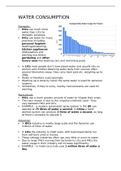
WATER CONSUMPTION
Domestic:
HICs use much more
water than LICs for
domestic purposes.
HICs use water for many
practices including
personal hygiene
(bathing/showering),
kitchen appliances
(dishwashers and
washing machines),
gardening and other
luxury uses like washing cars and swimming pools.
In LICs most people don’t have piped water and usually rely on
women and children obtaining water daily from sources often
several kilometres away; they carry back pots etc. weighing up to
20kg.
Water is therefore used sparingly.
Washing up is done by hand; the same water is used for personal
hygiene.
Sometimes, if they’re lucky, nearby rivers/streams are used for
washing.
Agricultural:
HICs use a much greater amount of water to irrigate their crops.
The main reason is due to the irrigation methods used – they
vary between HICs and LICs.
EXAMPLE – a modern automated spray system in the UK can
operate at 75 litres of water a second; in China a hand
worked system can produce 2 litres of water a second, as long
at there’s someone to operate it.
Industrial:
In HICs industry is mostly large scale and the factories use
millions of litres of water.
In LICs the industry is small scale, with businesses being run
from self-built units or homes.
These cottage industries often use very little or even no water.
Due to large TNCs moving their factories to LICs and MICs the
water usage in their industry will increase significantly.
EXAMPLE – in India Coca-Cola uses 1 million litres of water a
day.
, HOW DOES GREATER WEALTH LEAD
TO INCREASED WATER
CONSUMPTION?
As a country’s economy becomes stronger, individual wealth
increases therefore there’s more money available to luxuries.
There’s been a huge growth in labour-saving devices that use
considerable amounts of water (like dishwashers).
Personal hygiene has also changed – where people would once
have weekly baths now people bath or shower several times a
week, if not daily.
Access to baths and showers has also become much easier – in
the past people had to heat water and pour it into a metal bath in
front of a fire, but nowadays all houses are fitted with bathrooms
containing showers and baths.
In LICs, however, bathing and showering are still rare.
Greater disposable income has led to a greater number of
holidays and short breaks for people in HICs.
The growth in the leisure and tourism industry has seen huge
demands in water use for things like golf courses, swimming
pools, waterparks etc.
EXAMPLE – between 1990 and 2004 the UK saw 603 new golf
courses built.
Even though there have been technological improvements in
watering systems, large amounts are still used.
Artificial lakes on golf courses further increase water usage.
EXAMPLE – in Spain, where the summers are very dry, there are
often water shortages due to the great volume of water used for
golf courses, swimming pools etc.
Domestic:
HICs use much more
water than LICs for
domestic purposes.
HICs use water for many
practices including
personal hygiene
(bathing/showering),
kitchen appliances
(dishwashers and
washing machines),
gardening and other
luxury uses like washing cars and swimming pools.
In LICs most people don’t have piped water and usually rely on
women and children obtaining water daily from sources often
several kilometres away; they carry back pots etc. weighing up to
20kg.
Water is therefore used sparingly.
Washing up is done by hand; the same water is used for personal
hygiene.
Sometimes, if they’re lucky, nearby rivers/streams are used for
washing.
Agricultural:
HICs use a much greater amount of water to irrigate their crops.
The main reason is due to the irrigation methods used – they
vary between HICs and LICs.
EXAMPLE – a modern automated spray system in the UK can
operate at 75 litres of water a second; in China a hand
worked system can produce 2 litres of water a second, as long
at there’s someone to operate it.
Industrial:
In HICs industry is mostly large scale and the factories use
millions of litres of water.
In LICs the industry is small scale, with businesses being run
from self-built units or homes.
These cottage industries often use very little or even no water.
Due to large TNCs moving their factories to LICs and MICs the
water usage in their industry will increase significantly.
EXAMPLE – in India Coca-Cola uses 1 million litres of water a
day.
, HOW DOES GREATER WEALTH LEAD
TO INCREASED WATER
CONSUMPTION?
As a country’s economy becomes stronger, individual wealth
increases therefore there’s more money available to luxuries.
There’s been a huge growth in labour-saving devices that use
considerable amounts of water (like dishwashers).
Personal hygiene has also changed – where people would once
have weekly baths now people bath or shower several times a
week, if not daily.
Access to baths and showers has also become much easier – in
the past people had to heat water and pour it into a metal bath in
front of a fire, but nowadays all houses are fitted with bathrooms
containing showers and baths.
In LICs, however, bathing and showering are still rare.
Greater disposable income has led to a greater number of
holidays and short breaks for people in HICs.
The growth in the leisure and tourism industry has seen huge
demands in water use for things like golf courses, swimming
pools, waterparks etc.
EXAMPLE – between 1990 and 2004 the UK saw 603 new golf
courses built.
Even though there have been technological improvements in
watering systems, large amounts are still used.
Artificial lakes on golf courses further increase water usage.
EXAMPLE – in Spain, where the summers are very dry, there are
often water shortages due to the great volume of water used for
golf courses, swimming pools etc.