FINANCE
CHAPTER 14
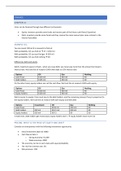
Firms can be financed through two different instruments:
• Equity: investors provide some funds and receive part of the future cash flows (if positive)
• Debt: investors provide some funds and they receive the same amount plus some interest in the
future (if possible)
EXAMPLE OIL:
You can invest 100 mil € in research to find oil
With probability 1/3 you find oil → CF = €150 mil
With probability 1/3 you just find gas → €50 mil
With probability 1/3 you find nothing → €0
Differences debt and equity
Debt’s maximum payout is fixed – when you issue debt, you never pay more than the amount borrowed +
interest rate. We fund the oil research 100% with debt at a 5% interest rate:
Options Oil Gas Nothing
Cash Flows €150 mil €50 mil €0
Debt holders €105 mil €50 mil €0
On the other hand, equity holders earn all the cash flow. We fund the oil research 100% with equity:
Options Oil Gas Nothing
Cash Flows €150 mil €50 mil €0
Equity holders €150 mil €50 mil €0
Debt is senior to equity: firms must pay to the debt holders, and the remaining money (if any) is payed out to
the equity holders. We fund the oil research 50% with equity and 50% debt:
Options Investment Oil Gas Nothing
Cash Flows €150 mil €50 mil €0
Debt holders €50 mil €52.5 mil €50 mil €0
Equity holders €50 mil €97.5 €0 €0
In bad times, debt holders get money back, equity holders don’t. → equity holders have more risk
PRICING: WHAT IS THE PRICE OF EQUITY AND DEBT?
Consider an entrepreneur with the following investment opportunity:
• Initial investment (date 0) : €800
• Cash flow at date 1:
o Strong economy: €1,400
o Weak economy: €900
• The economy can be in each state with equal probability
• The risk-free interest rate: 5%
• Risk premium: 10%
,Equity:
If she promises all future cash flows to investors, she would get:
PV (cash flows): (½ * 1400 + ½ * 900) / 1.15 = 1,000
Therefore, the entrepreneur can invest 800 in the project and earns 200 for the idea. Note that another
possibility is to sell 80% of the cash flows
Debt:
If the entrepreneur asks for a €800 loan, it is risk free. Therefore the value of the debt today is:
PV (cash flows): (½ * 840 + ½ * 840) / 1.05 = 800
Reminder: the risk free rate is 5%
Mixing equity and debt:
The entrepreneur can also issue €500 in debt and promise the remaining cash flows (CF) to share holders:
Date 0 Date 1: Cash flows
Initial value Strong economy Weak economy
Debt €500 €525 €525
Levered equity E=? €875 €375
Firm €1000 €1400 €900
CF debt + CF levered equity = CF unlevered equity. According to the law of one price, their value should be
equal to €500
PV (cash flows): (½ * 875 + ½ * 375) / 1.15 = 543
→ This is incorrect: the risk is not computed properly. Once debtholders enter the firm, equity becomes more
risky. Levered equity is more riskier than the equity before debt holders were in the firm (in bad times, debt
holders get money first)
Systematic risk Risk premium
∆R = R (strong) – R (weak) E[r] - rf
Debt 5% - 5% = 0% 5% - 5% = 0%
Unlevered equity 40% - (-10%) = 50% 15% - 5% = 10%
Levered equity 75% - (-25%) = 100% 20%
Levered equity is riskier than unlevered equity. In this case, it carries double systematic risk; therefore double
risk premium
= 1400/1000 - 1
= 900/1000 - 1
= 875/500 - 1
= 375/500 – 1
If we discount the cash flow with the new risk premium (20%):
PV (cash flows): (½ * 875 + ½ * 375) / 1.25 = 500
More leverage leads to:
Higher risk for shareholders + Higher expected return for shareholders
But:
Return on assets remains constant + cash flows do not change
,MODIGLIANI – MILLER I: LEVERAGE, ARBITRAGE, AND FIRM VALUE
Proposition 1
Modigliani and Miller (MM) showed that:
Leverage does not affect the total value of the firm (no matter how much debt you have, the total value of the
firm stays the same)
under a set of conditions referred to as perfect capital markets:
• Investors and firms can trade the same set of securities at competitive market prices equal to the
present value of their future cash flows
• There are no taxes, transaction costs, or issuance costs associated with security trading
• A firm’s financing decisions do not change the cash flows generated by its investments, nor do they
reveal new information about them
Homemade leverage
Consider that we have two firms U (unlevered) and L (levered) that only differ in their capital structure.
However, investors love leverage. Which firm has a higher value?
→ their value is the same. Why? Homemade leverage: When investors use leverage in their own portfolios to
adjust the leverage choice made by the firm (if you want the levered equity, you don’t need to buy levered
equity because you can create it in your portfolio)
You want to invest in a firm with 50% equity and 50% debt. There is only a firm with 100% equity:
Get a €500 loan, buy €1000 in 100% equity firm:
Date 0 Date 1: Cash flows
Initial Cost Strong economy Weak economy
Unlevered equity €1000 €1400 €900
Margin loan - €500 - €525 - €525
Portfolio €500 €875 €375
Levered equity €500 €875 €375
Note: Excess Cash
Sometimes firms’ balance sheet includes cash or other risk-free assets. These securities reduce the risk of firm
assets. Then, they have the opposite effect as leverage. Thus we consider them as “negative debt”, that is,
what we call debt is actually net debt (debt – excess cash)
MODIGLIANI – MILLER I: LEVERAGE RECAP
Leverage Recap – is an operation in which we increase the leverage of the firm without changing the actual
cash flow of the firm. So MM still applies but we have a higher debt compared to equity.
Assets = equity + debt
Borrow money from a bank → use the borrowed money to buy back shares from your shareholders → reduce
the equity of the firm because you have your own shares → value of the firm stays the same
, Example:
Unlevered firm = U
Shares outstanding = N
Share price (ex ante) = p
Borrowed amount = B
Ex post number of shares = N’
Ex post price = p’
MM1 → U = D + E
Unlevered equity = N * p
Debt = B
Value of the equity after the leverage recap = N’ * p’
N’ = N – (B/p)
→ U = B + (N – B/p) * p’
→ Np = B + (N – B/p) * p’
→ Np – B = 1/p * (Np – B) * p’
→ 1 = p’/p
→ p’ = p
A share price is not going to change whenever the firm does a leverage recap. The value of the firm is going to
stay the same and the price per share is going to be the same after the leverage recap
MODIGLIANI – MILLER II: LEVERAGE, RISK, AND THE COST OF CAPITAL
Notation:
Symbol Definition
A Market Value (MV) cash flows generated by assets
U Value unlevered firm
E MV equity
D MV debt
PCM Perfect Capital Market
Recall MM 1:
A=U=D+E
The Law of One Price implies:
→ Weighted Average Cost of Capital
Note: ru ≥ rd → re ≥ ru
Leverage ratio = D/E
CHAPTER 14
Firms can be financed through two different instruments:
• Equity: investors provide some funds and receive part of the future cash flows (if positive)
• Debt: investors provide some funds and they receive the same amount plus some interest in the
future (if possible)
EXAMPLE OIL:
You can invest 100 mil € in research to find oil
With probability 1/3 you find oil → CF = €150 mil
With probability 1/3 you just find gas → €50 mil
With probability 1/3 you find nothing → €0
Differences debt and equity
Debt’s maximum payout is fixed – when you issue debt, you never pay more than the amount borrowed +
interest rate. We fund the oil research 100% with debt at a 5% interest rate:
Options Oil Gas Nothing
Cash Flows €150 mil €50 mil €0
Debt holders €105 mil €50 mil €0
On the other hand, equity holders earn all the cash flow. We fund the oil research 100% with equity:
Options Oil Gas Nothing
Cash Flows €150 mil €50 mil €0
Equity holders €150 mil €50 mil €0
Debt is senior to equity: firms must pay to the debt holders, and the remaining money (if any) is payed out to
the equity holders. We fund the oil research 50% with equity and 50% debt:
Options Investment Oil Gas Nothing
Cash Flows €150 mil €50 mil €0
Debt holders €50 mil €52.5 mil €50 mil €0
Equity holders €50 mil €97.5 €0 €0
In bad times, debt holders get money back, equity holders don’t. → equity holders have more risk
PRICING: WHAT IS THE PRICE OF EQUITY AND DEBT?
Consider an entrepreneur with the following investment opportunity:
• Initial investment (date 0) : €800
• Cash flow at date 1:
o Strong economy: €1,400
o Weak economy: €900
• The economy can be in each state with equal probability
• The risk-free interest rate: 5%
• Risk premium: 10%
,Equity:
If she promises all future cash flows to investors, she would get:
PV (cash flows): (½ * 1400 + ½ * 900) / 1.15 = 1,000
Therefore, the entrepreneur can invest 800 in the project and earns 200 for the idea. Note that another
possibility is to sell 80% of the cash flows
Debt:
If the entrepreneur asks for a €800 loan, it is risk free. Therefore the value of the debt today is:
PV (cash flows): (½ * 840 + ½ * 840) / 1.05 = 800
Reminder: the risk free rate is 5%
Mixing equity and debt:
The entrepreneur can also issue €500 in debt and promise the remaining cash flows (CF) to share holders:
Date 0 Date 1: Cash flows
Initial value Strong economy Weak economy
Debt €500 €525 €525
Levered equity E=? €875 €375
Firm €1000 €1400 €900
CF debt + CF levered equity = CF unlevered equity. According to the law of one price, their value should be
equal to €500
PV (cash flows): (½ * 875 + ½ * 375) / 1.15 = 543
→ This is incorrect: the risk is not computed properly. Once debtholders enter the firm, equity becomes more
risky. Levered equity is more riskier than the equity before debt holders were in the firm (in bad times, debt
holders get money first)
Systematic risk Risk premium
∆R = R (strong) – R (weak) E[r] - rf
Debt 5% - 5% = 0% 5% - 5% = 0%
Unlevered equity 40% - (-10%) = 50% 15% - 5% = 10%
Levered equity 75% - (-25%) = 100% 20%
Levered equity is riskier than unlevered equity. In this case, it carries double systematic risk; therefore double
risk premium
= 1400/1000 - 1
= 900/1000 - 1
= 875/500 - 1
= 375/500 – 1
If we discount the cash flow with the new risk premium (20%):
PV (cash flows): (½ * 875 + ½ * 375) / 1.25 = 500
More leverage leads to:
Higher risk for shareholders + Higher expected return for shareholders
But:
Return on assets remains constant + cash flows do not change
,MODIGLIANI – MILLER I: LEVERAGE, ARBITRAGE, AND FIRM VALUE
Proposition 1
Modigliani and Miller (MM) showed that:
Leverage does not affect the total value of the firm (no matter how much debt you have, the total value of the
firm stays the same)
under a set of conditions referred to as perfect capital markets:
• Investors and firms can trade the same set of securities at competitive market prices equal to the
present value of their future cash flows
• There are no taxes, transaction costs, or issuance costs associated with security trading
• A firm’s financing decisions do not change the cash flows generated by its investments, nor do they
reveal new information about them
Homemade leverage
Consider that we have two firms U (unlevered) and L (levered) that only differ in their capital structure.
However, investors love leverage. Which firm has a higher value?
→ their value is the same. Why? Homemade leverage: When investors use leverage in their own portfolios to
adjust the leverage choice made by the firm (if you want the levered equity, you don’t need to buy levered
equity because you can create it in your portfolio)
You want to invest in a firm with 50% equity and 50% debt. There is only a firm with 100% equity:
Get a €500 loan, buy €1000 in 100% equity firm:
Date 0 Date 1: Cash flows
Initial Cost Strong economy Weak economy
Unlevered equity €1000 €1400 €900
Margin loan - €500 - €525 - €525
Portfolio €500 €875 €375
Levered equity €500 €875 €375
Note: Excess Cash
Sometimes firms’ balance sheet includes cash or other risk-free assets. These securities reduce the risk of firm
assets. Then, they have the opposite effect as leverage. Thus we consider them as “negative debt”, that is,
what we call debt is actually net debt (debt – excess cash)
MODIGLIANI – MILLER I: LEVERAGE RECAP
Leverage Recap – is an operation in which we increase the leverage of the firm without changing the actual
cash flow of the firm. So MM still applies but we have a higher debt compared to equity.
Assets = equity + debt
Borrow money from a bank → use the borrowed money to buy back shares from your shareholders → reduce
the equity of the firm because you have your own shares → value of the firm stays the same
, Example:
Unlevered firm = U
Shares outstanding = N
Share price (ex ante) = p
Borrowed amount = B
Ex post number of shares = N’
Ex post price = p’
MM1 → U = D + E
Unlevered equity = N * p
Debt = B
Value of the equity after the leverage recap = N’ * p’
N’ = N – (B/p)
→ U = B + (N – B/p) * p’
→ Np = B + (N – B/p) * p’
→ Np – B = 1/p * (Np – B) * p’
→ 1 = p’/p
→ p’ = p
A share price is not going to change whenever the firm does a leverage recap. The value of the firm is going to
stay the same and the price per share is going to be the same after the leverage recap
MODIGLIANI – MILLER II: LEVERAGE, RISK, AND THE COST OF CAPITAL
Notation:
Symbol Definition
A Market Value (MV) cash flows generated by assets
U Value unlevered firm
E MV equity
D MV debt
PCM Perfect Capital Market
Recall MM 1:
A=U=D+E
The Law of One Price implies:
→ Weighted Average Cost of Capital
Note: ru ≥ rd → re ≥ ru
Leverage ratio = D/E