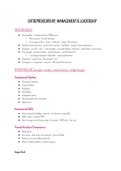
ENTREPRENEURSHIP, MANAGEMENT & LEADERSHIP
INTREPRENEURS
● Same qualities - entrepreneurs but 2 differences:
○ More cautious + less of risk takers.
○ Circumstances force - remain - stable job + unable - follow dreams.
● Employees within business - use talent of innovation + leadership - change / improve department.
● Employees - any level - intre - + intre manager - encourage change - innovation + subordinates - pursue ideas.
● Intre manager - persuasive leader - assist employees - reach full potential.
○ + encourage employees - help others - improve performance.
● Cooperation + team-driven - key concepts - intre.
● Entrepreneur = intrepreneur - continues - INnovate IN the business.
ENTREPRENEURS (saw gap - market + starts business - bridge the gap)
Entrepreneurial Qualities:
● Passionate visionaries
● Creative thinkers
● Risk takers
● Good leaders
● Independent spirits
● Have perseverance & commitment
● Opportunists
Entrepreneurial Skills:
● Have necessary knowledge + expertise - run business successfully.
● Skills - learnt + includes POLC.
● Have to recognise own shortcomings + hire people - fulfill roles - they can’t.
Personal Attitudes of Entrepreneurs:
● Result driven
● Have vision - what needs to be achieved + vision is flexible.
● Realises no success without teamwork.
● Desire - achieve, ambition + strike to improve.
Sanjana Vinod
, ● Leader’s ability - inspire, gain trust + motivate - influence followers.
● Have to display honesty & integrity.
● Instilling confidence - followers.
● Possess EQ.
● Comm skills with active listening - important.
● Ability + self-motivation - follow through + implement plans - important.
● Without follow-through - leader will fail + lack of implementation - followers - cynical + have low morale.
MANAGEMENT & LEADERSHIP
● Manage - from italian word ‘maneggiare’ = to handle a situation, event / person.
● Involves POLC.
The difference:
● Leader’s most important task - make people aware of what they feel - can take action.
● Manager = granted authority - appointed in specific position.
○ Has power - position he holds.
● Leader = shares vision + inspires others - carry it out.
○ Has power - expertise (perceived/real).
● Manager should be leader - org.
MANAGER LEADER
- Maintain systems - Develops new methods
- Focus on system + structures - Focuses on people
- Relies on control - Inspires trust
- Accepts status quo - Challenges status quo
Management & leadership styles:
● Management - complex + each person brings personality, experience + abilities - job.
● Type of business + degree of formality - play a role.
● One will display - variety of styles in different situations.
● Analysing success of task + role of manager - important to assess management style used.
1. Autocratic:
● Manager - only person making decisions.
● Strongly associated - second wave management approach.
● May be used - turn-around strategy / discipline required.
● Long-term basis - demotivating - employees + self-destructive - org.
Sanjana Vinod
INTREPRENEURS
● Same qualities - entrepreneurs but 2 differences:
○ More cautious + less of risk takers.
○ Circumstances force - remain - stable job + unable - follow dreams.
● Employees within business - use talent of innovation + leadership - change / improve department.
● Employees - any level - intre - + intre manager - encourage change - innovation + subordinates - pursue ideas.
● Intre manager - persuasive leader - assist employees - reach full potential.
○ + encourage employees - help others - improve performance.
● Cooperation + team-driven - key concepts - intre.
● Entrepreneur = intrepreneur - continues - INnovate IN the business.
ENTREPRENEURS (saw gap - market + starts business - bridge the gap)
Entrepreneurial Qualities:
● Passionate visionaries
● Creative thinkers
● Risk takers
● Good leaders
● Independent spirits
● Have perseverance & commitment
● Opportunists
Entrepreneurial Skills:
● Have necessary knowledge + expertise - run business successfully.
● Skills - learnt + includes POLC.
● Have to recognise own shortcomings + hire people - fulfill roles - they can’t.
Personal Attitudes of Entrepreneurs:
● Result driven
● Have vision - what needs to be achieved + vision is flexible.
● Realises no success without teamwork.
● Desire - achieve, ambition + strike to improve.
Sanjana Vinod
, ● Leader’s ability - inspire, gain trust + motivate - influence followers.
● Have to display honesty & integrity.
● Instilling confidence - followers.
● Possess EQ.
● Comm skills with active listening - important.
● Ability + self-motivation - follow through + implement plans - important.
● Without follow-through - leader will fail + lack of implementation - followers - cynical + have low morale.
MANAGEMENT & LEADERSHIP
● Manage - from italian word ‘maneggiare’ = to handle a situation, event / person.
● Involves POLC.
The difference:
● Leader’s most important task - make people aware of what they feel - can take action.
● Manager = granted authority - appointed in specific position.
○ Has power - position he holds.
● Leader = shares vision + inspires others - carry it out.
○ Has power - expertise (perceived/real).
● Manager should be leader - org.
MANAGER LEADER
- Maintain systems - Develops new methods
- Focus on system + structures - Focuses on people
- Relies on control - Inspires trust
- Accepts status quo - Challenges status quo
Management & leadership styles:
● Management - complex + each person brings personality, experience + abilities - job.
● Type of business + degree of formality - play a role.
● One will display - variety of styles in different situations.
● Analysing success of task + role of manager - important to assess management style used.
1. Autocratic:
● Manager - only person making decisions.
● Strongly associated - second wave management approach.
● May be used - turn-around strategy / discipline required.
● Long-term basis - demotivating - employees + self-destructive - org.
Sanjana Vinod