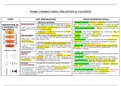
PS1080: UNDERSTANDING PERCEPTION & COGNITION
TOPIC A01 (KNOWLEDGE) A02/3 (EVIDENCE+EVAL)
Theories of perception - Perception & cognition: collecting & interpreting information about the
Gestalt psychology - GP suggests that we do not simply focus on every world. Fundamental steps of info processing to convert the outside
PERCEPTION AS small component. Instead, our minds tend to perceive (physical) world into internal (psychological) events leads to encoding.
A GATEWAY TO (Looks at the human objects as part of a greater whole and as elements of - Sensory & processing systems: a channel to collect information (our
mind and behavior as a
THE WORLD more complex systems. ‘window’)
whole).
- Gestalt laws are rules that describe how the human - Perception: how humans experience their environment. Input of
eye perceives visual elements. information from the outside world. (senses)
Direct perception - Gibson argues that perception is direct. We perceive - Cognition: how humans understand their environment. Information
the world directly using the sensory information we processing. (thoughts)
(Gibson (1972) argued gain using our eyes.
that perception is
- Cognitive science is a group of disciplines that help understand the
bottom-up processing) human mind (psychology, neuroscience, AI, philosophy, linguistics).
- Sensation is perception: what you see if what you get.
There is no need for processing (interpretation) as the - Basic neural engineering concept: filtering.
- fast & automatic information we receive (about size, shape, distance) is - Magnetic field: orientation of the magnetic energy coming out of the
responses. earth itself. Humans use tools to exploit the magnetic field of the earth
- Object affordances can
sufficiently detailed for us to interact directly w/ the
environment. for navigation: compass.
be perceived directly.
GESTALT LAWS:
Constructivist - Gregory argues that perception is an active - Transfer across sensory modalities:
approach constructive process driven by cognition. = Ventriloquism: speaking in a way that it seems to come from another
- Sensory information is combined w/ stored source (eg. puppet).
(Gregory (1970) argued knowledge about the world which constructs our = Synaesthesia: a mixing of sense causing a person to experience
that perception is top- perception since stimulus info from environment is such things such as coloured hearing, auditory smells, etc. (1/25,000).
down processing) often ambiguous to interpret by itself. = Sensory subsituition: replacing a lost/missing sense with another.
- Different sensory modalities give us different type of information.
Information (neuroscientific & computational approach to perception)
- Information processing (scientific approach): acquisition, processing,
processing approach
- Information made available by the environment is storage, recall of data in the human brain.
processed by a series of processing systems (e.g. - Information needs to be collected & stored (processed).
attention, perception, short-term memory). - Problems with info processing: perceptual bottleneck- limited capacity
- Information processing in humans resembles that in about the amount of data we can input & perceptual filter- channel
computers. tuning, selective information of a size and frequency.
, - Components: black and white and colour - The outside world is represented in retinotopic maps of neurons with
ILLUSIONS AS = Brightness: subjective attribute of light. It is the perceived intensity of light and centre-surround receptive fields (‘filters’)
cannot be measured objectively.
KEY TO - The grey spots in the grid are as a result of
= Luminance: luminous intensity, projected on a given area & direction. It is a opponency filtering (opponency filters (centre-
REALITY, IN measure of the amount of light falling on a surface. (objectively measurable). surround receptive fields) increase/decrease the
SPACE AND = Difference between B&W: black- no energy of light coming to the retina to apparent brightness of a line in front of a
darker/brighter background).
TIME white- a lot of energy of light coming to the retina.
- Inside the black square there is no stimulation of
(Illusions are when we = Colour is the spectrum of light coming into our eyes. They are small number
excitatory centre & inhibitory surround (no overall
perceive things different from linguistic categories and only a small amount have specific names (red, blue…) excitation) so it is perceived as dark.
what they actually are. They = 3M different colours. - The white bars are the only small parts of the
are a predictable result of inhibitory surround which are stimulated, so the
optimized cortical information - Contrast: the relative difference in stimulus intensity between a bright and a
excitation dominates the inhibition (bright).
processing.) dark region of a visual stimulus. - White intersections: the larger parts of inhibitory
= Contrast enhancement: excitation & inhibition surround are stimulated (small overall excitation)
= In regions of equal luminance excitation and inhibition cancel each other. which leads to an apparent reduction of brightness.
= ‘filters’ in the visual stream subtract stimulus intensity (lightness) in It is a contrast between centre & surround.
surrounding region (red) from lightness in the centre (green). The balance
between the centre and surround is attributed as percieved brightness to the - Depth cues:
1) Pictorial cues: a wide range of
centre.
depth info can be directly
= Perceptual measure is not the absolute but rather relative stimulus intensity in
extracted from a static
comparison to its surround. There is a simultaneous contrast and comparison of monocular (single eye) image.
brightness. 2) Binocular cues: both eyes
combined to give one image.
- Contrast illusion: enhancemment of colour differences in space when This allows an extended visual
presented next to each other. field and precise depth
- Other factors that influence percieved colour: collour illumination, tinted glass, measurements through
colour blindness. stereopsis.
- Stereopsis: perception of depth
- The third dimension: depth. Construction of an illusion of space in a flat image.
produced by both eyes in
= Multiple cues: size, perspectice, texture, contrast, shade, our two eyes, etc…
combination looking at the same
– Motion: combination of space and time. object as one image.
3) Relative size: more distant an
= 1) Motion illusion: aftereffect: Contrast illusion compares two things happening
object, the smaller its image on
in a sequence. A successive motion contrast> opponency mechanism in time. the retina. Also known as the
= 2) Motion illusion: barbers pole: shape of an aperture can change the size constancy effect.
perceived direction of motion.
TOPIC A01 (KNOWLEDGE) A02/3 (EVIDENCE+EVAL)
Theories of perception - Perception & cognition: collecting & interpreting information about the
Gestalt psychology - GP suggests that we do not simply focus on every world. Fundamental steps of info processing to convert the outside
PERCEPTION AS small component. Instead, our minds tend to perceive (physical) world into internal (psychological) events leads to encoding.
A GATEWAY TO (Looks at the human objects as part of a greater whole and as elements of - Sensory & processing systems: a channel to collect information (our
mind and behavior as a
THE WORLD more complex systems. ‘window’)
whole).
- Gestalt laws are rules that describe how the human - Perception: how humans experience their environment. Input of
eye perceives visual elements. information from the outside world. (senses)
Direct perception - Gibson argues that perception is direct. We perceive - Cognition: how humans understand their environment. Information
the world directly using the sensory information we processing. (thoughts)
(Gibson (1972) argued gain using our eyes.
that perception is
- Cognitive science is a group of disciplines that help understand the
bottom-up processing) human mind (psychology, neuroscience, AI, philosophy, linguistics).
- Sensation is perception: what you see if what you get.
There is no need for processing (interpretation) as the - Basic neural engineering concept: filtering.
- fast & automatic information we receive (about size, shape, distance) is - Magnetic field: orientation of the magnetic energy coming out of the
responses. earth itself. Humans use tools to exploit the magnetic field of the earth
- Object affordances can
sufficiently detailed for us to interact directly w/ the
environment. for navigation: compass.
be perceived directly.
GESTALT LAWS:
Constructivist - Gregory argues that perception is an active - Transfer across sensory modalities:
approach constructive process driven by cognition. = Ventriloquism: speaking in a way that it seems to come from another
- Sensory information is combined w/ stored source (eg. puppet).
(Gregory (1970) argued knowledge about the world which constructs our = Synaesthesia: a mixing of sense causing a person to experience
that perception is top- perception since stimulus info from environment is such things such as coloured hearing, auditory smells, etc. (1/25,000).
down processing) often ambiguous to interpret by itself. = Sensory subsituition: replacing a lost/missing sense with another.
- Different sensory modalities give us different type of information.
Information (neuroscientific & computational approach to perception)
- Information processing (scientific approach): acquisition, processing,
processing approach
- Information made available by the environment is storage, recall of data in the human brain.
processed by a series of processing systems (e.g. - Information needs to be collected & stored (processed).
attention, perception, short-term memory). - Problems with info processing: perceptual bottleneck- limited capacity
- Information processing in humans resembles that in about the amount of data we can input & perceptual filter- channel
computers. tuning, selective information of a size and frequency.
, - Components: black and white and colour - The outside world is represented in retinotopic maps of neurons with
ILLUSIONS AS = Brightness: subjective attribute of light. It is the perceived intensity of light and centre-surround receptive fields (‘filters’)
cannot be measured objectively.
KEY TO - The grey spots in the grid are as a result of
= Luminance: luminous intensity, projected on a given area & direction. It is a opponency filtering (opponency filters (centre-
REALITY, IN measure of the amount of light falling on a surface. (objectively measurable). surround receptive fields) increase/decrease the
SPACE AND = Difference between B&W: black- no energy of light coming to the retina to apparent brightness of a line in front of a
darker/brighter background).
TIME white- a lot of energy of light coming to the retina.
- Inside the black square there is no stimulation of
(Illusions are when we = Colour is the spectrum of light coming into our eyes. They are small number
excitatory centre & inhibitory surround (no overall
perceive things different from linguistic categories and only a small amount have specific names (red, blue…) excitation) so it is perceived as dark.
what they actually are. They = 3M different colours. - The white bars are the only small parts of the
are a predictable result of inhibitory surround which are stimulated, so the
optimized cortical information - Contrast: the relative difference in stimulus intensity between a bright and a
excitation dominates the inhibition (bright).
processing.) dark region of a visual stimulus. - White intersections: the larger parts of inhibitory
= Contrast enhancement: excitation & inhibition surround are stimulated (small overall excitation)
= In regions of equal luminance excitation and inhibition cancel each other. which leads to an apparent reduction of brightness.
= ‘filters’ in the visual stream subtract stimulus intensity (lightness) in It is a contrast between centre & surround.
surrounding region (red) from lightness in the centre (green). The balance
between the centre and surround is attributed as percieved brightness to the - Depth cues:
1) Pictorial cues: a wide range of
centre.
depth info can be directly
= Perceptual measure is not the absolute but rather relative stimulus intensity in
extracted from a static
comparison to its surround. There is a simultaneous contrast and comparison of monocular (single eye) image.
brightness. 2) Binocular cues: both eyes
combined to give one image.
- Contrast illusion: enhancemment of colour differences in space when This allows an extended visual
presented next to each other. field and precise depth
- Other factors that influence percieved colour: collour illumination, tinted glass, measurements through
colour blindness. stereopsis.
- Stereopsis: perception of depth
- The third dimension: depth. Construction of an illusion of space in a flat image.
produced by both eyes in
= Multiple cues: size, perspectice, texture, contrast, shade, our two eyes, etc…
combination looking at the same
– Motion: combination of space and time. object as one image.
3) Relative size: more distant an
= 1) Motion illusion: aftereffect: Contrast illusion compares two things happening
object, the smaller its image on
in a sequence. A successive motion contrast> opponency mechanism in time. the retina. Also known as the
= 2) Motion illusion: barbers pole: shape of an aperture can change the size constancy effect.
perceived direction of motion.