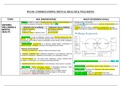
PS1110: UNDERSTANDING MENTAL HEALTH & WELLBEING
TOPIC A01 (KNOWLEDGE) A02/3 (EVIDENCE+EVAL)
- Wellbeing: ‘Health is a state of complete physical, mental & social well-being and - (findings across 136 studies)
not merely the absence of disease or infirmity’ (WHO, 1946) = On average 1/5 adults experienced a common mental disorder within
DEFINING the past 12 months.
WELLBEING & Hedonistic view on wellbeing Eudaimonic view on wellbeing = Females were more likely to experience mood/anxiety disorder.
- subjective wellbeing - psychological wellbeing = Males more likely to experience an alcholol/substance use disorder.
MENTAL
- positive mood - self-actualization
HEALTH - avoidance of pain & negative mood - personal growth
- Mental health: a state of wellbeing in which every individual realizes their own
potential, can cope with the common stresses of life, can work productively and
successfully, and is able to make a contribution to their family, friends, workplace
and community.
- Mental disorder: disturbances to a person’s mental health. Combination of
troubled thoughts, emotions, behaviour and relationship with others.
- Defining mental disorder:
1. Violating a societal norm (failing to follow conventional rules)
2. Violating a statistical norm (statistical infrequent or rare behaviour could be
considered maladaptive. Statistical commonality is not necessarily normal.)
3. Personal distress (e.g., low mood, worry, depression, anxiety. However does
not apply to all disorders, e.g. antisocial personality disorder). - Diagnosing psychological dysfunction: set of criteria from DSM-5, ICD-
10
4. Disability/dysfunction in behaviour (to the individual, those around, to society).
- Construct validity: quantitaviley relate to other measures of the same
- Why classify? Identify meaningful clusters of maladaptive behaviour. Clear theoretical construct.
definitions of order. Useful for gathering statistics on disorders. - Criterion validity: correlate with measures of the same construct
= Advantages: common nomenclature, structure info in a helpful manner. concurrently or prospectively.
= Disadvantages: stigma, stereotypes, labelling change in self-concept. - Test-retest reliability: within the same person over time.
- Classification is categorical and dimensional. - Inter-reater reliability: different raters rating at the same time.
, - RD Laing (1927-1989): psychiatry was founded on a false epistemology: illness MICHEL FOUCAULT
was diagnosed by conduct but treated biologically. - was a French 20th century philosopher and historian.
PHILOSOPHY OF - He challenged the core values of psychiatry which considers mental illness as - 1961: published his book Madness and Civilization.
PSYCHO- primarily a biological phenomenon with no social, intellectual or political - Foucault wanted to demolish the attitude towards how mental people
significance. were/are treated (hospital, drugs, etc). He argued that things back in
PATHOLOGY - Antipsychiatry have two central contentions: the Renaissance were far better for the mad. They were seen as
1. The specific definitions/criteria for current psychiatric diagnoses/disorders are ‘different’ rather than crazy and possessing a wisdom because they
vague and arbitrary. They leave too much room for opinions and interpretations to demonstrated the limits of reason.
meet basic scientific standards. THE HISTORY OF MADNESS IN THE CLASSICAL AGE
2. Prevailing psychiatric treatments are ultimately far more damaging than helpful. - Middle ages: Social and physical exclusion of lepers. Gradual
- Criticisms of psychiatric authority: disappearance of leprosy → madness came to occupy this excluded
- Inappropriate and overuse of medical concepts and tools to understand the mind. position.
- Ill-founded system of categorical diagnoses (e.g., DSM) & stigmatization. - Renaissance: Humans cannot come close to the Reason of God.
- Unexamined abuse & misuse of power over patients who are often treated Madmen are those who had come close to God’s Reason and so were
against their will. accepted in society.
- Compromise of medical & ethical integrity because of psychiatrics’ financial and - 17th century: The Great Confinement → “unreasonable” members
professional links w/ pharmaceutical companies. were systematically locked away and institutionalized.
- Wakefield: “The concept of mental disorder” (in its history) - 18th century: Madness was seen as the loss of what made them
= Sexual, racial, and sexual orientational biases in diagnosis. human (reason) and so became animal-like. They then were treated as
= Psychodiagnosis is often used to control or stigmatize socially undesirable such.
behaviour that isn’t really disordered. (e.g., drapetomania, childhood masturbation - 19th century: Madness was regarded as a ‘curable’ mental illness of
disorder, homosexuality, alcoholism, etc.) the mind and not possession of evil demons.
- Different concepts of mental disorders take a value or scientific approach.
- Wakefield: Both facts & values are involved in the concept of disorder. FOUCAULT’S ARGUMENT
- In the Early Middle Ages: parallel between the medieval isolation of
PROBLEMS W/ STANDARD ANALYSES OF MENTAL DISORDER lepers and the modern isolation of madness.
1. Szasz: Mental disorder is an evaluatory label that justifies use of medical power to = Both lepers and the mad were objects of fear and repulsion: they
intervene in socially disapproved behaviour. were isolated in houses designed for separation from society than as a
1. The myth of the myth of 2. The pure value account of disorder asserts that disorder is nothing but a value concept, cure.
mental disorder
so that social judgments of disorder are nothing but judgments of desirability according - He was interested in the attitudes towards madness. He found that
2. Disorder as a pure value
to social norms and ideals. madness of the people who were confined was one division of a wider
concept 3. Frustration with failed attempts to analyze the concept of mental disorder often leads category of people who were seen as ‘unreasonable’
3. Disorder to the suggestion that a disorder is simply any condition that health professionals treat. - Not only the ‘mad’ were confined but a wide range of other people
as whatever professionals treat 4. The criterion is purely objective and scientific. Diseases are seen as quantitative such as sexual offenders, free-thinkers, those guilty of religious
4. D as statistical deviance deviations from the normal. profanation...
5. D as biological disadvantage 5. Disorder is anything that reduces longevity or fertility. - Confinement was seen as an economic policy to deal with problems
6. Disorder as unexpectable 6. Disorders are associated w/ present distress (a painful symptom) or disability
distress
of poverty. They were also seen as moral troublemakers of society.
(impairment in one or more key areas of functioning).
TOPIC A01 (KNOWLEDGE) A02/3 (EVIDENCE+EVAL)
- Wellbeing: ‘Health is a state of complete physical, mental & social well-being and - (findings across 136 studies)
not merely the absence of disease or infirmity’ (WHO, 1946) = On average 1/5 adults experienced a common mental disorder within
DEFINING the past 12 months.
WELLBEING & Hedonistic view on wellbeing Eudaimonic view on wellbeing = Females were more likely to experience mood/anxiety disorder.
- subjective wellbeing - psychological wellbeing = Males more likely to experience an alcholol/substance use disorder.
MENTAL
- positive mood - self-actualization
HEALTH - avoidance of pain & negative mood - personal growth
- Mental health: a state of wellbeing in which every individual realizes their own
potential, can cope with the common stresses of life, can work productively and
successfully, and is able to make a contribution to their family, friends, workplace
and community.
- Mental disorder: disturbances to a person’s mental health. Combination of
troubled thoughts, emotions, behaviour and relationship with others.
- Defining mental disorder:
1. Violating a societal norm (failing to follow conventional rules)
2. Violating a statistical norm (statistical infrequent or rare behaviour could be
considered maladaptive. Statistical commonality is not necessarily normal.)
3. Personal distress (e.g., low mood, worry, depression, anxiety. However does
not apply to all disorders, e.g. antisocial personality disorder). - Diagnosing psychological dysfunction: set of criteria from DSM-5, ICD-
10
4. Disability/dysfunction in behaviour (to the individual, those around, to society).
- Construct validity: quantitaviley relate to other measures of the same
- Why classify? Identify meaningful clusters of maladaptive behaviour. Clear theoretical construct.
definitions of order. Useful for gathering statistics on disorders. - Criterion validity: correlate with measures of the same construct
= Advantages: common nomenclature, structure info in a helpful manner. concurrently or prospectively.
= Disadvantages: stigma, stereotypes, labelling change in self-concept. - Test-retest reliability: within the same person over time.
- Classification is categorical and dimensional. - Inter-reater reliability: different raters rating at the same time.
, - RD Laing (1927-1989): psychiatry was founded on a false epistemology: illness MICHEL FOUCAULT
was diagnosed by conduct but treated biologically. - was a French 20th century philosopher and historian.
PHILOSOPHY OF - He challenged the core values of psychiatry which considers mental illness as - 1961: published his book Madness and Civilization.
PSYCHO- primarily a biological phenomenon with no social, intellectual or political - Foucault wanted to demolish the attitude towards how mental people
significance. were/are treated (hospital, drugs, etc). He argued that things back in
PATHOLOGY - Antipsychiatry have two central contentions: the Renaissance were far better for the mad. They were seen as
1. The specific definitions/criteria for current psychiatric diagnoses/disorders are ‘different’ rather than crazy and possessing a wisdom because they
vague and arbitrary. They leave too much room for opinions and interpretations to demonstrated the limits of reason.
meet basic scientific standards. THE HISTORY OF MADNESS IN THE CLASSICAL AGE
2. Prevailing psychiatric treatments are ultimately far more damaging than helpful. - Middle ages: Social and physical exclusion of lepers. Gradual
- Criticisms of psychiatric authority: disappearance of leprosy → madness came to occupy this excluded
- Inappropriate and overuse of medical concepts and tools to understand the mind. position.
- Ill-founded system of categorical diagnoses (e.g., DSM) & stigmatization. - Renaissance: Humans cannot come close to the Reason of God.
- Unexamined abuse & misuse of power over patients who are often treated Madmen are those who had come close to God’s Reason and so were
against their will. accepted in society.
- Compromise of medical & ethical integrity because of psychiatrics’ financial and - 17th century: The Great Confinement → “unreasonable” members
professional links w/ pharmaceutical companies. were systematically locked away and institutionalized.
- Wakefield: “The concept of mental disorder” (in its history) - 18th century: Madness was seen as the loss of what made them
= Sexual, racial, and sexual orientational biases in diagnosis. human (reason) and so became animal-like. They then were treated as
= Psychodiagnosis is often used to control or stigmatize socially undesirable such.
behaviour that isn’t really disordered. (e.g., drapetomania, childhood masturbation - 19th century: Madness was regarded as a ‘curable’ mental illness of
disorder, homosexuality, alcoholism, etc.) the mind and not possession of evil demons.
- Different concepts of mental disorders take a value or scientific approach.
- Wakefield: Both facts & values are involved in the concept of disorder. FOUCAULT’S ARGUMENT
- In the Early Middle Ages: parallel between the medieval isolation of
PROBLEMS W/ STANDARD ANALYSES OF MENTAL DISORDER lepers and the modern isolation of madness.
1. Szasz: Mental disorder is an evaluatory label that justifies use of medical power to = Both lepers and the mad were objects of fear and repulsion: they
intervene in socially disapproved behaviour. were isolated in houses designed for separation from society than as a
1. The myth of the myth of 2. The pure value account of disorder asserts that disorder is nothing but a value concept, cure.
mental disorder
so that social judgments of disorder are nothing but judgments of desirability according - He was interested in the attitudes towards madness. He found that
2. Disorder as a pure value
to social norms and ideals. madness of the people who were confined was one division of a wider
concept 3. Frustration with failed attempts to analyze the concept of mental disorder often leads category of people who were seen as ‘unreasonable’
3. Disorder to the suggestion that a disorder is simply any condition that health professionals treat. - Not only the ‘mad’ were confined but a wide range of other people
as whatever professionals treat 4. The criterion is purely objective and scientific. Diseases are seen as quantitative such as sexual offenders, free-thinkers, those guilty of religious
4. D as statistical deviance deviations from the normal. profanation...
5. D as biological disadvantage 5. Disorder is anything that reduces longevity or fertility. - Confinement was seen as an economic policy to deal with problems
6. Disorder as unexpectable 6. Disorders are associated w/ present distress (a painful symptom) or disability
distress
of poverty. They were also seen as moral troublemakers of society.
(impairment in one or more key areas of functioning).