

Building systems
1. Introduction/ repetition
What is a structure = System of physical components organized to take all loads of a building
safely to the ground and to always ensure stability
o Cables, arches, trusses, beams …
What is a force = free vector with a direction, intensity, point of action and a line of action
What is a load = external forces
o Permanent loads, dead loads, live loads, snow load, wind load
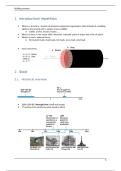
Force and stress:
2. Steel
2.1. Historical overview
2000-1000 BC: Wrought Iron (small and strong)
9th century: First structures were found in China
1
,Building systems
1760: introduction Cast Iron in Europe: since industrial revolution railways,
factory’s …
door iron ging het allemaal heel snel en kon er veel gebouwd worden
1779: First bridge in an arch form with wooden connections
o Hollow columns (now they’re full), why? They just didn’t know how to
make them hollow
1851: important building steel structure!! Crystal palace London
o new face for modern architecture
o used for the first world exhibition
o slender and naked structure
o fast principle: repetitive (in 119 days build)
o first modular and artificial building materials (omkeerbaar)
difference iron and steel = the ingredient carbon (koolstof)
o more carbon in iron stronger
o less carbon in steel more ductility
1885: steel makes high rise buildings possible
1951 Mies van de Rohe: uses the naked structure from steel in designs modern
1997 Centre Pompidou: the steel machine, hollow elements, repetitive
1997 Bilbao: new modeling techniques
o Grid with triangles
o Facades are load bearing structures (dragende structuur)
2021 bride Amsterdam: robotique fabrication combined with traditional techniques
2
, Building systems
2.2. Mechanical properties (how can we use the material)
2.2.1.Properties (eigenschappen)
Steel is not only used for beams and columns, but also as connecters, because it can stretch a lot!!
Steel = very ductile (kan ver uit rekken)
2.2.2. Formulas
Stress-strain steel: Relationship between the force and reaction/ elongation = linear
N = force {N}
Delta l = elongation (verlenging) {mm}
l = length of material {mm}
A = area (oppervlakte) {mm²}
E = elasticiteitsmodulus for steel E = 210 000 mPa of N/mm²
K = stiffness relation: the more force, the more it elongates (verlengd)
o Formula 1: k = N/delta l
o Formula 2: k = (E * A)/ l
o Formula 3: N = (E * A)/ l * delta l
o Formula 4: N/A = E * (delta l/ l)
σ sigma (stress = trek) = Relationship force and material
o Formula: σ = N/A
o {N*mm²}
ε epsilon (strain = druk) = deformation relation (= vervorming)
o Formula 1: ε = delta l / l
o Formula 2: σ = E * ε
o {%}
2.2.3.Stress-strain diagram (steel: same for compression and
tension)
3
1. Introduction/ repetition
What is a structure = System of physical components organized to take all loads of a building
safely to the ground and to always ensure stability
o Cables, arches, trusses, beams …
What is a force = free vector with a direction, intensity, point of action and a line of action
What is a load = external forces
o Permanent loads, dead loads, live loads, snow load, wind load
Force and stress:
2. Steel
2.1. Historical overview
2000-1000 BC: Wrought Iron (small and strong)
9th century: First structures were found in China
1
,Building systems
1760: introduction Cast Iron in Europe: since industrial revolution railways,
factory’s …
door iron ging het allemaal heel snel en kon er veel gebouwd worden
1779: First bridge in an arch form with wooden connections
o Hollow columns (now they’re full), why? They just didn’t know how to
make them hollow
1851: important building steel structure!! Crystal palace London
o new face for modern architecture
o used for the first world exhibition
o slender and naked structure
o fast principle: repetitive (in 119 days build)
o first modular and artificial building materials (omkeerbaar)
difference iron and steel = the ingredient carbon (koolstof)
o more carbon in iron stronger
o less carbon in steel more ductility
1885: steel makes high rise buildings possible
1951 Mies van de Rohe: uses the naked structure from steel in designs modern
1997 Centre Pompidou: the steel machine, hollow elements, repetitive
1997 Bilbao: new modeling techniques
o Grid with triangles
o Facades are load bearing structures (dragende structuur)
2021 bride Amsterdam: robotique fabrication combined with traditional techniques
2
, Building systems
2.2. Mechanical properties (how can we use the material)
2.2.1.Properties (eigenschappen)
Steel is not only used for beams and columns, but also as connecters, because it can stretch a lot!!
Steel = very ductile (kan ver uit rekken)
2.2.2. Formulas
Stress-strain steel: Relationship between the force and reaction/ elongation = linear
N = force {N}
Delta l = elongation (verlenging) {mm}
l = length of material {mm}
A = area (oppervlakte) {mm²}
E = elasticiteitsmodulus for steel E = 210 000 mPa of N/mm²
K = stiffness relation: the more force, the more it elongates (verlengd)
o Formula 1: k = N/delta l
o Formula 2: k = (E * A)/ l
o Formula 3: N = (E * A)/ l * delta l
o Formula 4: N/A = E * (delta l/ l)
σ sigma (stress = trek) = Relationship force and material
o Formula: σ = N/A
o {N*mm²}
ε epsilon (strain = druk) = deformation relation (= vervorming)
o Formula 1: ε = delta l / l
o Formula 2: σ = E * ε
o {%}
2.2.3.Stress-strain diagram (steel: same for compression and
tension)
3

