Crimi
nolog
1.1 compare criminal behaviour and deviance:
norms values and morals;
y Unit
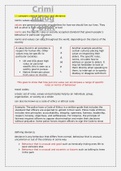
values are general principles or guidelines for how we should live our lives. They
tell us what is right or wrong, good, or bad
norms are the specific rules or socially accepted standard that govern people’s
2
behaviour in particular situations
norms and values can vary throughout the world, depending on the stance of the
country
A value found in all societies is E Another example would be
respect for human life. Other certain cultures placing high
values may be specific to X value on respecting their
particular societies: elders. The specific rules,
A
norms, circulate how to
UK and USA place high
M address or speak to alders. It
value on personal
may be forbidden to look at
wealth; this is seen as a P them directly when speaking to
worthy goal to pursue.
them, to interrupt or to openly
Native Americans place L
disobey or disagree with them
high value on sharing
This goes to show that how just one value can encompass a range of specific
rules or norms of behaviour
moral codes;
a basic set of rules, values and principles help by an individual, group,
organisation, or society as a whole
can also be known as a code of ethics or ethical code
Example: The police have a Code of Ethics in a written guide that includes the
standard that officers are expected to uphold in their work. Police Code of Ethics
includes nine principles: accountability, integrity, openness, fairness, leadership,
respect, honesty, objectives, and selflessness. For instance, the principle of
fairness requires officers to oppose discrimination and make their decisions
without prejudice. Some police forces require officers to sign the Code to show
their commitment to the principles
defining deviance;
deviance is any behaviour that differs from normal, behaviour that is unusual,
uncommon or out of the ordinary in some way
Behaviour that is unusual and good such as heroically risking ones life to
save someone else
Behaviour that is unusual and eccentric or bizarre such as talking to trees
in the park
, Behaviour that is unusual and bad or disapproved of such as physically
attacking someone for no reasons or standing up in class and throwing a
chair at
Remember! the teacher
Although all of these definitions of deviance are valid, it is the last one
that is the most relevant to criminologists. This type involves breaking a rule or
norm of some kind
Remember! Societies have many different rules and therefore deviance, which
involves breaking the rules, can take many different forms. Things that take place
theorists;
walter reckless said that people robert k. merton argued that albert cohen argues it is the
have two types of controls that crime and deviance is caused by education system that
stop them being deviant: inter relationship between: socialises children and labels
those who do not achieve as
internal controls: the cultural goals set by high as others
religious values, society, wealth, status
conscience, morality, power they may feel status
societal values, and the chances and means frustration and try to achieve
integrity of achieving such goals status elsewhere through an
external controls: law, alternative subculture
friends, family, school,
howard becker says it that is society who labels people
deviant
formal and informal sanctions against deviance;
deviance that is disapproved of is likely to lead to negative sanctions of
punishment. Sanctions can be formal and informal
formal: imposed by official bodies such as the Police, courts, schools and
other institutions. They are punishments for breaking written rules or laws eg,
courts may fine an offender for theft
informal: used when the rules are not formally written down or unspoken eg
being told off
positive sanctions: rewarding behaviour that society approves of eg medals
for bravery or for sporting achievement
social control: all of the above sanctions are forms of social control, ways in
which society seeks to control out behaviour and ensure that we conform to
its norms and behave as others expect us to
defining criminal behaviour, legal:
criminal behaviour is any act or action that is forbidden by criminals. For a
court to consider a defendant’s actions to be a crime, the action must
normally have two elements:
actus reus: guilty act
mens rea: guilty mind
, the defendant must have done something that the law forbids AND they must
have done so with bad intentions. There are two important expectations to
this principle:
strict liability, in some cases mens rea is not required and a conviction can be
made through the wrongful act being committed. Many health and safety
laws operate on this basis; A factory owner who is negligent and fails to
safeguard dangerous machinery is liable for the injuries to workers resulting
from this, even if the owner had no intention to harm them. However, most
strict liability offences are ‘regulatory’ offences meaning they aim at
regulating how businesses behave. Other examples include speeding or
watching TV without a license. These are offences, even if you intend on
doing nothing wrong
self defence, if an act is done in self defence it is not a crime as long as the
force used was reasonable in the situation
social definition of criminal behaviour;
we know what crime is in terms of the law, however not all harmful acts are in
fact criminal. Even though pollution harms the environment, companies and
factories are still allowed to emit (legally) a certain amount with no
consequence. Therefore, it is important to understand the definition of
criminal behaviour by considering how it is seen socially…
law enforcement, not all criminal laws are enforced, it all depends on police
prioritisation
law making, which actions get officially made illegal often depends on who
has the power to influence the laws makers, such as media, celebrities,
campaigning pressure groups or a big business. Sometimes laws are changed
to reflect changes in public opinion, with some actions being decriminalised
and others, previously legal ones being redefined as crimes
acts that are criminal;
seriousness of the offence Subject matter of the
in the UK, the law distinguishes between two some main categories of indicatable offences:
offence
main types of offence:
violence against the person, murder,
Summary offences, less serious manslaughter
offences, such as speeding. They are
tried by magistrates sexual offences, rape, sex trafficking,
indictable offences, more serious grooming
offences such as rape or murder. They offences against property, theft, burglary
are tried in a Crown Court before a
judge or jury. The sentences are more fraud and forgery, fraud by company directors
severe
criminal damage, arson
, formal sanctions against criminals, court;
custodial sentences community sentences
Serious offences can be punished with these are served in the community rather
custodial sentences: imprisonment, or than jail. They include probation orders,
detention in a young offender’s restrictions such as curfews, attendance on
institution anger management courses, mandatory drug
Prisoners serving life sentences are testing and treatment orders, and unpaid
usually eligible to apply for parole work such as cleaning graffiti, picking up
after about fifteen years, though rubbish
courts can impose a longer minimum
sentence in more serious cases fines, you may have to pay a financial
courts can impose intermediate penalty. The size of the fine depends
sentences, ones with no specific on the seriousness of the offence,
release date, if the offender is a whether it is a repeat offence and the
danger to the public. In these cases, offender’s ability to pay. This can be
the parole board decides if and when paid in instalments
the prisoner is fit to be released discharge, a conditional discharge
involves the offender committing no
further offences for a given period. If
they commit an offence, the court can
impose a sentence for the original
offence and the new one. A
unconditional or absolute discharge
formal sanctions against criminals, police
in the case of minor offences, the police can sanction offenders without going to
court, by issuing a caution or penalty notices
cautions: warnings that can be given by the police or CPS to anyone aged ten or
over for minor crimes such as graffiti. They intend for low-level, first-time
offending. You must admit to the offence and agree to be cautioned
conditional cautions: this means you must stick to certain rules and restrictions,
such as going for treatment for drug abuse. If you break the conditions, you
could be charged with a crime
penalty notices for disorder: these can be issued for minor crimes such as
shoplifting or possession of cannabis. You won’t get a conviction if you pay the
penalty. If you disagree with the penalty notice, you can go to trial instead
implications of committing a criminal act
as well as the punishment imposed by the court, the offender will also receive a
criminal record. Depending on the offence and the court’s sentence, there may
also be other implications
exclusion from occupations eg working with young people
placed on the Violent and Sex Offenders Register (ViSOR)
banned from travelling to certain countries or require special visas
restrictions of adoption, jury service and standing for elected office
may have to declare unspent convictions when obtaining insurance
nolog
1.1 compare criminal behaviour and deviance:
norms values and morals;
y Unit
values are general principles or guidelines for how we should live our lives. They
tell us what is right or wrong, good, or bad
norms are the specific rules or socially accepted standard that govern people’s
2
behaviour in particular situations
norms and values can vary throughout the world, depending on the stance of the
country
A value found in all societies is E Another example would be
respect for human life. Other certain cultures placing high
values may be specific to X value on respecting their
particular societies: elders. The specific rules,
A
norms, circulate how to
UK and USA place high
M address or speak to alders. It
value on personal
may be forbidden to look at
wealth; this is seen as a P them directly when speaking to
worthy goal to pursue.
them, to interrupt or to openly
Native Americans place L
disobey or disagree with them
high value on sharing
This goes to show that how just one value can encompass a range of specific
rules or norms of behaviour
moral codes;
a basic set of rules, values and principles help by an individual, group,
organisation, or society as a whole
can also be known as a code of ethics or ethical code
Example: The police have a Code of Ethics in a written guide that includes the
standard that officers are expected to uphold in their work. Police Code of Ethics
includes nine principles: accountability, integrity, openness, fairness, leadership,
respect, honesty, objectives, and selflessness. For instance, the principle of
fairness requires officers to oppose discrimination and make their decisions
without prejudice. Some police forces require officers to sign the Code to show
their commitment to the principles
defining deviance;
deviance is any behaviour that differs from normal, behaviour that is unusual,
uncommon or out of the ordinary in some way
Behaviour that is unusual and good such as heroically risking ones life to
save someone else
Behaviour that is unusual and eccentric or bizarre such as talking to trees
in the park
, Behaviour that is unusual and bad or disapproved of such as physically
attacking someone for no reasons or standing up in class and throwing a
chair at
Remember! the teacher
Although all of these definitions of deviance are valid, it is the last one
that is the most relevant to criminologists. This type involves breaking a rule or
norm of some kind
Remember! Societies have many different rules and therefore deviance, which
involves breaking the rules, can take many different forms. Things that take place
theorists;
walter reckless said that people robert k. merton argued that albert cohen argues it is the
have two types of controls that crime and deviance is caused by education system that
stop them being deviant: inter relationship between: socialises children and labels
those who do not achieve as
internal controls: the cultural goals set by high as others
religious values, society, wealth, status
conscience, morality, power they may feel status
societal values, and the chances and means frustration and try to achieve
integrity of achieving such goals status elsewhere through an
external controls: law, alternative subculture
friends, family, school,
howard becker says it that is society who labels people
deviant
formal and informal sanctions against deviance;
deviance that is disapproved of is likely to lead to negative sanctions of
punishment. Sanctions can be formal and informal
formal: imposed by official bodies such as the Police, courts, schools and
other institutions. They are punishments for breaking written rules or laws eg,
courts may fine an offender for theft
informal: used when the rules are not formally written down or unspoken eg
being told off
positive sanctions: rewarding behaviour that society approves of eg medals
for bravery or for sporting achievement
social control: all of the above sanctions are forms of social control, ways in
which society seeks to control out behaviour and ensure that we conform to
its norms and behave as others expect us to
defining criminal behaviour, legal:
criminal behaviour is any act or action that is forbidden by criminals. For a
court to consider a defendant’s actions to be a crime, the action must
normally have two elements:
actus reus: guilty act
mens rea: guilty mind
, the defendant must have done something that the law forbids AND they must
have done so with bad intentions. There are two important expectations to
this principle:
strict liability, in some cases mens rea is not required and a conviction can be
made through the wrongful act being committed. Many health and safety
laws operate on this basis; A factory owner who is negligent and fails to
safeguard dangerous machinery is liable for the injuries to workers resulting
from this, even if the owner had no intention to harm them. However, most
strict liability offences are ‘regulatory’ offences meaning they aim at
regulating how businesses behave. Other examples include speeding or
watching TV without a license. These are offences, even if you intend on
doing nothing wrong
self defence, if an act is done in self defence it is not a crime as long as the
force used was reasonable in the situation
social definition of criminal behaviour;
we know what crime is in terms of the law, however not all harmful acts are in
fact criminal. Even though pollution harms the environment, companies and
factories are still allowed to emit (legally) a certain amount with no
consequence. Therefore, it is important to understand the definition of
criminal behaviour by considering how it is seen socially…
law enforcement, not all criminal laws are enforced, it all depends on police
prioritisation
law making, which actions get officially made illegal often depends on who
has the power to influence the laws makers, such as media, celebrities,
campaigning pressure groups or a big business. Sometimes laws are changed
to reflect changes in public opinion, with some actions being decriminalised
and others, previously legal ones being redefined as crimes
acts that are criminal;
seriousness of the offence Subject matter of the
in the UK, the law distinguishes between two some main categories of indicatable offences:
offence
main types of offence:
violence against the person, murder,
Summary offences, less serious manslaughter
offences, such as speeding. They are
tried by magistrates sexual offences, rape, sex trafficking,
indictable offences, more serious grooming
offences such as rape or murder. They offences against property, theft, burglary
are tried in a Crown Court before a
judge or jury. The sentences are more fraud and forgery, fraud by company directors
severe
criminal damage, arson
, formal sanctions against criminals, court;
custodial sentences community sentences
Serious offences can be punished with these are served in the community rather
custodial sentences: imprisonment, or than jail. They include probation orders,
detention in a young offender’s restrictions such as curfews, attendance on
institution anger management courses, mandatory drug
Prisoners serving life sentences are testing and treatment orders, and unpaid
usually eligible to apply for parole work such as cleaning graffiti, picking up
after about fifteen years, though rubbish
courts can impose a longer minimum
sentence in more serious cases fines, you may have to pay a financial
courts can impose intermediate penalty. The size of the fine depends
sentences, ones with no specific on the seriousness of the offence,
release date, if the offender is a whether it is a repeat offence and the
danger to the public. In these cases, offender’s ability to pay. This can be
the parole board decides if and when paid in instalments
the prisoner is fit to be released discharge, a conditional discharge
involves the offender committing no
further offences for a given period. If
they commit an offence, the court can
impose a sentence for the original
offence and the new one. A
unconditional or absolute discharge
formal sanctions against criminals, police
in the case of minor offences, the police can sanction offenders without going to
court, by issuing a caution or penalty notices
cautions: warnings that can be given by the police or CPS to anyone aged ten or
over for minor crimes such as graffiti. They intend for low-level, first-time
offending. You must admit to the offence and agree to be cautioned
conditional cautions: this means you must stick to certain rules and restrictions,
such as going for treatment for drug abuse. If you break the conditions, you
could be charged with a crime
penalty notices for disorder: these can be issued for minor crimes such as
shoplifting or possession of cannabis. You won’t get a conviction if you pay the
penalty. If you disagree with the penalty notice, you can go to trial instead
implications of committing a criminal act
as well as the punishment imposed by the court, the offender will also receive a
criminal record. Depending on the offence and the court’s sentence, there may
also be other implications
exclusion from occupations eg working with young people
placed on the Violent and Sex Offenders Register (ViSOR)
banned from travelling to certain countries or require special visas
restrictions of adoption, jury service and standing for elected office
may have to declare unspent convictions when obtaining insurance