STRUCTURE AND BONDING SUMMARY
Atoms can Chemically bond in 3 different ways;
IONIC
found in compounds between metals and non-metals.
Attractions between oppositely charged ions.
COVALENT
found in compounds between non-metals.
involves 2 or more atoms sharing 1 or more pairs of electrons.
METALLIC
found in compounds between metals (and their alloys)
involves attraction between positive metal ions and sea of delocalised electrons
IONS
Ions are particles with a charge, which are created when an atom or molecule gains or loses
electrons.
- Gaining electrons = negative ion (anion)
- Losing electrons = positive ion (cation)
IONIC BONDING
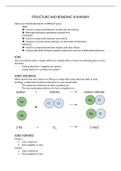
When atoms form ions, they try to fill up or empty their outer electron shell. In ionic
bonding, a metal atom transfers electrons to a non-metal atom.
- The metal loses electrons to form a positive ion.
- The non-metal gains electrons to form a negative ion.
IONS FORMED
Group 1
Lose 1 electron
Form positive 1+ ions
Group 2
Lose 2 electrons
Form positive 2+ ions
, Group 6
Gain 2 electrons
Form negative -2 ions
Group 7
Gain 1 electron
Form negative -1 ions
Noble gases
Already have a full outer electron shell
Are unreactive and don’t normally form ionic bonds
IONIC COMPOUNDS
Ionic compounds form when millions of metal atoms transfer their outer electrons to
millions of non-metal atoms transfer their outer electrons to millions of non-metal atoms at
the same time. The resulting oppositely charged ions are held together in ionic lattices.
IONIC LATTICE – a giant structure held together by strong electrostatic forces between the
positive and negative ions. The electrostatic forces are called ionic bonds and they exist in
all directions.
PROPERTIES
High melting and boiling points
- To break ionic bonds, lots of energy is required to overcome the electrostatic forces
between the ions in the lattice
Does not conduct when solid
- In the solid state, ions are held in fixed positions in the lattice so charge cannot flow,
and electricity is not conducted.
Conducts when liquid
- When molten or dissolved in water, the ions in the lattice can move freely so charge
can flow and electricity can be conducted.
COVALENT BONDING
Covalent bonds are formed when 2 non-metal atoms share a pair of electrons (or multiple
pairs). They are strong because the shared electrons are attracted to the nucleus of both
atoms. Covalently bonded substances can be;
- Small molecules e.g. water
- Large molecules e.g. polymers
- Giant covalent structures e.g. diamonds
REPRESENTING COVALENT BONDS
(1) Dot-and-cross
The dot represents the outer electrons of one element while the crosses represent
the outer electrons of the other.
A limitation is that it shows electrons as being different when they are, in fact, the
same.
(2) Ball-and-stick
The balls represent the atoms and the sticks represent the bonds.
Atoms can Chemically bond in 3 different ways;
IONIC
found in compounds between metals and non-metals.
Attractions between oppositely charged ions.
COVALENT
found in compounds between non-metals.
involves 2 or more atoms sharing 1 or more pairs of electrons.
METALLIC
found in compounds between metals (and their alloys)
involves attraction between positive metal ions and sea of delocalised electrons
IONS
Ions are particles with a charge, which are created when an atom or molecule gains or loses
electrons.
- Gaining electrons = negative ion (anion)
- Losing electrons = positive ion (cation)
IONIC BONDING
When atoms form ions, they try to fill up or empty their outer electron shell. In ionic
bonding, a metal atom transfers electrons to a non-metal atom.
- The metal loses electrons to form a positive ion.
- The non-metal gains electrons to form a negative ion.
IONS FORMED
Group 1
Lose 1 electron
Form positive 1+ ions
Group 2
Lose 2 electrons
Form positive 2+ ions
, Group 6
Gain 2 electrons
Form negative -2 ions
Group 7
Gain 1 electron
Form negative -1 ions
Noble gases
Already have a full outer electron shell
Are unreactive and don’t normally form ionic bonds
IONIC COMPOUNDS
Ionic compounds form when millions of metal atoms transfer their outer electrons to
millions of non-metal atoms transfer their outer electrons to millions of non-metal atoms at
the same time. The resulting oppositely charged ions are held together in ionic lattices.
IONIC LATTICE – a giant structure held together by strong electrostatic forces between the
positive and negative ions. The electrostatic forces are called ionic bonds and they exist in
all directions.
PROPERTIES
High melting and boiling points
- To break ionic bonds, lots of energy is required to overcome the electrostatic forces
between the ions in the lattice
Does not conduct when solid
- In the solid state, ions are held in fixed positions in the lattice so charge cannot flow,
and electricity is not conducted.
Conducts when liquid
- When molten or dissolved in water, the ions in the lattice can move freely so charge
can flow and electricity can be conducted.
COVALENT BONDING
Covalent bonds are formed when 2 non-metal atoms share a pair of electrons (or multiple
pairs). They are strong because the shared electrons are attracted to the nucleus of both
atoms. Covalently bonded substances can be;
- Small molecules e.g. water
- Large molecules e.g. polymers
- Giant covalent structures e.g. diamonds
REPRESENTING COVALENT BONDS
(1) Dot-and-cross
The dot represents the outer electrons of one element while the crosses represent
the outer electrons of the other.
A limitation is that it shows electrons as being different when they are, in fact, the
same.
(2) Ball-and-stick
The balls represent the atoms and the sticks represent the bonds.