What is it?
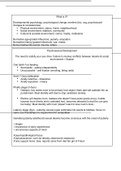
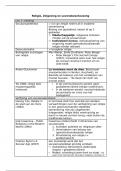
Developmental psychology: psychological change overtime (bio, cog, psychosocial
changes & consistencies)
Physical environment: uterus, home, neighbourhood
Social environment: relations, community
Cultural & societal environment: norms, media, institutions
Normative age-graded influences: puberty, education
Normative history-graded influences: war, media
Nonnormative life events: trauma, lottery
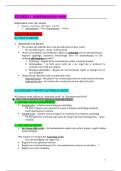
Psychosexual Development
The need to satisfy your sex drive. Failure to resolve conflicts between desires & social
environment = fixation
Oral (birth-1yr) feeding
Successful - eating independently
Unsuccessful - oral fixation (smoking, biting nails)
Anal (1-3yrs) defecation
Anally retentive - obsessive
Anally expulsive - messy
Phallic stage (3-5yrs)
Oedipus: boy wants mum to be primary love object, fears dad will castrate him as
punishment. Must identify with dad to stop castration anxiety.
Electra: girl desires mum, realises she doesn't have penis (penis envy), hostile
towards mum (thinks she's castrated her), becomes attracted to dad (he can give
her baby). Must identify with mum (doesn't want to lose mum's love)
Latency stage (6yrs - puberty) sexual urges sublimate into sports & hobbies, focus on
same-sex friendships no requirement for competition
Genetial (puberty-adulthood) sexual desires become conscious with the onset of puberty
✓stages
✓importance of early experiences
✓unconscious aspects of mind
✗psychopathological focus
✗pseudoscience: can’t be directly observed & measured
✗only support Hans: bias, reports came from dad fan girl of Freud
,f
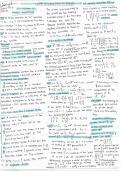
, Erikson’s Theory of Psychosocial Development Behaviourism
Havighurst’s Developmental Tasks
In each6.of Culture
the 8 stages,
& Context:
you experience
culture = beliefs,
a customs
Born&asbehaviours
blank slates of aandparticular
all behaviour
societyis//
psychosocial
At dif
context:
crisis
periods
whichcultural
in your
could determines
life,
havedevelopmental
+ve context,
or -ve multiple
task arises
learnt
systems
– through
successful
that social
influence
achievement
consequences
each other
= happiness &
outcome for personality development success (involves
with later tasks // failurepresented
= disapproval in environment.
& sad
psych need conflicting
Ecological with the
System
needs Theory:
of society)
Infancy o &individual
early childhood
(genes)[0-6]: learning Rewarding
to walk behaviour develops through
Matthew principle:
Middleif things
o childhood
go well [6-13]:
in earlier
microsystem (relations) developing
stage fundamental
maximising
skills: rewards
reading,&writing
minimising
in life, morelikely willo goMesosystem
Adolescence well[13-18]:
in later (interactions
life as wellmasculine/feminine
achieving between systems), punishment
social role
Earlyoadulthood [19-30]: starting
Exosystem (policies, services), a family
1. Trust vs. Mistrust:
Middle infants
age learn tosatisfactory
[30-60]:
o Macrosystem trust
(culture, career✓methodology
othersnorms), achievement
to care for basic
Laterneeds.
maturity [60+]: adjusting
o Chronosystem (life course) to ✓learning
decreasing strength
theory & health
(conditioning)
✓objective measures
2. Autonomy vs Shame & Doubt: learn to
✓7.stages
Differential Development: individual differences in sensitivity, resilience to adversity. Smal
exercise willcourse
✓ life & control themselves or they ✗no cog
associations between childhood & adulthood psych traits, measures appropriate for
doubt ✓they can do thingsmilestones
developmental by themselves ✗inadequate attention to developmental
children often not appropriate for adults.
change
3. Initiative vs guilt: if they don’t assert control
Equifinality: same outcome has different causes
over environment, feel guilty for attempts of Other Theories
Multifinality: same cause leads to different Piaget’soutcomes
Theory of Cog Development
independence
Evolutionary: how behaviour contributes to survival of species, how our past influences
We adapt to our environment through
development
4. Industry vs Inferiority: learn to be competent
assimilation & accommodation of
Social or
at valued activities learning
feel inferior
Information processing: cognitive development, basic schemata. Kids have an innate motivation
cog processes
to learn, they’re ‘little scientists’
5. Identity vs RoleSystems:
Confusion: envision development
establish personalin terms of complex wholes made up of parts, how
identity withinthese
socialpartsgroup interact with each other & change overtime (ecological systems theory by
[birth-2] Sensorimotor: differentiate
Bronfenbrenner)
themselves from world, deliberately
6. Intimacy vs isolation: young adults form
interact with it
intimate loving relationships Central Issues
[2-6] Preoperational: represent reality via
7. Generativity vs Stagnation:
1. Nature vs. Nurture adults must be
symbols, can’t distinguish POV, confused
productive in work & raise next gen or risk
about causal relations
stagnation
2. Plasticity in Development: ability to develop in a variety of ways in order to adapt to a
specific environment [6-12] Concrete Operational: mental
8. Integrity vs Despair:
o Critical make sense
period: of prior
period beyond whichoperations
a phenomenon will not appearorder
(abrupt)
(combine, separate
experience &oassure themselves life has been
Sensitive period: period of maximalobjects/actions),
sensitivity (gradual)focus on real & concrete
meaningful
[12-19] Formal Operational: think
✓ life course
3. Continuity vs. Discontinuity: small continuous changes about
vs abrupt transformations
systematically all logical relations
✓ considers cultural aspects
within problem, abstract reasoning
✓ +ve psych
✓ psychosocial aspects
✓childhood important for development
4. Active or Passive Development: OLD, parents' contribution most
✓cog developmental important factor. NOW,
milestones
✗ evidence kids actively shape their developmental context (bidirectional)
✗ stages may be less discrete
✗individual variation
Developmental psychology: psychological change overtime (bio, cog, psychosocial
changes & consistencies)
Physical environment: uterus, home, neighbourhood
Social environment: relations, community
Cultural & societal environment: norms, media, institutions
Normative age-graded influences: puberty, education
Normative history-graded influences: war, media
Nonnormative life events: trauma, lottery
Psychosexual Development
The need to satisfy your sex drive. Failure to resolve conflicts between desires & social
environment = fixation
Oral (birth-1yr) feeding
Successful - eating independently
Unsuccessful - oral fixation (smoking, biting nails)
Anal (1-3yrs) defecation
Anally retentive - obsessive
Anally expulsive - messy
Phallic stage (3-5yrs)
Oedipus: boy wants mum to be primary love object, fears dad will castrate him as
punishment. Must identify with dad to stop castration anxiety.
Electra: girl desires mum, realises she doesn't have penis (penis envy), hostile
towards mum (thinks she's castrated her), becomes attracted to dad (he can give
her baby). Must identify with mum (doesn't want to lose mum's love)
Latency stage (6yrs - puberty) sexual urges sublimate into sports & hobbies, focus on
same-sex friendships no requirement for competition
Genetial (puberty-adulthood) sexual desires become conscious with the onset of puberty
✓stages
✓importance of early experiences
✓unconscious aspects of mind
✗psychopathological focus
✗pseudoscience: can’t be directly observed & measured
✗only support Hans: bias, reports came from dad fan girl of Freud
,f
, Erikson’s Theory of Psychosocial Development Behaviourism
Havighurst’s Developmental Tasks
In each6.of Culture
the 8 stages,
& Context:
you experience
culture = beliefs,
a customs
Born&asbehaviours
blank slates of aandparticular
all behaviour
societyis//
psychosocial
At dif
context:
crisis
periods
whichcultural
in your
could determines
life,
havedevelopmental
+ve context,
or -ve multiple
task arises
learnt
systems
– through
successful
that social
influence
achievement
consequences
each other
= happiness &
outcome for personality development success (involves
with later tasks // failurepresented
= disapproval in environment.
& sad
psych need conflicting
Ecological with the
System
needs Theory:
of society)
Infancy o &individual
early childhood
(genes)[0-6]: learning Rewarding
to walk behaviour develops through
Matthew principle:
Middleif things
o childhood
go well [6-13]:
in earlier
microsystem (relations) developing
stage fundamental
maximising
skills: rewards
reading,&writing
minimising
in life, morelikely willo goMesosystem
Adolescence well[13-18]:
in later (interactions
life as wellmasculine/feminine
achieving between systems), punishment
social role
Earlyoadulthood [19-30]: starting
Exosystem (policies, services), a family
1. Trust vs. Mistrust:
Middle infants
age learn tosatisfactory
[30-60]:
o Macrosystem trust
(culture, career✓methodology
othersnorms), achievement
to care for basic
Laterneeds.
maturity [60+]: adjusting
o Chronosystem (life course) to ✓learning
decreasing strength
theory & health
(conditioning)
✓objective measures
2. Autonomy vs Shame & Doubt: learn to
✓7.stages
Differential Development: individual differences in sensitivity, resilience to adversity. Smal
exercise willcourse
✓ life & control themselves or they ✗no cog
associations between childhood & adulthood psych traits, measures appropriate for
doubt ✓they can do thingsmilestones
developmental by themselves ✗inadequate attention to developmental
children often not appropriate for adults.
change
3. Initiative vs guilt: if they don’t assert control
Equifinality: same outcome has different causes
over environment, feel guilty for attempts of Other Theories
Multifinality: same cause leads to different Piaget’soutcomes
Theory of Cog Development
independence
Evolutionary: how behaviour contributes to survival of species, how our past influences
We adapt to our environment through
development
4. Industry vs Inferiority: learn to be competent
assimilation & accommodation of
Social or
at valued activities learning
feel inferior
Information processing: cognitive development, basic schemata. Kids have an innate motivation
cog processes
to learn, they’re ‘little scientists’
5. Identity vs RoleSystems:
Confusion: envision development
establish personalin terms of complex wholes made up of parts, how
identity withinthese
socialpartsgroup interact with each other & change overtime (ecological systems theory by
[birth-2] Sensorimotor: differentiate
Bronfenbrenner)
themselves from world, deliberately
6. Intimacy vs isolation: young adults form
interact with it
intimate loving relationships Central Issues
[2-6] Preoperational: represent reality via
7. Generativity vs Stagnation:
1. Nature vs. Nurture adults must be
symbols, can’t distinguish POV, confused
productive in work & raise next gen or risk
about causal relations
stagnation
2. Plasticity in Development: ability to develop in a variety of ways in order to adapt to a
specific environment [6-12] Concrete Operational: mental
8. Integrity vs Despair:
o Critical make sense
period: of prior
period beyond whichoperations
a phenomenon will not appearorder
(abrupt)
(combine, separate
experience &oassure themselves life has been
Sensitive period: period of maximalobjects/actions),
sensitivity (gradual)focus on real & concrete
meaningful
[12-19] Formal Operational: think
✓ life course
3. Continuity vs. Discontinuity: small continuous changes about
vs abrupt transformations
systematically all logical relations
✓ considers cultural aspects
within problem, abstract reasoning
✓ +ve psych
✓ psychosocial aspects
✓childhood important for development
4. Active or Passive Development: OLD, parents' contribution most
✓cog developmental important factor. NOW,
milestones
✗ evidence kids actively shape their developmental context (bidirectional)
✗ stages may be less discrete
✗individual variation