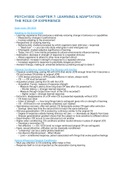
PSYCH1000: CHAPTER 7: LEARNING & ADAPTATION:
THE ROLE OF EXPERIENCE
Exam room: 3M 3250
Adapting to the Environment
• Learning: experience that produces a relatively enduring change in behaviour or capabilities
• Measured by changes in performance
• Involves adapting to the environment
• Perspectives on studying learning
• Behaviourists: studied processes by which organisms learn (stimulus + response)
• “black box” —> you can only study what goes in and what goes out
• Ethologists: studied adaptive significance of learning
• Today: mix of 2, how mental processes & cultural environments influence learning
• Habituation: decrease in strength of response to a repeated stimulus
• Allows organisms to attend to other more important stimuli
• Sensitization: increase in strength of response to a repeated stimulus
• Increases organism’s response to potentially dangerous stimuli
• Aversion therapy: making an unwanted behaviour punishing enough to deter it
Classical Conditioning: Associating One Stimulus with Another
• Classical conditioning: pairing NS with UCS (that elicits UCR) enough times that it becomes a
CS and evokes CR (similar to original UCR)
• UCS always produces a UCR (usually reflexive in nature, always work)
• CS —> CR must be learned
• Acquisition phase: pairing the CS with the UCS
• Acquisition Curves: measure of response strength
• Measure through Latency (how long does CR take after CS presented?)
• Shorter latency = stronger learned response
• Measure through Output (how much of the CR is recorded?)
• Higher output = stronger learned response
• Extinction: disappearance of a CR when CS is presented repeatedly without UCS
• CS loses cue value
• Index of strength —> how long things take to extinguish gives info on strength of learning
• CS - UCS bond is not completely unlearned, just masked
• Spontaneous recovery: after rest period, CS temporarily evokes CR again after extinction
• Savings: takes less time the second time to teach the same behaviour
• Stimulus generalization: CR is evoked by a stimulus similar to the original CS
• Degree of response outside training stimulus not zero —> decreases as departs from base
• Sharper generalization gradient shows that the subject is more sensitive to different stimuli
• Discrimination: CR occurs to one stimulus but not another
• Higher order conditioning: CS conditions another neutral stimulus in place of original UCS
• Develops a secondary CS
• Not effective —> CS / UCS bond no longer reinforced (original CR can extinguish)
• Fears, sexual attraction, attitudes can be classically conditioned
• “unlearning” can be a useful phobia treatment
• Don Byrne’s Reinforcement - Affect Model
• Love = conditioned response, person associated with things that evoke positive feelings
Factors Influencing Classical Conditioning
• Must pay attention to CS (orienting reflex helps w this)
• Response itself is not as important as the association during learning
THE ROLE OF EXPERIENCE
Exam room: 3M 3250
Adapting to the Environment
• Learning: experience that produces a relatively enduring change in behaviour or capabilities
• Measured by changes in performance
• Involves adapting to the environment
• Perspectives on studying learning
• Behaviourists: studied processes by which organisms learn (stimulus + response)
• “black box” —> you can only study what goes in and what goes out
• Ethologists: studied adaptive significance of learning
• Today: mix of 2, how mental processes & cultural environments influence learning
• Habituation: decrease in strength of response to a repeated stimulus
• Allows organisms to attend to other more important stimuli
• Sensitization: increase in strength of response to a repeated stimulus
• Increases organism’s response to potentially dangerous stimuli
• Aversion therapy: making an unwanted behaviour punishing enough to deter it
Classical Conditioning: Associating One Stimulus with Another
• Classical conditioning: pairing NS with UCS (that elicits UCR) enough times that it becomes a
CS and evokes CR (similar to original UCR)
• UCS always produces a UCR (usually reflexive in nature, always work)
• CS —> CR must be learned
• Acquisition phase: pairing the CS with the UCS
• Acquisition Curves: measure of response strength
• Measure through Latency (how long does CR take after CS presented?)
• Shorter latency = stronger learned response
• Measure through Output (how much of the CR is recorded?)
• Higher output = stronger learned response
• Extinction: disappearance of a CR when CS is presented repeatedly without UCS
• CS loses cue value
• Index of strength —> how long things take to extinguish gives info on strength of learning
• CS - UCS bond is not completely unlearned, just masked
• Spontaneous recovery: after rest period, CS temporarily evokes CR again after extinction
• Savings: takes less time the second time to teach the same behaviour
• Stimulus generalization: CR is evoked by a stimulus similar to the original CS
• Degree of response outside training stimulus not zero —> decreases as departs from base
• Sharper generalization gradient shows that the subject is more sensitive to different stimuli
• Discrimination: CR occurs to one stimulus but not another
• Higher order conditioning: CS conditions another neutral stimulus in place of original UCS
• Develops a secondary CS
• Not effective —> CS / UCS bond no longer reinforced (original CR can extinguish)
• Fears, sexual attraction, attitudes can be classically conditioned
• “unlearning” can be a useful phobia treatment
• Don Byrne’s Reinforcement - Affect Model
• Love = conditioned response, person associated with things that evoke positive feelings
Factors Influencing Classical Conditioning
• Must pay attention to CS (orienting reflex helps w this)
• Response itself is not as important as the association during learning