PROBLEM 5. PANIC DISORDER 1
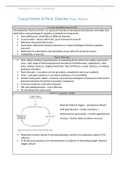
Causal Model of Panic Disorder (Fava, Morton)
Causal modeling framework
Developed by /Morton & Firth > to represent theories of developmental disorder and make clear
distinctions among biological, cognitive & behavioral components
Show differences, similarities of different theories
Causal model = theory within the causal framework network
Elements connected with arrows
Equivalents: effectively identical elements to a theory (biological element-cognitive
element)
Distinction bt antecedents and immediate causes (distal VS proximal causes)
Falsifiability of theories
Panic Disorder
Panic attack: feeling of apprehension or impending doom which has sudden onset and is
assoc. with range of distressing physical sensations (breathlessness, palpitations, chest
pain, choking, dizziness, tingling hands/feet, hot/cold flushes, sweat, faintness, trembling,
feeling of unreality)
Panic disorder > sensations are not provoked, unexplained and occur suddenly.
Panic > principal symptom or secondary (evidence of co-morbidity)
Anxiety during panic attack > physical, social and psychological consequences that extend
beyond immediate discomfort (secondary symptoms)
Common symptoms with other disorders
CBT and antidepressants > more effective
PD not always the same cause
Clark’s Cognitive Model
Internal/ External trigger > perceived as threat >
mild apprehension > bodily sensations >
interpreted as catastrophic > further apprehension
increase > further body sensations increase.
Distinction of panic attacks in normal population and the recurring panic attacks in PD
sufferers.
In PD physical symptoms are misinterpreted as evidence of impending danger (internal
trigger stimuli)
, PROBLEM 5. PANIC DISORDER 2
Antecedent: learned threat from
previously occurring critical event
External or internal trigger > small
variation in bodily sensations
(threshold of bodily sensation- panic
attack trigger)
Composite Cognitive Model
Three antecedents: high anxiety sensitivity (AS), learned threat, lower self-efficacy
AS: genetic predisposition +
attachment problems
Learned threat: critical event
Low self-efficacy: attachment
problems
Internal trigger (low self-efficacy,
high arousal)
External trigger (combined with
learned threat)
Cycle operating without
catastrophic interpretations
Constructs valid?
Related with each other?
Distinct or dimensions of PD?
Relationship between high AS and
low self-efficacy
Causal Model of Panic Disorder (Fava, Morton)
Causal modeling framework
Developed by /Morton & Firth > to represent theories of developmental disorder and make clear
distinctions among biological, cognitive & behavioral components
Show differences, similarities of different theories
Causal model = theory within the causal framework network
Elements connected with arrows
Equivalents: effectively identical elements to a theory (biological element-cognitive
element)
Distinction bt antecedents and immediate causes (distal VS proximal causes)
Falsifiability of theories
Panic Disorder
Panic attack: feeling of apprehension or impending doom which has sudden onset and is
assoc. with range of distressing physical sensations (breathlessness, palpitations, chest
pain, choking, dizziness, tingling hands/feet, hot/cold flushes, sweat, faintness, trembling,
feeling of unreality)
Panic disorder > sensations are not provoked, unexplained and occur suddenly.
Panic > principal symptom or secondary (evidence of co-morbidity)
Anxiety during panic attack > physical, social and psychological consequences that extend
beyond immediate discomfort (secondary symptoms)
Common symptoms with other disorders
CBT and antidepressants > more effective
PD not always the same cause
Clark’s Cognitive Model
Internal/ External trigger > perceived as threat >
mild apprehension > bodily sensations >
interpreted as catastrophic > further apprehension
increase > further body sensations increase.
Distinction of panic attacks in normal population and the recurring panic attacks in PD
sufferers.
In PD physical symptoms are misinterpreted as evidence of impending danger (internal
trigger stimuli)
, PROBLEM 5. PANIC DISORDER 2
Antecedent: learned threat from
previously occurring critical event
External or internal trigger > small
variation in bodily sensations
(threshold of bodily sensation- panic
attack trigger)
Composite Cognitive Model
Three antecedents: high anxiety sensitivity (AS), learned threat, lower self-efficacy
AS: genetic predisposition +
attachment problems
Learned threat: critical event
Low self-efficacy: attachment
problems
Internal trigger (low self-efficacy,
high arousal)
External trigger (combined with
learned threat)
Cycle operating without
catastrophic interpretations
Constructs valid?
Related with each other?
Distinct or dimensions of PD?
Relationship between high AS and
low self-efficacy