Evolutionary psychology
- What behaviour increased chances of survival and reproduction?
- What it the function of behaviour?
- Example: why do we show emotion expressions?
Innate
A disgust expression makes your visual field smaller -> you don’t want to perceive it.
Afraid -> bigger visual field -> see al fear/danger
Behavioural genetics
- How large is the influence of genetics (hereditary factors) on behaviour?
- Example: three identical strangers
Neuroscience
- What are the underlying neural mechanisms associated with specific behaviours?
- Example: neural mechanisms associated with gambling addiction
- Unexpected reward causes strong activation of reward system (nucleus accumbens)
- The neurotransmitter dopamine that is released strengthens the association between
environment(slot machine) and behaviour (putting money in)
Development psychology
- Change in behaviour over the course of life
- Example: development of cognitive functions
- Piaget’s (1896-1980) stages of development
Sensorimotor stage
Preoperational stage
Concrete-operational stage
Formal-operational stage
-----------------------------------------
Motivation
Drives:
- Drive = motivational state
- Directed towards an incentive
- Incentive= goal/reward/reinforcer
- Motivation (strong/weak) interacts with incentive (strong/weak)
Homeostasis:
- =Strive to Most optimal internal condition
Body temperature
Oxygen
Minerals
Water
Energy (food)
Sleep
, - Our behaviour is in accordance with the need of bodily tissued
Drives:
- Strive towards balance
- Physical shortage
- Enough is enough
- Regulatory drive (has to do with survival)
Homeostasis
- Nonregulatory drives (not needed for survival)
Safety (bas on emotion : ‘’flight fight’’)
Reproductive (sexual drive, drive to care for offspring)
Social drives (friendship, acceptance and approval)
Educational drives (play and explore)
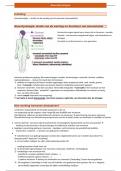
Hub of Central Drive System: Hypothalamus
- Connected to higher brain area’s
- Connected to autonomic nervous system
- Control of release of hormones (connected to pituitary)
- Connected to limbic system
Drive: hunger
- Essential for survival
Growth, repair
- Nutrition
Energy
Proteins
Vitamins, minerals, etc.
- Food scarcity
Robust mechanisms
Strong drive (really hungry > really driven to eat)
- Arcuate nucleus:
Appetite stimulating neurons
Appetite supressing neurons
Feedback control:
- Short term effects of eating:
Elevated blood temperature
Increased glucose in blood stream
Release of hormones : PYY (after 15 minutes)
Acts on arcuate nucleus: activate suppressing neurons and inhibit stimulating
neurons
- Long term effects of eating:
, Fat cells secrete hormone leptin
Acts on arcuate nucleus: activate suppressing neurons and inhibit stimulating
neurons
Drive: sleep
- Safety
- Body restauration
- Memory
- Dreams.. (not clear what function is )
- EG Data
- Different stages of sleep
- 6-8 hours of sleep a night (individual differences)
- Circadian rhythm (+-24 hours)
Brain mechanism of sleep:
- Rhythm generating neurons: sleep-wake rhythm
- Rhythm body temperature (decline in the evening, increase in the morning)
Suprachiasmatic nucleus:
- Controls the circadian rhythm, body temperature
Pineal gland:
- Production of melatonin
Sleep deprivation
- 6-8 hours a night
- Nonsomnia (can easily live with 5 hours of sleep)
Energetic
Positive attitude towards life
- Insomnia (cannot easily live with 5 hours of sleep)
Tired
Worries
----------------------------------
Emotion
What are emotions?
- Phenomenal experience (you have a feeling)
- Physiological pattern (bodily responses)
- Verbal + non verbal behaviour (laughing, fighting, screaming)
How universal?
- Typical expressions are distinct states of the mind, displayed early in life (babies/innate)
- The child could not have observed this > innate
6 basic expressions/emotions:
, - Happiness
- Sadness
- Anger
- Surprise
- Disgust
- Fear
Theories of emotions
1. Bodily responses (James-Lange theory, late 19thyh century)
- If something horrible happens, the first thing that happens is your visual logical responses
react. Then behaviour. And not until later you will have the feeling.
- Perception of event> physiological pattern> verbal + nonverbal expression> phenomenal
experience
- Change in facial expression alters your emotional experience (slightly)
- Substance-induced change in facial expression alters related neural activity.
2. Cognitive approach (Schachter-Singer experiment, 20 th century)
- 2 groups during experiment: informed & not informed
- Injection of epinephrine
- Events elicit emotional arousal
Undifferentiated
Unexplained
- Arousal interpreted by actor
Shaped by current situational context
- Perception of event> arousal/ physiological pattern <> cognition/context/appraisal >
phenomenal experience (emotion)
Emotions and the brain
- Amygdala (you have 2)
- Almond-shaped, bilateral in medial temporal lobe
- Processing of biological relevant stimuli
- Connections with frontal areas, motor areas, visual areas and peripheral nervous system
Removal amygdala:
- Bilateral surgical removal of the anterior parts of temporal lobes
- Lack of emotional response
- Loss of fear response
- Increase in sexual activities (also with objects)
- Increase oral tendency
LeDoux’s Dual Route Theory
- Two pathways for processing emotional stimuli
1. High (cortical) road: identifying stimulus > emotional evaluation > action
2. Low (subcortical) road: direct evolutionary shortcut via thalamus & amygdala to action
Affective blindsight: seeing/feeling emotions without being aware of it.
- What behaviour increased chances of survival and reproduction?
- What it the function of behaviour?
- Example: why do we show emotion expressions?
Innate
A disgust expression makes your visual field smaller -> you don’t want to perceive it.
Afraid -> bigger visual field -> see al fear/danger
Behavioural genetics
- How large is the influence of genetics (hereditary factors) on behaviour?
- Example: three identical strangers
Neuroscience
- What are the underlying neural mechanisms associated with specific behaviours?
- Example: neural mechanisms associated with gambling addiction
- Unexpected reward causes strong activation of reward system (nucleus accumbens)
- The neurotransmitter dopamine that is released strengthens the association between
environment(slot machine) and behaviour (putting money in)
Development psychology
- Change in behaviour over the course of life
- Example: development of cognitive functions
- Piaget’s (1896-1980) stages of development
Sensorimotor stage
Preoperational stage
Concrete-operational stage
Formal-operational stage
-----------------------------------------
Motivation
Drives:
- Drive = motivational state
- Directed towards an incentive
- Incentive= goal/reward/reinforcer
- Motivation (strong/weak) interacts with incentive (strong/weak)
Homeostasis:
- =Strive to Most optimal internal condition
Body temperature
Oxygen
Minerals
Water
Energy (food)
Sleep
, - Our behaviour is in accordance with the need of bodily tissued
Drives:
- Strive towards balance
- Physical shortage
- Enough is enough
- Regulatory drive (has to do with survival)
Homeostasis
- Nonregulatory drives (not needed for survival)
Safety (bas on emotion : ‘’flight fight’’)
Reproductive (sexual drive, drive to care for offspring)
Social drives (friendship, acceptance and approval)
Educational drives (play and explore)
Hub of Central Drive System: Hypothalamus
- Connected to higher brain area’s
- Connected to autonomic nervous system
- Control of release of hormones (connected to pituitary)
- Connected to limbic system
Drive: hunger
- Essential for survival
Growth, repair
- Nutrition
Energy
Proteins
Vitamins, minerals, etc.
- Food scarcity
Robust mechanisms
Strong drive (really hungry > really driven to eat)
- Arcuate nucleus:
Appetite stimulating neurons
Appetite supressing neurons
Feedback control:
- Short term effects of eating:
Elevated blood temperature
Increased glucose in blood stream
Release of hormones : PYY (after 15 minutes)
Acts on arcuate nucleus: activate suppressing neurons and inhibit stimulating
neurons
- Long term effects of eating:
, Fat cells secrete hormone leptin
Acts on arcuate nucleus: activate suppressing neurons and inhibit stimulating
neurons
Drive: sleep
- Safety
- Body restauration
- Memory
- Dreams.. (not clear what function is )
- EG Data
- Different stages of sleep
- 6-8 hours of sleep a night (individual differences)
- Circadian rhythm (+-24 hours)
Brain mechanism of sleep:
- Rhythm generating neurons: sleep-wake rhythm
- Rhythm body temperature (decline in the evening, increase in the morning)
Suprachiasmatic nucleus:
- Controls the circadian rhythm, body temperature
Pineal gland:
- Production of melatonin
Sleep deprivation
- 6-8 hours a night
- Nonsomnia (can easily live with 5 hours of sleep)
Energetic
Positive attitude towards life
- Insomnia (cannot easily live with 5 hours of sleep)
Tired
Worries
----------------------------------
Emotion
What are emotions?
- Phenomenal experience (you have a feeling)
- Physiological pattern (bodily responses)
- Verbal + non verbal behaviour (laughing, fighting, screaming)
How universal?
- Typical expressions are distinct states of the mind, displayed early in life (babies/innate)
- The child could not have observed this > innate
6 basic expressions/emotions:
, - Happiness
- Sadness
- Anger
- Surprise
- Disgust
- Fear
Theories of emotions
1. Bodily responses (James-Lange theory, late 19thyh century)
- If something horrible happens, the first thing that happens is your visual logical responses
react. Then behaviour. And not until later you will have the feeling.
- Perception of event> physiological pattern> verbal + nonverbal expression> phenomenal
experience
- Change in facial expression alters your emotional experience (slightly)
- Substance-induced change in facial expression alters related neural activity.
2. Cognitive approach (Schachter-Singer experiment, 20 th century)
- 2 groups during experiment: informed & not informed
- Injection of epinephrine
- Events elicit emotional arousal
Undifferentiated
Unexplained
- Arousal interpreted by actor
Shaped by current situational context
- Perception of event> arousal/ physiological pattern <> cognition/context/appraisal >
phenomenal experience (emotion)
Emotions and the brain
- Amygdala (you have 2)
- Almond-shaped, bilateral in medial temporal lobe
- Processing of biological relevant stimuli
- Connections with frontal areas, motor areas, visual areas and peripheral nervous system
Removal amygdala:
- Bilateral surgical removal of the anterior parts of temporal lobes
- Lack of emotional response
- Loss of fear response
- Increase in sexual activities (also with objects)
- Increase oral tendency
LeDoux’s Dual Route Theory
- Two pathways for processing emotional stimuli
1. High (cortical) road: identifying stimulus > emotional evaluation > action
2. Low (subcortical) road: direct evolutionary shortcut via thalamus & amygdala to action
Affective blindsight: seeing/feeling emotions without being aware of it.