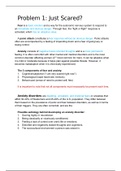
Problem 1: Just Scared?
Fear is a basic emotion and a way for the autonomic nervous system to respond to
an immediate and obvious danger. Through fear, the “fight or flight” response is
activated, which has an adaptive value.
A panic attack constitutes a fear response without an obvious danger. Panic attacks
often are accompanied by a feeling of impending doom and a fear of going lazy or
losing control.
Anxiety consists of negative future-oriented thoughts and is a more permanent
feeling. It is often comorbid with other mental and medical disorders and is the most
common disorder affecting women (2nd most common for men). It can be adaptive when
it is mild or moderate because it helps plan against possible threats. However, it
becomes maladaptive when it is chronically experienced.
The 3 components of fear and anxiety:
1. Cognitive/subjective (“I am very scared right now”)
2. Physiological (rapid heart rate, tremors)
3. Behavioural (sense of need to protect self, flee)
It is important to note that not all components must necessarily be present each time.
Anxiety disorders are disabling, unrealistic, and irrational fears or anxieties that
afflict 30-40% of Westerners and 25-29% of the U.S. population. They differ between
them based on the prevalence of panic and fear between disorders, as well as in terms
of their triggers. They are often comorbid, and are the
Possible aetiology behind developing an anxiety disorder:
1. Scoring highly in neuroticism.
2. Being classically or vicariously conditioned.
3. Feeling a lack of control over one's life or emotions.
4. Distorted and negatively biased thoughts and cognitions.
5. The sociocultural environment a person was raised in.
Fear is a basic emotion and a way for the autonomic nervous system to respond to
an immediate and obvious danger. Through fear, the “fight or flight” response is
activated, which has an adaptive value.
A panic attack constitutes a fear response without an obvious danger. Panic attacks
often are accompanied by a feeling of impending doom and a fear of going lazy or
losing control.
Anxiety consists of negative future-oriented thoughts and is a more permanent
feeling. It is often comorbid with other mental and medical disorders and is the most
common disorder affecting women (2nd most common for men). It can be adaptive when
it is mild or moderate because it helps plan against possible threats. However, it
becomes maladaptive when it is chronically experienced.
The 3 components of fear and anxiety:
1. Cognitive/subjective (“I am very scared right now”)
2. Physiological (rapid heart rate, tremors)
3. Behavioural (sense of need to protect self, flee)
It is important to note that not all components must necessarily be present each time.
Anxiety disorders are disabling, unrealistic, and irrational fears or anxieties that
afflict 30-40% of Westerners and 25-29% of the U.S. population. They differ between
them based on the prevalence of panic and fear between disorders, as well as in terms
of their triggers. They are often comorbid, and are the
Possible aetiology behind developing an anxiety disorder:
1. Scoring highly in neuroticism.
2. Being classically or vicariously conditioned.
3. Feeling a lack of control over one's life or emotions.
4. Distorted and negatively biased thoughts and cognitions.
5. The sociocultural environment a person was raised in.