Health insurance and health care financing
Monday, 3 February 2020 09:17
- Ill health usually unpredictable
- Health care consumed under conditions of uncertainty
○ Specifically concerning the timing of health care expenditure and the
amount of health care expenditure required
- Health care expenditures may be catastrophic if they require people to spend
a significant proportion of their income on health care as a result of
unforeseen illness. They might not be able to work when they are ill and thus
unable to afford the health care they need
- Usual solution to this uncertainty is insurance
Health Insurance
- Contract between insurance provider and person at risk of ill health
- Pay insurance premium in exchange for pay-out should the person become ill
- Insurance works by pooling risks
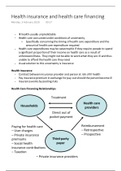
Health Care Financing Relationships
, Risk and the Demand for Health
- Role of health insurance in dealing with uncertainty depends on attitude to risk
Attitudes to risk
- Risk averse refuses fair gamble
- Risk neutral indifferent between accepting and declining fair gamble
- Risk loving accepts fair gamble and maybe unfavourable gamble
- People buy health insurance because they are risk averse
- Amount someone is prepared to pay for insurance is equal to the fair premium,
which is their unexpected loss if uninsured, plus a risk premium which reflects their
degree of risk aversion.
- Explanation for risk aversion is the diminishing marginal utility of income
The Supply of Health Insurance
- Health insurance allows people to swap uncertain outcomes for certain ones
- Insurance companies able to supply health insurance because they can pool risks
across a large number of insured people
- Total premium charged by insurance providers is equal to the fair premium plus a
loading factor, which covers the insurance provider's admin costs and profit it
needs to earn from each insured person to remain in the market
Market Failures in Health Insurance
- Adverse selection
○ Arises because of the asymmetry of information between insured and insurer
○ People who wish to buy insurance often have a good idea of their own risk
status, insurer only knows average risk
○ They set community rate for insurance which will be more attractive to high
risk individuals and less attractive to low risk individuals unless they are
sufficiently risk averse
○ May be addressed by:
§ Experience rating: where the provider sets up a different insurance
premium for different risk groups
§ Making insurance compulsory: typically used with publicly provided
health insurance.
○ Genetic tests for insurance purposes
, ○ May be addressed by:
§ Experience rating: where the provider sets up a different insurance
premium for different risk groups
§ Making insurance compulsory: typically used with publicly provided
health insurance.
○ Genetic tests for insurance purposes
§ In UK, use of genetic test results in insurance remains under review
until 2021
§ Huntington's disease is the only exception to this
§ Those in favour of allowing these test results to be used in insurance
argue that the insurance companies can already use family history to
determine the susceptibility to some diseases.
§ Those against argue that mandatory disclosure of test results may
discourage people from being tested, and therefore reduce early
identification of risks and update of treatment
- Moral Hazard
○ Health insurance changes the economic incentives facing both consumers
and providers of health care
○ Arises when it is possible to alter the probability of the insured event or the
size of the insured loss
○ When people are insured against risks and their consequences, they are less
careful about minimising them - problem of excess use
○ Moral hazard may be reduced by coinsurance, deductibles and no claims
bonuses
○ Coinsurance
§ Shares loss with insurer
○ Deductibles/excess
§ Amount of money insured pays when a claim is made irrespective of
co-insurance
○ No-claim bonuses
§ Payments made by insurers to discourage claims, usually paid in the
form of reduced premiums
- Non-Price Competition
○ Insurance can have a perverse effect on the efficiency of health care
providers as price is no longer important to patients
○ Insured patients will not be price sensitive and are more likely to choose
provider on the basis of other factors such as comfort, available facilities and
perceived quality
○ This leads to smaller incentive for health care providers to make their services
affordable by minimising costs
○ This causes costs to rise
○ Contrary to normal conclusions of economic theory, a greater level of
competition leads to higher costs and prices
- Incomplete Insurance Coverage
Monday, 3 February 2020 09:17
- Ill health usually unpredictable
- Health care consumed under conditions of uncertainty
○ Specifically concerning the timing of health care expenditure and the
amount of health care expenditure required
- Health care expenditures may be catastrophic if they require people to spend
a significant proportion of their income on health care as a result of
unforeseen illness. They might not be able to work when they are ill and thus
unable to afford the health care they need
- Usual solution to this uncertainty is insurance
Health Insurance
- Contract between insurance provider and person at risk of ill health
- Pay insurance premium in exchange for pay-out should the person become ill
- Insurance works by pooling risks
Health Care Financing Relationships
, Risk and the Demand for Health
- Role of health insurance in dealing with uncertainty depends on attitude to risk
Attitudes to risk
- Risk averse refuses fair gamble
- Risk neutral indifferent between accepting and declining fair gamble
- Risk loving accepts fair gamble and maybe unfavourable gamble
- People buy health insurance because they are risk averse
- Amount someone is prepared to pay for insurance is equal to the fair premium,
which is their unexpected loss if uninsured, plus a risk premium which reflects their
degree of risk aversion.
- Explanation for risk aversion is the diminishing marginal utility of income
The Supply of Health Insurance
- Health insurance allows people to swap uncertain outcomes for certain ones
- Insurance companies able to supply health insurance because they can pool risks
across a large number of insured people
- Total premium charged by insurance providers is equal to the fair premium plus a
loading factor, which covers the insurance provider's admin costs and profit it
needs to earn from each insured person to remain in the market
Market Failures in Health Insurance
- Adverse selection
○ Arises because of the asymmetry of information between insured and insurer
○ People who wish to buy insurance often have a good idea of their own risk
status, insurer only knows average risk
○ They set community rate for insurance which will be more attractive to high
risk individuals and less attractive to low risk individuals unless they are
sufficiently risk averse
○ May be addressed by:
§ Experience rating: where the provider sets up a different insurance
premium for different risk groups
§ Making insurance compulsory: typically used with publicly provided
health insurance.
○ Genetic tests for insurance purposes
, ○ May be addressed by:
§ Experience rating: where the provider sets up a different insurance
premium for different risk groups
§ Making insurance compulsory: typically used with publicly provided
health insurance.
○ Genetic tests for insurance purposes
§ In UK, use of genetic test results in insurance remains under review
until 2021
§ Huntington's disease is the only exception to this
§ Those in favour of allowing these test results to be used in insurance
argue that the insurance companies can already use family history to
determine the susceptibility to some diseases.
§ Those against argue that mandatory disclosure of test results may
discourage people from being tested, and therefore reduce early
identification of risks and update of treatment
- Moral Hazard
○ Health insurance changes the economic incentives facing both consumers
and providers of health care
○ Arises when it is possible to alter the probability of the insured event or the
size of the insured loss
○ When people are insured against risks and their consequences, they are less
careful about minimising them - problem of excess use
○ Moral hazard may be reduced by coinsurance, deductibles and no claims
bonuses
○ Coinsurance
§ Shares loss with insurer
○ Deductibles/excess
§ Amount of money insured pays when a claim is made irrespective of
co-insurance
○ No-claim bonuses
§ Payments made by insurers to discourage claims, usually paid in the
form of reduced premiums
- Non-Price Competition
○ Insurance can have a perverse effect on the efficiency of health care
providers as price is no longer important to patients
○ Insured patients will not be price sensitive and are more likely to choose
provider on the basis of other factors such as comfort, available facilities and
perceived quality
○ This leads to smaller incentive for health care providers to make their services
affordable by minimising costs
○ This causes costs to rise
○ Contrary to normal conclusions of economic theory, a greater level of
competition leads to higher costs and prices
- Incomplete Insurance Coverage