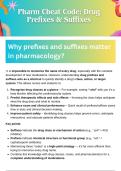
Pharm Cheat Code: Drug
Prefixes & Suffixes
Why prefixes and suffixes matter
in pharmacology?
It is impossible to memorize the name of every drug, especially with the constant
development of new medications. However, understanding drug prefixes and
suffixes acts as a shortcut to quickly identify a drug’s class, action, or target
system. This allows nurses and students to:
1. Recognize drug classes at a glance – For example, seeing “-olol” tells you it’s a
beta blocker affecting the cardiovascular system.
2. Predict therapeutic effects and side effects – Knowing the class helps anticipate
what the drug does and what to monitor.
3. Enhance exam and clinical performance – Quick recall of prefixes/suffixes saves
time in tests and clinical decision-making.
4. Improve patient safety – Identifying drug classes helps prevent errors, anticipate
interactions, and educate patients effectively.
Key points:
Suffixes indicate the drug class or mechanism of action (e.g., “-pril” = ACE
inhibitor).
Prefixes indicate chemical structure or functional group (e.g., “cef-” =
cephalosporin antibiotic).
Memorizing these “codes” is a high-yield strategy — it’s far more efficient than
trying to memorize every drug name.
Combine this knowledge with drug classes, routes, and pharmacokinetics for a
complete understanding of medications.
,Tip: Think of prefixes and suffixes as a cheat code for pharmacology — they help
you decode and identify drugs quickly without memorizing every single name.
1. Cardiovascular Drugs
Suffix / Prefix Drug Class Examples Key Nursing
Tips
-olol Beta Blocker Metoprolol, Atenolol Monitor HR/BP;
do not stop
abruptly
-pril ACE Inhibitor Lisinopril, Enalapril Monitor BP &
K+; watch for
cough
-sartan ARB Losartan, Valsartan Monitor BP &
K+
-dipine Calcium Channel Amlodipine, Monitor BP;
Blocker Nifedipine watch for
edema
hydro- Diuretic Hydrochlorothiazide Monitor BP &
electrolytes
iso- Vasodilator / anti- Isosorbide Check BP;
anginal watch for
hypotension
Assessment Tip:
Monitor vital signs, heart rate, BP, and watch for signs of edema or fluid overload.
Check lab values for electrolytes and renal function with diuretics.
, 2. Antibiotics /
Antimicrobials/Anti-fungals
Prefixes & Suffixes
Why prefixes and suffixes matter
in pharmacology?
It is impossible to memorize the name of every drug, especially with the constant
development of new medications. However, understanding drug prefixes and
suffixes acts as a shortcut to quickly identify a drug’s class, action, or target
system. This allows nurses and students to:
1. Recognize drug classes at a glance – For example, seeing “-olol” tells you it’s a
beta blocker affecting the cardiovascular system.
2. Predict therapeutic effects and side effects – Knowing the class helps anticipate
what the drug does and what to monitor.
3. Enhance exam and clinical performance – Quick recall of prefixes/suffixes saves
time in tests and clinical decision-making.
4. Improve patient safety – Identifying drug classes helps prevent errors, anticipate
interactions, and educate patients effectively.
Key points:
Suffixes indicate the drug class or mechanism of action (e.g., “-pril” = ACE
inhibitor).
Prefixes indicate chemical structure or functional group (e.g., “cef-” =
cephalosporin antibiotic).
Memorizing these “codes” is a high-yield strategy — it’s far more efficient than
trying to memorize every drug name.
Combine this knowledge with drug classes, routes, and pharmacokinetics for a
complete understanding of medications.
,Tip: Think of prefixes and suffixes as a cheat code for pharmacology — they help
you decode and identify drugs quickly without memorizing every single name.
1. Cardiovascular Drugs
Suffix / Prefix Drug Class Examples Key Nursing
Tips
-olol Beta Blocker Metoprolol, Atenolol Monitor HR/BP;
do not stop
abruptly
-pril ACE Inhibitor Lisinopril, Enalapril Monitor BP &
K+; watch for
cough
-sartan ARB Losartan, Valsartan Monitor BP &
K+
-dipine Calcium Channel Amlodipine, Monitor BP;
Blocker Nifedipine watch for
edema
hydro- Diuretic Hydrochlorothiazide Monitor BP &
electrolytes
iso- Vasodilator / anti- Isosorbide Check BP;
anginal watch for
hypotension
Assessment Tip:
Monitor vital signs, heart rate, BP, and watch for signs of edema or fluid overload.
Check lab values for electrolytes and renal function with diuretics.
, 2. Antibiotics /
Antimicrobials/Anti-fungals