WGU D662 Section 1
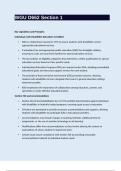
Key Legislation and Principles
Individuals with Disabilities Education Act (IDEA)
IDEA is a federal law enacted in 1975 to ensure students with disabilities receive
appropriate educational services.
It mandates free and appropriate public education (FAPE) for all eligible children,
ensuring no costs are incurred by families for special education services.
The law outlines 13 eligibility categories that determine a child's qualification for special
education services based on their specific needs.
Individualized Education Programs (IEPs) are required under IDEA, detailing personalized
educational goals and necessary support services for each student.
The principle of least restrictive environment (LRE) promotes inclusion, allowing
students with disabilities to learn alongside their peers in general education settings
whenever possible.
IDEA emphasizes the importance of collaboration among educators, parents, and
specialists to create effective educational plans.
Section 504 and Accommodations
Section 504 of the Rehabilitation Act of 1973 prohibits discrimination against individuals
with disabilities in federally funded programs, ensuring equal access to education.
504 plans are developed to provide necessary accommodations and supports, allowing
students with disabilities to participate fully in educational activities.
Accommodations may include changes in teaching methods, additional time for
assignments, or the use of assistive technology to aid learning.
Modifications differ from accommodations as they involve altering the content or
expectations of what a student is required to learn.
Schools must ensure compliance with Section 504 by providing reasonable
accommodations tailored to individual student needs.
Key Legislation and Principles
Individuals with Disabilities Education Act (IDEA)
IDEA is a federal law enacted in 1975 to ensure students with disabilities receive
appropriate educational services.
It mandates free and appropriate public education (FAPE) for all eligible children,
ensuring no costs are incurred by families for special education services.
The law outlines 13 eligibility categories that determine a child's qualification for special
education services based on their specific needs.
Individualized Education Programs (IEPs) are required under IDEA, detailing personalized
educational goals and necessary support services for each student.
The principle of least restrictive environment (LRE) promotes inclusion, allowing
students with disabilities to learn alongside their peers in general education settings
whenever possible.
IDEA emphasizes the importance of collaboration among educators, parents, and
specialists to create effective educational plans.
Section 504 and Accommodations
Section 504 of the Rehabilitation Act of 1973 prohibits discrimination against individuals
with disabilities in federally funded programs, ensuring equal access to education.
504 plans are developed to provide necessary accommodations and supports, allowing
students with disabilities to participate fully in educational activities.
Accommodations may include changes in teaching methods, additional time for
assignments, or the use of assistive technology to aid learning.
Modifications differ from accommodations as they involve altering the content or
expectations of what a student is required to learn.
Schools must ensure compliance with Section 504 by providing reasonable
accommodations tailored to individual student needs.