samenvatti
ng
public
policy
1
,Hoofdstuk 1: Government and policy
1. What is public policy?
1.1. different definitions
- anything a government chooses to do or not to do
- decision made in public context
- a targeted action
1.2. examples
- primary school teacher feel abandoned, nothing is being done for their
safety (covid) policy problem
- policy in our daily life: mobility & transport, education, health, housing,
sports, …
1.3. examenvragen
1) who makes policy?
Only the government makes police, not the experts. The government
didn’t want the responsibility so they ‘gave’ it to the experts. But only the
government makes the policy
2) when do we make public policy?
When we have a problem. They make it because they respond to a
certain problem in society. Sometimes they frame a certain problem. You
think there is no problem, but politicians will bring up a problem.
3) What is public policy?
It’s a targeted action ( it’s targeted to a specific problem), it always has
an objective (it always had a purpose to change the problem), is always in
response to a problem (bv. housing is too expensive) and is only made by
government.
1.4. types of public policy
1.4.1. source: lowi
- regulatory policies (regulerend): rules that are formed by the
government: f.e.: not drinking alcohol before the age of 16, are about
giving rules, obligations to an individual primary rules environmental
regulations
- distributive policies (verdelend): resources and benefits to specific
groups, individuals, or communities secondary rules a subsidy
2
, - redistributive policies (herverdelend) : “re”, changing the existing
income distribution (rich ppl are required to pay more taxes, the poor
have to pay less primary rules income tax, social security
- constituent policies (constituerend) : the dutch government: they
should have a trashhold on the dutch government (too many political
parties) secondary rules new government institutions
1.4.2. source: smith onderscheidt regulerend, characteristics of ethical policy
- competitive policy: access to the provision of certain goods or services,
imposes conditions that the facilities must meet
*f.e. access to the telecom market
- protective policy: intended to protect citizens by establishing the
conditions under which private activities may be provided and non-
compliance with them are sanctioned
*f.e. safety standards for the food industry
- self-regulating policy: corresponds to protective policy, although the
initiative is taken by the providers themselves
f.e. self-regulation at the banks, if you are agriculture, you need to come
together and discuss the amount of pesticide
1.4.3. source: bekkers voegt 3 nieuwe toe
- exploratory policy: indicating new schools of thought with the intention
of mobilizing parties to think along about the desired development and
the necessary changes
*f.e. the debate on climate change and sustainable energy
- facilitating policy: supporting certain desirable objectives without
imposing them coercively, directly
*subsidies for renewable energy
- stimulating policy: stimulating people or organisations to show a
certain desirable behaviour.
*f.e. tax incentives for electric vehicles, taxes for entrepreneurs in corona
1.5. why does government pursue policy?
1.5.1. problems?
- a problem can be defined as a gap between a desirable (wenselijke)
situation and perceived (waargenomen) condition – hoornbeek & peters
- not everyone sees the same problem/gap
gap is not automatically the same size and urgence for everyone
- a battle between ideas, ideologies, … - bridgman & davis
1.5.2. lasswell & knoepfel et al
- what can we do best to address this problem? how can we do this? how
can we know exactly what we have done?
- public policy = bridge between the knowledge vs. the actual problems
3
, 1.5.3. easton
o systemmodel from the politics = input-output of the political
system
o questions and support from the environment are converted into
policy through politics
o 1. Demands: we want this
o 2. Support: who is going to support these demands
o 3. They go into the political system
o 4. They make certain decisions/priorities to solve
problems/demands
o 5. If the solution doesn’t work, we go back and try It again
<-> not always problems, also ambitions
f.e. ambition to land a man on the moon – america, nasa, kennedy
1.6. who is involved?
1) not typical the government – (dye said the government)
2) government organisations, politicians – andersson
3) politicians as elected decision-makers with formal authority,
participants and players – bridgman & davis
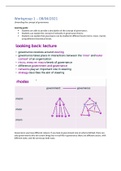
4) basic triangle of policy actors – how you deal with a certain policy
problem in perspective of the government
1. Political-administrative authorities: everyone involved in
developing a solution to a problem
Intervention hypothesis: if we do this, the problem will be solved
2. Target groups:
Causal hypothesis: what causes the problem and people suffering
from a certain problem
3. End beneficiaries experiencing negative effects of the
problem
Political definition of the problem to be solved: what is the
problem?
4
ng
public
policy
1
,Hoofdstuk 1: Government and policy
1. What is public policy?
1.1. different definitions
- anything a government chooses to do or not to do
- decision made in public context
- a targeted action
1.2. examples
- primary school teacher feel abandoned, nothing is being done for their
safety (covid) policy problem
- policy in our daily life: mobility & transport, education, health, housing,
sports, …
1.3. examenvragen
1) who makes policy?
Only the government makes police, not the experts. The government
didn’t want the responsibility so they ‘gave’ it to the experts. But only the
government makes the policy
2) when do we make public policy?
When we have a problem. They make it because they respond to a
certain problem in society. Sometimes they frame a certain problem. You
think there is no problem, but politicians will bring up a problem.
3) What is public policy?
It’s a targeted action ( it’s targeted to a specific problem), it always has
an objective (it always had a purpose to change the problem), is always in
response to a problem (bv. housing is too expensive) and is only made by
government.
1.4. types of public policy
1.4.1. source: lowi
- regulatory policies (regulerend): rules that are formed by the
government: f.e.: not drinking alcohol before the age of 16, are about
giving rules, obligations to an individual primary rules environmental
regulations
- distributive policies (verdelend): resources and benefits to specific
groups, individuals, or communities secondary rules a subsidy
2
, - redistributive policies (herverdelend) : “re”, changing the existing
income distribution (rich ppl are required to pay more taxes, the poor
have to pay less primary rules income tax, social security
- constituent policies (constituerend) : the dutch government: they
should have a trashhold on the dutch government (too many political
parties) secondary rules new government institutions
1.4.2. source: smith onderscheidt regulerend, characteristics of ethical policy
- competitive policy: access to the provision of certain goods or services,
imposes conditions that the facilities must meet
*f.e. access to the telecom market
- protective policy: intended to protect citizens by establishing the
conditions under which private activities may be provided and non-
compliance with them are sanctioned
*f.e. safety standards for the food industry
- self-regulating policy: corresponds to protective policy, although the
initiative is taken by the providers themselves
f.e. self-regulation at the banks, if you are agriculture, you need to come
together and discuss the amount of pesticide
1.4.3. source: bekkers voegt 3 nieuwe toe
- exploratory policy: indicating new schools of thought with the intention
of mobilizing parties to think along about the desired development and
the necessary changes
*f.e. the debate on climate change and sustainable energy
- facilitating policy: supporting certain desirable objectives without
imposing them coercively, directly
*subsidies for renewable energy
- stimulating policy: stimulating people or organisations to show a
certain desirable behaviour.
*f.e. tax incentives for electric vehicles, taxes for entrepreneurs in corona
1.5. why does government pursue policy?
1.5.1. problems?
- a problem can be defined as a gap between a desirable (wenselijke)
situation and perceived (waargenomen) condition – hoornbeek & peters
- not everyone sees the same problem/gap
gap is not automatically the same size and urgence for everyone
- a battle between ideas, ideologies, … - bridgman & davis
1.5.2. lasswell & knoepfel et al
- what can we do best to address this problem? how can we do this? how
can we know exactly what we have done?
- public policy = bridge between the knowledge vs. the actual problems
3
, 1.5.3. easton
o systemmodel from the politics = input-output of the political
system
o questions and support from the environment are converted into
policy through politics
o 1. Demands: we want this
o 2. Support: who is going to support these demands
o 3. They go into the political system
o 4. They make certain decisions/priorities to solve
problems/demands
o 5. If the solution doesn’t work, we go back and try It again
<-> not always problems, also ambitions
f.e. ambition to land a man on the moon – america, nasa, kennedy
1.6. who is involved?
1) not typical the government – (dye said the government)
2) government organisations, politicians – andersson
3) politicians as elected decision-makers with formal authority,
participants and players – bridgman & davis
4) basic triangle of policy actors – how you deal with a certain policy
problem in perspective of the government
1. Political-administrative authorities: everyone involved in
developing a solution to a problem
Intervention hypothesis: if we do this, the problem will be solved
2. Target groups:
Causal hypothesis: what causes the problem and people suffering
from a certain problem
3. End beneficiaries experiencing negative effects of the
problem
Political definition of the problem to be solved: what is the
problem?
4