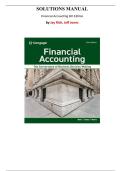
SOLUTIONS MANUAL
Financial Accounting 6th Edition
by Jay Rich, Jeff Jones
SC
O
R
EG
U
ID
ES
,TABLE OF CONTENT
1. Accounting and the Financial Statements
2. The Accounting Information System
3. Accrual Accounting
SC
4. Internal Control and Cash
5. Sales and Receivables
O
6. Cost of Goods Sold and Inventory
7. Operating Assets
R
8. Current and Contingent Liabilities
EG
9. Long-Term Liabilities
10. Stockholders’ Equity
U
11. The Statement of Cash Flows
ID
12. Financial Statement Analysis
ES
, APPENDIX
1 INVESTMENTS
DISCUSSION QUESTIONS
SC
1. The three classifications for investments in debt securities are as follows:
a. Held-to-maturity securities are debt investments that management intends to
hold until the debt contract requires the borrower to repay the debt in its entirety.
On the balance sheet, held-to-maturity securities are classified as noncurrent assets
unless the date of maturity is within 1 year or one operating cycle, whichever is
longer.
O
b. Trading securities are debt investments that management intends to sell in
the near term. Trading securities are bought and sold frequently and typically are owned
for under 1 month. Trading securities are always classified as current assets on the
balance sheet.
R
c. Available-for-sale securities are debt investments that management intends to sell in the
future, but not necessarily in the near term. Therefore, investments in debt securities
that do not warrant inclusion as trading securities or held-to-maturity securities are
EG
considered available-for-sale. On the balance sheet, available-for-sale securities are
classified as current or noncurrent assets depending on whether they will be sold within
1 year or one operating cycle, whichever is longer.
2. The amortized cost method is used for investments in debt securities that are to be held
to maturity. It is implemented by:
● Recording securities purchased at cost
U
● Carrying those investments on the balance sheet at cost adjusted for unamortized premium
or discount amortization during the holding period
● Recording receipt of interest income with appropriate amortization of premium/discount each
accounting period
ID
● Removing cost from the accounting records when the securities are redeemed at
maturity
3. Investment income is recognized for: (1) the amortized cost method when interest is earned
each accounting period and when amortization of premium or discount is recorded, (2) the fair
ES
value method when interest or dividends are received and when investments are sold, and (3) the
equity method when the investee earns income (or loss) and when investments are sold.
A1-1
© 2025 Cengage Learning®. May not be scanned, copied or duplicated, or posted to a publicly accessible website, in whole or in part.
, APPENDIX 1 Investments
4. The fair value method is used for investments in debt securities that are classified
as trading or available-for-sale. It is implemented by:
● Recording securities purchased at cost (fair value on the date of purchase)
● Adjusting the carrying amount of those investments to their fair (or market) value at
the end of each accounting period
● Recognizing the adjustment to the carrying amount (for unrealized gains or losses)
of these investments as a separate element of stockholders’ equity (available-for-sale
debt securities) or as income on the income statement (investments in debt
SC
securities classified as trading)
● Recording interest or dividends as income as they are realized each accounting period
● Removing the investment carrying amount from the accounting records when the
securities are sold and recognizing a gain (or loss) measured by the difference
between the selling price and the cost of the investment
O
The fair value method is also used to account for equity securities. The accounting for equity
securities under the fair value method mirrors that of the accounting for debt securities classified
as trading securities.
5. Trading securities are debt investments that management intends to sell in the
R
near term. Trading securities are bought and sold frequently and typically are owned for
less than 1 month. Trading securities are always classified as current assets. On the
income statement, unrealized gains (losses) on trading securities are included on the income
statement as part of net income. Available-for-sale securities are debt investments that
EG
management intends to sell in the future but not necessarily in the near term. On the balance
sheet, available-for-sale debt securities are classified as current or noncurrent assets
depending on whether they will be sold within 1 year or one operating cycle, whichever is
longer. Unrealized gains (losses) on available-for-sale securities are not included on the
income statement; instead, they are reported in accumulated other comprehensive
income, which is an element of stockholders’ equity.
6. The allowance to adjust short-term investments to market is the valuation account
containing unrealized gains and losses on the short-term investment portfolio. It is
U
adjusted at year end to the current amount of unrealized gain or loss and is reported on
the balance sheet to adjust the cost of the portfolio to its current market value. Use of this
allowance reveals the current cash-generating potential of the short-term investments;
reporting only their cost would deny this information to users of the financial statements.
ID
7. The equity method is used to account for long-term investments in common stock,
which enables the investor to significantly influence the operations of another business.
When an investment represents an ownership of 20% or more, the investor
can usually influence the operations of the investee, and the equity method is used.
ES
It is implemented by:
● Recording securities purchased at cost
● Recognizing as income the investor’s share of investee net income (or net loss)
● Adding the investor’s share of investee net income (or subtracting the investor’s
share of net loss) to the investment account
● Recording dividends received as a reduction in the investment account
● Removing the investment carrying amount from the accounting records when the
securities are sold and recognizing a gain (or loss) measured by the difference
between the selling price and the carrying amount
A1-2
© 2025 Cengage Learning®. May not be scanned, copied or duplicated, or posted to a publicly accessible website, in whole or in part.
Financial Accounting 6th Edition
by Jay Rich, Jeff Jones
SC
O
R
EG
U
ID
ES
,TABLE OF CONTENT
1. Accounting and the Financial Statements
2. The Accounting Information System
3. Accrual Accounting
SC
4. Internal Control and Cash
5. Sales and Receivables
O
6. Cost of Goods Sold and Inventory
7. Operating Assets
R
8. Current and Contingent Liabilities
EG
9. Long-Term Liabilities
10. Stockholders’ Equity
U
11. The Statement of Cash Flows
ID
12. Financial Statement Analysis
ES
, APPENDIX
1 INVESTMENTS
DISCUSSION QUESTIONS
SC
1. The three classifications for investments in debt securities are as follows:
a. Held-to-maturity securities are debt investments that management intends to
hold until the debt contract requires the borrower to repay the debt in its entirety.
On the balance sheet, held-to-maturity securities are classified as noncurrent assets
unless the date of maturity is within 1 year or one operating cycle, whichever is
longer.
O
b. Trading securities are debt investments that management intends to sell in
the near term. Trading securities are bought and sold frequently and typically are owned
for under 1 month. Trading securities are always classified as current assets on the
balance sheet.
R
c. Available-for-sale securities are debt investments that management intends to sell in the
future, but not necessarily in the near term. Therefore, investments in debt securities
that do not warrant inclusion as trading securities or held-to-maturity securities are
EG
considered available-for-sale. On the balance sheet, available-for-sale securities are
classified as current or noncurrent assets depending on whether they will be sold within
1 year or one operating cycle, whichever is longer.
2. The amortized cost method is used for investments in debt securities that are to be held
to maturity. It is implemented by:
● Recording securities purchased at cost
U
● Carrying those investments on the balance sheet at cost adjusted for unamortized premium
or discount amortization during the holding period
● Recording receipt of interest income with appropriate amortization of premium/discount each
accounting period
ID
● Removing cost from the accounting records when the securities are redeemed at
maturity
3. Investment income is recognized for: (1) the amortized cost method when interest is earned
each accounting period and when amortization of premium or discount is recorded, (2) the fair
ES
value method when interest or dividends are received and when investments are sold, and (3) the
equity method when the investee earns income (or loss) and when investments are sold.
A1-1
© 2025 Cengage Learning®. May not be scanned, copied or duplicated, or posted to a publicly accessible website, in whole or in part.
, APPENDIX 1 Investments
4. The fair value method is used for investments in debt securities that are classified
as trading or available-for-sale. It is implemented by:
● Recording securities purchased at cost (fair value on the date of purchase)
● Adjusting the carrying amount of those investments to their fair (or market) value at
the end of each accounting period
● Recognizing the adjustment to the carrying amount (for unrealized gains or losses)
of these investments as a separate element of stockholders’ equity (available-for-sale
debt securities) or as income on the income statement (investments in debt
SC
securities classified as trading)
● Recording interest or dividends as income as they are realized each accounting period
● Removing the investment carrying amount from the accounting records when the
securities are sold and recognizing a gain (or loss) measured by the difference
between the selling price and the cost of the investment
O
The fair value method is also used to account for equity securities. The accounting for equity
securities under the fair value method mirrors that of the accounting for debt securities classified
as trading securities.
5. Trading securities are debt investments that management intends to sell in the
R
near term. Trading securities are bought and sold frequently and typically are owned for
less than 1 month. Trading securities are always classified as current assets. On the
income statement, unrealized gains (losses) on trading securities are included on the income
statement as part of net income. Available-for-sale securities are debt investments that
EG
management intends to sell in the future but not necessarily in the near term. On the balance
sheet, available-for-sale debt securities are classified as current or noncurrent assets
depending on whether they will be sold within 1 year or one operating cycle, whichever is
longer. Unrealized gains (losses) on available-for-sale securities are not included on the
income statement; instead, they are reported in accumulated other comprehensive
income, which is an element of stockholders’ equity.
6. The allowance to adjust short-term investments to market is the valuation account
containing unrealized gains and losses on the short-term investment portfolio. It is
U
adjusted at year end to the current amount of unrealized gain or loss and is reported on
the balance sheet to adjust the cost of the portfolio to its current market value. Use of this
allowance reveals the current cash-generating potential of the short-term investments;
reporting only their cost would deny this information to users of the financial statements.
ID
7. The equity method is used to account for long-term investments in common stock,
which enables the investor to significantly influence the operations of another business.
When an investment represents an ownership of 20% or more, the investor
can usually influence the operations of the investee, and the equity method is used.
ES
It is implemented by:
● Recording securities purchased at cost
● Recognizing as income the investor’s share of investee net income (or net loss)
● Adding the investor’s share of investee net income (or subtracting the investor’s
share of net loss) to the investment account
● Recording dividends received as a reduction in the investment account
● Removing the investment carrying amount from the accounting records when the
securities are sold and recognizing a gain (or loss) measured by the difference
between the selling price and the carrying amount
A1-2
© 2025 Cengage Learning®. May not be scanned, copied or duplicated, or posted to a publicly accessible website, in whole or in part.