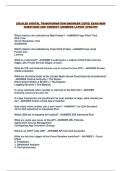
Wall Street Prep Premium Exam 2026: Ace
Your Finance Interview in NYC, London &
HK
Description:
Prepare for your 2026 finance interviews with our definitive Wall Street Prep Premium Exam
guide. This comprehensive resource features 50+ targeted practice questions and detailed
answers covering essential technical topics like DCF modeling, LBO analysis, M&A
accounting, and 3-statement financial modeling. Specifically designed for candidates targeting
competitive financial hubs including New York, London, and Hong Kong, our updated 2026
exam reflects the latest industry standards and interview trends.
Whether you're preparing for investment banking interviews, private equity recruiting, or
financial analyst positions, this guide provides the critical practice you need to demonstrate
technical proficiency and stand out from other candidates. The questions are structured to mimic
real-world technical tests used by top banks and financial institutions globally.
Master the technical skills that get you hired – download your free exam preview now and start
your journey to a top finance career today!
, Wall Street Prep Premium Exam 2026: Practice Questions &
Answers
1. Which of the following items is typically classified as a recurring part of a company's core
operations rather than a pre-tax non-recurring item?
a) Restructuring charges
b) Gains/Losses from asset sales
c) Goodwill impairment
d) Cost of Goods Sold
Answer: d) Cost of Goods Sold
Explanation: Cost of Goods Sold (COGS) is a fundamental, recurring operating expense
directly tied to the production of a company's goods and services. Items like restructuring
charges, asset sale gains/losses, and impairments are typically considered unusual or infrequent
and are separated from core operational results for analysis.
2. Identify the incorrect statement regarding depreciation and amortization (D&A).
a) D&A is a non-cash expense.
b) D&A reduces a company's taxable income.
c) D&A can be found within the Cost of Goods Sold line item.
d) D&A is typically classified within interest expense on the income statement.
Answer: d) D&A is typically classified within interest expense on the income statement.
Explanation: Depreciation and amortization are non-cash charges related to the consumption of
tangible and intangible assets. They are never classified as interest expense, which is the cost of
borrowing debt. D&A can appear within COGS and/or SG&A, depending on the nature of the
underlying assets.
3. If a company's current assets increase by $75 million and its current liabilities increase by $50
million over a fiscal period, what is the cash impact of the change in net working capital?
a) An increase of $25 million
b) A decrease of $25 million
c) An increase of $125 million
d) A decrease of $125 million
Answer: b) A decrease of $25 million
Explanation: The change in Net Working Capital is calculated as the change in Current Assets
, minus the change in Current Liabilities ($75M - $50M = $25M). An increase in net working
capital represents a use of cash, as more capital is tied up in the company's short-term operations,
thus decreasing cash flow.
4. Modeling interest expense can create a circular reference in a financial model. This is primarily
because:
a) Interest income is difficult to forecast accurately.
b) The interest rate on debt is subject to market fluctuations.
c) Interest expense affects net income, which influences free cash flow and debt paydown, which
in turn affects the debt balance and subsequent interest expense.
d) Depreciation schedules are dependent on interest calculations.
Answer: c) Interest expense affects net income, which influences free cash flow and debt
paydown, which in turn affects the debt balance and subsequent interest expense.
Explanation: This creates a circularity: interest expense lowers net income, which reduces free
cash flow, leaving less cash to pay down debt. A higher ending debt balance leads to higher
interest expense in the next period, creating a loop that requires a model to be iteratively
calculated.
5. All of the following are characteristics of a Form 10-Q filing except:
a) It contains unaudited financial statements.
b) It is filed quarterly with the SEC.
c) It includes a full Management's Discussion and Analysis (MD&A) for the entire fiscal year.
d) It is issued three times per year for most companies.
Answer: c) It includes a full Management's Discussion and Analysis (MD&A) for the entire
fiscal year.
Explanation: While a 10-Q does include an MD&A section, it focuses on the current quarter
and year-to-date period. A comprehensive, full-year MD&A is reserved for the annual report on
Form 10-K.
6. For a technology firm, depreciation expense found within the Research & Development (R&D)
line item would most likely be associated with which of the following assets?
a) The corporate headquarters building
b) Laboratory equipment used by scientists
c) Company-owned vehicles for the sales team
Your Finance Interview in NYC, London &
HK
Description:
Prepare for your 2026 finance interviews with our definitive Wall Street Prep Premium Exam
guide. This comprehensive resource features 50+ targeted practice questions and detailed
answers covering essential technical topics like DCF modeling, LBO analysis, M&A
accounting, and 3-statement financial modeling. Specifically designed for candidates targeting
competitive financial hubs including New York, London, and Hong Kong, our updated 2026
exam reflects the latest industry standards and interview trends.
Whether you're preparing for investment banking interviews, private equity recruiting, or
financial analyst positions, this guide provides the critical practice you need to demonstrate
technical proficiency and stand out from other candidates. The questions are structured to mimic
real-world technical tests used by top banks and financial institutions globally.
Master the technical skills that get you hired – download your free exam preview now and start
your journey to a top finance career today!
, Wall Street Prep Premium Exam 2026: Practice Questions &
Answers
1. Which of the following items is typically classified as a recurring part of a company's core
operations rather than a pre-tax non-recurring item?
a) Restructuring charges
b) Gains/Losses from asset sales
c) Goodwill impairment
d) Cost of Goods Sold
Answer: d) Cost of Goods Sold
Explanation: Cost of Goods Sold (COGS) is a fundamental, recurring operating expense
directly tied to the production of a company's goods and services. Items like restructuring
charges, asset sale gains/losses, and impairments are typically considered unusual or infrequent
and are separated from core operational results for analysis.
2. Identify the incorrect statement regarding depreciation and amortization (D&A).
a) D&A is a non-cash expense.
b) D&A reduces a company's taxable income.
c) D&A can be found within the Cost of Goods Sold line item.
d) D&A is typically classified within interest expense on the income statement.
Answer: d) D&A is typically classified within interest expense on the income statement.
Explanation: Depreciation and amortization are non-cash charges related to the consumption of
tangible and intangible assets. They are never classified as interest expense, which is the cost of
borrowing debt. D&A can appear within COGS and/or SG&A, depending on the nature of the
underlying assets.
3. If a company's current assets increase by $75 million and its current liabilities increase by $50
million over a fiscal period, what is the cash impact of the change in net working capital?
a) An increase of $25 million
b) A decrease of $25 million
c) An increase of $125 million
d) A decrease of $125 million
Answer: b) A decrease of $25 million
Explanation: The change in Net Working Capital is calculated as the change in Current Assets
, minus the change in Current Liabilities ($75M - $50M = $25M). An increase in net working
capital represents a use of cash, as more capital is tied up in the company's short-term operations,
thus decreasing cash flow.
4. Modeling interest expense can create a circular reference in a financial model. This is primarily
because:
a) Interest income is difficult to forecast accurately.
b) The interest rate on debt is subject to market fluctuations.
c) Interest expense affects net income, which influences free cash flow and debt paydown, which
in turn affects the debt balance and subsequent interest expense.
d) Depreciation schedules are dependent on interest calculations.
Answer: c) Interest expense affects net income, which influences free cash flow and debt
paydown, which in turn affects the debt balance and subsequent interest expense.
Explanation: This creates a circularity: interest expense lowers net income, which reduces free
cash flow, leaving less cash to pay down debt. A higher ending debt balance leads to higher
interest expense in the next period, creating a loop that requires a model to be iteratively
calculated.
5. All of the following are characteristics of a Form 10-Q filing except:
a) It contains unaudited financial statements.
b) It is filed quarterly with the SEC.
c) It includes a full Management's Discussion and Analysis (MD&A) for the entire fiscal year.
d) It is issued three times per year for most companies.
Answer: c) It includes a full Management's Discussion and Analysis (MD&A) for the entire
fiscal year.
Explanation: While a 10-Q does include an MD&A section, it focuses on the current quarter
and year-to-date period. A comprehensive, full-year MD&A is reserved for the annual report on
Form 10-K.
6. For a technology firm, depreciation expense found within the Research & Development (R&D)
line item would most likely be associated with which of the following assets?
a) The corporate headquarters building
b) Laboratory equipment used by scientists
c) Company-owned vehicles for the sales team