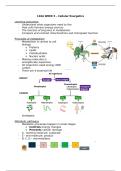
116A WEEK 5 – Cellular Energetics
Learning outcomes:
- Understand what organisms need to live
- How cells harness energy sources
- The function of enzymes in metabolism
- Compare and contrast mitochondrion and chloroplast function
Principles of metabolism
- Metabolism is central to cell
biology
o Proteins
o Lipids
o Carbohydrates
o Nucleic acids
- Making molecules is
energetically expensive
- All organisms need energy AND
carbon
- There are 4 essential life
strategies:
Metabolic pathways
- Metabolic processes happen in small stages
o Controls energy changes
o Prevents cellular damage
- A - starting molecule: substrate
- E - end molecule: product
- B, C, D – intermediates
-
, Metabolic networks
Anabolic and catabolic reactions
- Reactions that use energy to create molecules are called anabolic
reactions (i.e. biosynthesis)
o Synthesize cellular
components e.g. starch
o Produces metabolites
(small molecule
intermediates)
- Reactions that release energy
by breaking down cellular
components are called
catabolic reactions (e.g.
respiration)
o Produces metabolites
(small molecule
intermediates)
o Can be aerobic
o Can be anaerobic
Principles of energy transfer
- 1st law of thermodynamics:
o Energy can’t be created or destroyed
- 2 law of thermodynamics:
nd
o The total entropy (disorder) of any system cannot decrease
other than by increasing the entropy of some other system
- Energy transfer – moving energy from one place to another
- Work - the (useful) effect of energy transfer between systems
- Heat – the by-product of energy transfer between systems
Energy carriers
Learning outcomes:
- Understand what organisms need to live
- How cells harness energy sources
- The function of enzymes in metabolism
- Compare and contrast mitochondrion and chloroplast function
Principles of metabolism
- Metabolism is central to cell
biology
o Proteins
o Lipids
o Carbohydrates
o Nucleic acids
- Making molecules is
energetically expensive
- All organisms need energy AND
carbon
- There are 4 essential life
strategies:
Metabolic pathways
- Metabolic processes happen in small stages
o Controls energy changes
o Prevents cellular damage
- A - starting molecule: substrate
- E - end molecule: product
- B, C, D – intermediates
-
, Metabolic networks
Anabolic and catabolic reactions
- Reactions that use energy to create molecules are called anabolic
reactions (i.e. biosynthesis)
o Synthesize cellular
components e.g. starch
o Produces metabolites
(small molecule
intermediates)
- Reactions that release energy
by breaking down cellular
components are called
catabolic reactions (e.g.
respiration)
o Produces metabolites
(small molecule
intermediates)
o Can be aerobic
o Can be anaerobic
Principles of energy transfer
- 1st law of thermodynamics:
o Energy can’t be created or destroyed
- 2 law of thermodynamics:
nd
o The total entropy (disorder) of any system cannot decrease
other than by increasing the entropy of some other system
- Energy transfer – moving energy from one place to another
- Work - the (useful) effect of energy transfer between systems
- Heat – the by-product of energy transfer between systems
Energy carriers