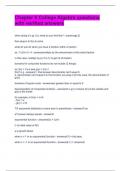
Chapter 6 College Algebra questions
with verified answers
when doing (f o g) (-2), what do you find first? - answersg(-2)
then plug in to f(x) to solve
what do you do when you have a fraction within a fraction
ex: 1/ (2/x+1) -4 - answersmultiply by the denominator of the extra fraction
in this case, multiply by (x+1/x-1) to get rid of fraction
domains for composite functions do not include (2 things)
ex: f(x) = 1/x-4 and g(x) = 2/x+1
find f o g - answers1. final answer denominator can't equal 0
2. denominator can't equal 0 in the function you plug in [in this case, the denominator of
g(x)]
domains of square roots - answersset greater than or equal to 0
decomposition of composite functions - answers(f o g) (x) means f(x) is the outside and
g(x) is the inside
for example, in H(x) = /x+5
- f(x) = /x
- g(x) = x+5
T/F exponents distribute to every term in parenthesis - answersTrue
a^0 power always equals - answers1
exponential function - answersf(x) = Ca^x
C is initial value of f(0)
a is growth factor
when x = 1 in an exponential function - answersf(1) = the base
when x = -1 in an exponential function - answersf(-1) = reciprocal
with verified answers
when doing (f o g) (-2), what do you find first? - answersg(-2)
then plug in to f(x) to solve
what do you do when you have a fraction within a fraction
ex: 1/ (2/x+1) -4 - answersmultiply by the denominator of the extra fraction
in this case, multiply by (x+1/x-1) to get rid of fraction
domains for composite functions do not include (2 things)
ex: f(x) = 1/x-4 and g(x) = 2/x+1
find f o g - answers1. final answer denominator can't equal 0
2. denominator can't equal 0 in the function you plug in [in this case, the denominator of
g(x)]
domains of square roots - answersset greater than or equal to 0
decomposition of composite functions - answers(f o g) (x) means f(x) is the outside and
g(x) is the inside
for example, in H(x) = /x+5
- f(x) = /x
- g(x) = x+5
T/F exponents distribute to every term in parenthesis - answersTrue
a^0 power always equals - answers1
exponential function - answersf(x) = Ca^x
C is initial value of f(0)
a is growth factor
when x = 1 in an exponential function - answersf(1) = the base
when x = -1 in an exponential function - answersf(-1) = reciprocal