WEEK 2
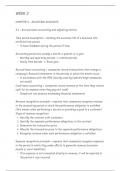
CHAPTER 3 - ADJUSTING ACCOUNTS
3.1 - Accrual-basis accounting and adjusting entries
Time period assumption = dividing the economic life of a business into
artificial time period
5 – To have feedback during the period of time
4
3
Accounting period are usually a month, a quarter or a year
2 – Monthly and quarterly periods -> interim periods
1 – Yearly time periods -> fiscal year
Accrual-basis accounting = companies record transactions that change a
company’s financial statements in the periods in which the events occur
– In accordance with the IFRS (mostly used by medium/large companies
not small)
Cash-basis accounting = companies record revenue at the time they receive
cash (or an expense when they pay out cash)
– Simple but can produce misleading financial statements
Revenue recognition principle = requires that companies recognise revenue
in the accounting period in which the performance obligation is satisfied
(this means when performing a service or providing a good to a customer)
Steps of revenue recognition
. Identify the contract with customers
. Identify the separate performance obligations in the contract
. Determine the transaction price
. Allocate the transaction price to the separate performance obligations
. Recognise revenue when each performance obligation is satisfied
Expense recognition principle = requires that companies recognise expenses
in the period in which they make efforts to generate revenue (consume
assets or incur liabilities)
– If an expense is not connected directly to revenue, it will be reported in
the period it was incurred
,The need for adjusting entries
-> adjusting entries ensure that the revenue and expense recognition
principles are followed
-> necessary because the trial balance (the first pulling together of the
transaction data) may not contain up-to-date or complete data because:
○ Some events are not recorded daily because it is not efficient to do so
(e.g. supplies, wages)
○ Some costs are not recorded during the accounting period because
these costs expire with the passage of time rather than as a result
of recurring daily transactions (e.g. rent, insurance)
○ Some items may be unrecorded (e.g. a utility service bill will not be
received until the next period)
Adjusting entries are required every time a company prepares financial
statements -> the company analyses each account in the trial balance to
determine whether it is complete and up-to-date for financial statement
purposes
– Every adjusting entry will include on income statement account and one
statement of financial position account
Types of adjusting entries
, ● Deferrals
○ Prepaid expenses = expenses paid in cash before they are used or
consumed
○ Unearned revenues = cash received before services are performed
● Accruals
○ Accrued revenues = revenues for services performed but not yet
received in cash or recorded
○ Accrued expenses = expenses incurred but not yet paid in cash or
recorded
3.2 - Adjusting entries for deferrals
Deferrals - expenses or revenues recognised at a date later than the point
when cash was originally exchanged
(1)
Prepaid expenses
-> when companies record payments of expenses that will benefit more than
one accounting period
-> when expenses are prepaid, an asset account is increased (debited) to
show the service or benefit that the company will receive in the future
● Prepaid expenses are costs that expire either the passage of time (e.g.
insurance) or through use (e.g. supplies)
● The expiration of these costs does not require daily entries, without
would be impractical and unnecessary - companies postpose the
recognition of such cost expirations until they prepare financial
statements
● At each statement date, they make adjusting entries to record the
expenses applicable to the current accounting period and show the
remaining amounts in the asset accounts
CHAPTER 3 - ADJUSTING ACCOUNTS
3.1 - Accrual-basis accounting and adjusting entries
Time period assumption = dividing the economic life of a business into
artificial time period
5 – To have feedback during the period of time
4
3
Accounting period are usually a month, a quarter or a year
2 – Monthly and quarterly periods -> interim periods
1 – Yearly time periods -> fiscal year
Accrual-basis accounting = companies record transactions that change a
company’s financial statements in the periods in which the events occur
– In accordance with the IFRS (mostly used by medium/large companies
not small)
Cash-basis accounting = companies record revenue at the time they receive
cash (or an expense when they pay out cash)
– Simple but can produce misleading financial statements
Revenue recognition principle = requires that companies recognise revenue
in the accounting period in which the performance obligation is satisfied
(this means when performing a service or providing a good to a customer)
Steps of revenue recognition
. Identify the contract with customers
. Identify the separate performance obligations in the contract
. Determine the transaction price
. Allocate the transaction price to the separate performance obligations
. Recognise revenue when each performance obligation is satisfied
Expense recognition principle = requires that companies recognise expenses
in the period in which they make efforts to generate revenue (consume
assets or incur liabilities)
– If an expense is not connected directly to revenue, it will be reported in
the period it was incurred
,The need for adjusting entries
-> adjusting entries ensure that the revenue and expense recognition
principles are followed
-> necessary because the trial balance (the first pulling together of the
transaction data) may not contain up-to-date or complete data because:
○ Some events are not recorded daily because it is not efficient to do so
(e.g. supplies, wages)
○ Some costs are not recorded during the accounting period because
these costs expire with the passage of time rather than as a result
of recurring daily transactions (e.g. rent, insurance)
○ Some items may be unrecorded (e.g. a utility service bill will not be
received until the next period)
Adjusting entries are required every time a company prepares financial
statements -> the company analyses each account in the trial balance to
determine whether it is complete and up-to-date for financial statement
purposes
– Every adjusting entry will include on income statement account and one
statement of financial position account
Types of adjusting entries
, ● Deferrals
○ Prepaid expenses = expenses paid in cash before they are used or
consumed
○ Unearned revenues = cash received before services are performed
● Accruals
○ Accrued revenues = revenues for services performed but not yet
received in cash or recorded
○ Accrued expenses = expenses incurred but not yet paid in cash or
recorded
3.2 - Adjusting entries for deferrals
Deferrals - expenses or revenues recognised at a date later than the point
when cash was originally exchanged
(1)
Prepaid expenses
-> when companies record payments of expenses that will benefit more than
one accounting period
-> when expenses are prepaid, an asset account is increased (debited) to
show the service or benefit that the company will receive in the future
● Prepaid expenses are costs that expire either the passage of time (e.g.
insurance) or through use (e.g. supplies)
● The expiration of these costs does not require daily entries, without
would be impractical and unnecessary - companies postpose the
recognition of such cost expirations until they prepare financial
statements
● At each statement date, they make adjusting entries to record the
expenses applicable to the current accounting period and show the
remaining amounts in the asset accounts