Problem 7 – Goldstein, Wolfe, Yantis
Functions of motion perception:
- Helps us understand the environment
- Optic flow: as a person moves forward, objects move relative to the person in the opposite
direction, this provides information about the walker’s direction and speed
- Attentional capture: the ability of motion to attract attention, occurs when you are
consciously looking for something
How do we perceive motion?
- Real motion: actual motion of an object
- Illusory motion: produces perception of motion from stimuli that are not moving
o Apparent motion: 2 stimuli in different locations alternate with correct timing and
look like they are moving but there is no actual movement
- Induced motion: occurs when motion of one object (usually a large one) causes nearby
stationary object (usually smaller) to appear to move
o E.g. the moon appears to be racing through clouds --> movement of large cloud
makes the smaller moon to appear to be moving
- Motion aftereffects (MAE): occurs after viewing a moving stimulus for 30-60 seconds and
then viewing stationary stimulus, which appears to move
- E.g.: waterfall illusion: if you look at a waterfall for 30-60 seconds and then look
somewhere else, everything you see will appear to move up (opposite direction) for a few
seconds
Real vs apparent motion:
- Real and apparent motion activate the similar areas in the brain
- Same brain mechanisms for perception of real and apparent motion
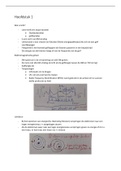
3 conditions:
1- Maria looks ahead as Jeremy walks by. She doesn’t move her eyes so Jeremy’s image
sweeps across her retina. As Jeremy’s image moves across Maria’s retina it stimulates
series of receptors that signal Jeremy’s motion
2- Maria follow Jeremy’s motion as he walks with her eyes. Jeremy’s image remains
stationary on Maria’s fovea. Although Maria perceives Jeremy’s motion this can’t be
explained by what’s happening on the retina
3- Maria decides to walk through the room. The images of walls and objects move across her
retina but Maria doesn’t see the room or objects as moving. There is motion on the retina
but no perception of motion.
, Ecological approach to perception by Gibson:
- Involves looking for information in the environment and not on the retina
- Optic array: the structure created by the surfaces, textures and contours of the
environment
- Gibson focused on how the movement of observes causes changes in optic array
In condition 1: When Jeremy walks across Maria’s field of view, portions of optic array become
covered and uncovered as he walks by
- local disturbance in the optic array: when one object moves relative to the environment,
covering and uncovering the stationary background
In condition 2: Even though Jeremy’s image is stationary on the retina, the same local disturbance
information (that was available when Maria kept her eyes still) remains available when she moves
her eyes
In condition 3: as Maria moves, everything around her moves relative to her motion
- global optic flow: everything moves at once, this signals that Maria is moving but that the
environment is stationary
Motion of stimulus across the retina
- as stimulus sweeps across the retina, it activates directionally selective neurons in the
cortex that respond to oriented bars that are moving in a specific direction
o this doesn’t provide sufficient information!
Aperture problem: viewing only a small portion of a larger stimulus can result in misleading
information about the direction in which the stimulus is moving
- the problem is solved by pooling the responses of a number of neurons in the medial
temporal (MT) cortex in the dorsal (where) stream
- MT neurons receive signals from a number of neurons in the striate cortex (V1) and them
combine these signals to determine the actual direction of the object
- Neurons in MT have much larger receptive fields
Motion of arrays of dots in the retina
- Experiment: as the dots’ coherence (moving in the same direction) increased, monkey’s
judged direction more accurately and the MT neurons fired more rapidly
- This experiment provides information about the neurons in the cortex but not about the
connection between these neurons and perception
Corollary Discharge Theory
When you watch someone move with your eyes keeping your head stationary:
- your eyes move because motor signals (MS) are being sent from the motor area of the
brain to eye muscles
- Another neural signal called corollary discharge signal (CDS) splits off from the motor
signal
- The CDS occurs anytime a motor signal is sent to the eyes
- The CDS reaches a hypothetical structure called the comparator, which relays information
back to the brain that the eye is moving
- Basically: there is no movement of an image across the retina, but the comparator is
receiving information that the eye is moving so the observer perceives motion
Functions of motion perception:
- Helps us understand the environment
- Optic flow: as a person moves forward, objects move relative to the person in the opposite
direction, this provides information about the walker’s direction and speed
- Attentional capture: the ability of motion to attract attention, occurs when you are
consciously looking for something
How do we perceive motion?
- Real motion: actual motion of an object
- Illusory motion: produces perception of motion from stimuli that are not moving
o Apparent motion: 2 stimuli in different locations alternate with correct timing and
look like they are moving but there is no actual movement
- Induced motion: occurs when motion of one object (usually a large one) causes nearby
stationary object (usually smaller) to appear to move
o E.g. the moon appears to be racing through clouds --> movement of large cloud
makes the smaller moon to appear to be moving
- Motion aftereffects (MAE): occurs after viewing a moving stimulus for 30-60 seconds and
then viewing stationary stimulus, which appears to move
- E.g.: waterfall illusion: if you look at a waterfall for 30-60 seconds and then look
somewhere else, everything you see will appear to move up (opposite direction) for a few
seconds
Real vs apparent motion:
- Real and apparent motion activate the similar areas in the brain
- Same brain mechanisms for perception of real and apparent motion
3 conditions:
1- Maria looks ahead as Jeremy walks by. She doesn’t move her eyes so Jeremy’s image
sweeps across her retina. As Jeremy’s image moves across Maria’s retina it stimulates
series of receptors that signal Jeremy’s motion
2- Maria follow Jeremy’s motion as he walks with her eyes. Jeremy’s image remains
stationary on Maria’s fovea. Although Maria perceives Jeremy’s motion this can’t be
explained by what’s happening on the retina
3- Maria decides to walk through the room. The images of walls and objects move across her
retina but Maria doesn’t see the room or objects as moving. There is motion on the retina
but no perception of motion.
, Ecological approach to perception by Gibson:
- Involves looking for information in the environment and not on the retina
- Optic array: the structure created by the surfaces, textures and contours of the
environment
- Gibson focused on how the movement of observes causes changes in optic array
In condition 1: When Jeremy walks across Maria’s field of view, portions of optic array become
covered and uncovered as he walks by
- local disturbance in the optic array: when one object moves relative to the environment,
covering and uncovering the stationary background
In condition 2: Even though Jeremy’s image is stationary on the retina, the same local disturbance
information (that was available when Maria kept her eyes still) remains available when she moves
her eyes
In condition 3: as Maria moves, everything around her moves relative to her motion
- global optic flow: everything moves at once, this signals that Maria is moving but that the
environment is stationary
Motion of stimulus across the retina
- as stimulus sweeps across the retina, it activates directionally selective neurons in the
cortex that respond to oriented bars that are moving in a specific direction
o this doesn’t provide sufficient information!
Aperture problem: viewing only a small portion of a larger stimulus can result in misleading
information about the direction in which the stimulus is moving
- the problem is solved by pooling the responses of a number of neurons in the medial
temporal (MT) cortex in the dorsal (where) stream
- MT neurons receive signals from a number of neurons in the striate cortex (V1) and them
combine these signals to determine the actual direction of the object
- Neurons in MT have much larger receptive fields
Motion of arrays of dots in the retina
- Experiment: as the dots’ coherence (moving in the same direction) increased, monkey’s
judged direction more accurately and the MT neurons fired more rapidly
- This experiment provides information about the neurons in the cortex but not about the
connection between these neurons and perception
Corollary Discharge Theory
When you watch someone move with your eyes keeping your head stationary:
- your eyes move because motor signals (MS) are being sent from the motor area of the
brain to eye muscles
- Another neural signal called corollary discharge signal (CDS) splits off from the motor
signal
- The CDS occurs anytime a motor signal is sent to the eyes
- The CDS reaches a hypothetical structure called the comparator, which relays information
back to the brain that the eye is moving
- Basically: there is no movement of an image across the retina, but the comparator is
receiving information that the eye is moving so the observer perceives motion