Nutrition and Health
Introduction
The digestive system consists of the digestive tract and its supporting organs, which break down
food into molecules that the body's cells can absorb and use. Food gradually breaks down until the
molecules are tiny enough to be absorbed and the waste is removed (SEER, 2023). This will be
covered in detail as part of my science studies, to raise awareness and guidance on the anatomy
and physiology of the digestive system, sources and uses of various important nutrients and
associated symptoms of nutrient deficiency linked to the consequences of, and treatments for,
dietary related diseases.
The Digestive System – Structure and Function
Food must be broken down into smaller molecules in order for it to pass through the intestinal
wall's cells and into the bloodstream, which then carries the nutrients to every cell in your body.
This can either be done mechanically or chemically. Mechanical digestion includes the teeth,
tongue, and peristalsis, whereas chemical digestion includes enzymes and acid (Canvas, Class
Notes, 2023).
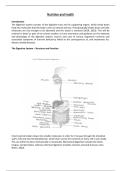
, Above is a hand labelled diagram completed in class, with all the important and necessary
components of the digestive system. Each of these components has a specific role:
1. Mouth = Digestion is first begun in the mouth, where ingestion is the food taken in by the
mouth. Within the mouth 2 other components aid the breakdown of food. Teeth allow the
food to be chewed and broken down into smaller pieces increasing the surface area for the
enzymes to act on. The tongue moves this food around the mouth and forms a bolus (ball)
of food that is easily swallowed.
(Lumen Learning, 2023).
2. Alimentary Canal = Once the food has been broken down and a bolus has been formed, the
tongue forces the produced bolus to the rear of the mouth, where it can then enter the
alimentary canal through the pharynx.
A specific name that lines the alimentary canal is called the mucosa. It is a moist epithelial
membrane that runs the length of the alimentary canal, from the mouth to the anus. The
mucosa secretes hormones, digestive enzymes, and mucus. As well as this it also absorbs
the byproducts of digestion into the blood and guards against infectious diseases.
Introduction
The digestive system consists of the digestive tract and its supporting organs, which break down
food into molecules that the body's cells can absorb and use. Food gradually breaks down until the
molecules are tiny enough to be absorbed and the waste is removed (SEER, 2023). This will be
covered in detail as part of my science studies, to raise awareness and guidance on the anatomy
and physiology of the digestive system, sources and uses of various important nutrients and
associated symptoms of nutrient deficiency linked to the consequences of, and treatments for,
dietary related diseases.
The Digestive System – Structure and Function
Food must be broken down into smaller molecules in order for it to pass through the intestinal
wall's cells and into the bloodstream, which then carries the nutrients to every cell in your body.
This can either be done mechanically or chemically. Mechanical digestion includes the teeth,
tongue, and peristalsis, whereas chemical digestion includes enzymes and acid (Canvas, Class
Notes, 2023).
, Above is a hand labelled diagram completed in class, with all the important and necessary
components of the digestive system. Each of these components has a specific role:
1. Mouth = Digestion is first begun in the mouth, where ingestion is the food taken in by the
mouth. Within the mouth 2 other components aid the breakdown of food. Teeth allow the
food to be chewed and broken down into smaller pieces increasing the surface area for the
enzymes to act on. The tongue moves this food around the mouth and forms a bolus (ball)
of food that is easily swallowed.
(Lumen Learning, 2023).
2. Alimentary Canal = Once the food has been broken down and a bolus has been formed, the
tongue forces the produced bolus to the rear of the mouth, where it can then enter the
alimentary canal through the pharynx.
A specific name that lines the alimentary canal is called the mucosa. It is a moist epithelial
membrane that runs the length of the alimentary canal, from the mouth to the anus. The
mucosa secretes hormones, digestive enzymes, and mucus. As well as this it also absorbs
the byproducts of digestion into the blood and guards against infectious diseases.