Musculoskeletal System
Introduction
A typical human skeleton consists of 206 bones which are connected to the muscles by
tendons. However, babies have 270 soft bones at birth, which is around 64 more than adults
have. By the age of 25, these will combine to form the 206 hard, permanent bones (Canvas,
Class Notes, 2023).
The musculoskeletal system consists of cartilage, tendons, ligaments, connective tissues,
bones, tissues, muscles, and joints. The body receives structure and support from this
system and permits movement. Throughout life, the components of the musculoskeletal
system develop and alter. Bones, muscles, and joints can be harmed by accidents and
numerous conditions which will be covered in this section (Health Direct, 2021).
Over 30 million working days are lost in the UK annually as a result of musculoskeletal
disorders, according to the NHS. They cost the NHS about £5 billion a year and make up up
to 30% of GP consultations in England (HealthClubManagement, 2023).
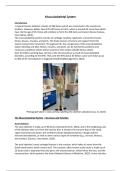
Photograph taken in class activity, labelling the skeleton (Jakubovicova, EJ, 2023).
The Musculoskeletal System – Structure and Function
Axial skeleton
The axial skeleton is made up of 80 bones (Cleveland Clinic, 2023), and is the lengthways axis
of the skeleton that runs from the head to feet. It involves the cranium (top of the skull),
upper and lower jaw bones, the vertebral column (backbone/spine), ribcage and the
sternum (breastbone), as well as other various types of vertebrae (e.g., cervical, thoracic,
and lumbar), (Canvas, Class Notes, 2023).
The axial skeleton’s most enlarged feature is the cranium, which takes its name from the
Greek word krania, which means skull. The cranium, often known as the skull, is made up of
22 bones and is separated into two parts: the viscerocranium, which forms the face, and the
neurocranium, which protects the brain (National Library of Medicine, 2023). It also includes
, the facial skeleton, upper teeth rooted in the maxilla and the lower teeth in the mandible,
which is the only free bone to be able to move, assisting in the chewing of nutritious.
Excluding the lower jawbone, all the bones in the skull are joined together but sutures which
are linking joints. The skull also has ‘holes’ or gaps in it which are crucial for nerves and
blood vessels to pass through the cranium. These gaps are called foramina (Canvas, Class
Notes, 2023).
The skull (proprofs, 2023)
The vertebral column is frequently referred to as the spine or spinal column. It is made up of
a series of vertebrae, each of which is connected to the adjacent in a line by an
intervertebral disc, in which the vertebral column is made up of. It is a flexible column that
holds up the head, neck and body and permits movement of those parts. Initially consisting
of 33 vertebrae, the vertebral column eventually becomes composed of 24 vertebrae plus
the sacrum and coccyx (LumenLearning, 2023). The sacrum and coccyx are distinct from
other spinal column bones. The sacrum is a big, flat, triangular shaped bone located below
the last lumbar vertebrae and is located between the hip bones. Below the sacrum lies the
coccyx, which is also called the tailbone. This can be shown in the image below
(HealthCentral, 2023).
(HealthCentral, 2023).
Introduction
A typical human skeleton consists of 206 bones which are connected to the muscles by
tendons. However, babies have 270 soft bones at birth, which is around 64 more than adults
have. By the age of 25, these will combine to form the 206 hard, permanent bones (Canvas,
Class Notes, 2023).
The musculoskeletal system consists of cartilage, tendons, ligaments, connective tissues,
bones, tissues, muscles, and joints. The body receives structure and support from this
system and permits movement. Throughout life, the components of the musculoskeletal
system develop and alter. Bones, muscles, and joints can be harmed by accidents and
numerous conditions which will be covered in this section (Health Direct, 2021).
Over 30 million working days are lost in the UK annually as a result of musculoskeletal
disorders, according to the NHS. They cost the NHS about £5 billion a year and make up up
to 30% of GP consultations in England (HealthClubManagement, 2023).
Photograph taken in class activity, labelling the skeleton (Jakubovicova, EJ, 2023).
The Musculoskeletal System – Structure and Function
Axial skeleton
The axial skeleton is made up of 80 bones (Cleveland Clinic, 2023), and is the lengthways axis
of the skeleton that runs from the head to feet. It involves the cranium (top of the skull),
upper and lower jaw bones, the vertebral column (backbone/spine), ribcage and the
sternum (breastbone), as well as other various types of vertebrae (e.g., cervical, thoracic,
and lumbar), (Canvas, Class Notes, 2023).
The axial skeleton’s most enlarged feature is the cranium, which takes its name from the
Greek word krania, which means skull. The cranium, often known as the skull, is made up of
22 bones and is separated into two parts: the viscerocranium, which forms the face, and the
neurocranium, which protects the brain (National Library of Medicine, 2023). It also includes
, the facial skeleton, upper teeth rooted in the maxilla and the lower teeth in the mandible,
which is the only free bone to be able to move, assisting in the chewing of nutritious.
Excluding the lower jawbone, all the bones in the skull are joined together but sutures which
are linking joints. The skull also has ‘holes’ or gaps in it which are crucial for nerves and
blood vessels to pass through the cranium. These gaps are called foramina (Canvas, Class
Notes, 2023).
The skull (proprofs, 2023)
The vertebral column is frequently referred to as the spine or spinal column. It is made up of
a series of vertebrae, each of which is connected to the adjacent in a line by an
intervertebral disc, in which the vertebral column is made up of. It is a flexible column that
holds up the head, neck and body and permits movement of those parts. Initially consisting
of 33 vertebrae, the vertebral column eventually becomes composed of 24 vertebrae plus
the sacrum and coccyx (LumenLearning, 2023). The sacrum and coccyx are distinct from
other spinal column bones. The sacrum is a big, flat, triangular shaped bone located below
the last lumbar vertebrae and is located between the hip bones. Below the sacrum lies the
coccyx, which is also called the tailbone. This can be shown in the image below
(HealthCentral, 2023).
(HealthCentral, 2023).