Corporate Communication Exam
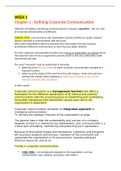
Week 1
Corporate Communication → a management function that offers a framework for the effective
coordination of all external and internal communication with the overall purpose of establishing
and maintaining favorable reputations with stakeholder groups upon which the organization is
dependent
Stakeholders → any group affected by the decisions of an organization
Corporation → how organization presents itself to stakeholders
● Narrow → specific legal form of organization
● Broad → group of people working together
Corpus → metaphor→ org. is a body with different functions
Metonymy → simple association allows us to talk about something much more complex
Organization → all organized groups that communicate strategically with their stakeholders
(e.g. NGO)
Integration of Strategic Communication functions
Stakeholders and Corporate Reputation:
- Corporate branding - Issues management - Employee com.
- Corp. Identity - Media Relations - Leadership com.
- CSR communication - Crisis com. - Change com.
1. Mission → purpose that aligns with the values and expectations of stakeholders
2. Vision → long-term aspiration/ goal of org.
3. Corporate obj. → statement of overall aims of an org.
4. Strategy → actions and communications that are linked to objectives that are specified in
sense of organizational functions
5. Corporate identity → profile and values communicated by an org.
6. Corporate image → associations of an individual in response to message from an
audience
7. Corporate reputation → individual’s collective representation of past images of an
organization established over time
8. Integration → act of coordination; everyone has the same idea about an organization’s
corporate identity
,Trends:
1900-1970 → publicity promotions
- Information dissemination (spreading); not strategically integrated into the org.; one-way
communication
1980-2000 → positioning
- More strategic; focus on reputation; getting the right corporate image
2000- present → stakeholder engagement; two way and one way communication;
fast-changing media landscape
- Transparency
- Advocacy → spontaneous activities of workplace members that are significant to
expanded achievement and furthering the well-being of themselves, their co-members,
and the collective workplace community
- Interactivity
- Authenticity
Corporate Positioning → planned and controlled transfer of corporate messages and campaigns
Content Generation → corp.com as a joint activity between org. and its stakeholders
Broadcasting → stakeholders receive messages from org. in controlled and planned manner
Crowd-casting → stakeholders as participants produce or forward content about the
organization
Classification of Social Media:
1. Owned media → online media that an org. owns and controls (e.g. tiktok account,
website, blog, facebook profile)
-Role: generate interest in the organization, engage stakeholders and build relationships
with them
-Benefits: control, cost efficiency, engaged stakeholders
-Challenges: no guarantee of engagement, potential skepticism toward organization
, 2. Paid media → paid for content or exposure on another media (advertising, paid search,
sponsored links)
-Role: direct advertisement of the organization, channel that feeds owned media and may
on occasion create earned media
-Benefits: immediacy, control
- Challenges: Clutter, declining reach and response rates, credibility
3. Earned media → stakeholder generated word of mouth (spoken communication) that
becomes a medium (word of mouth, online chatter, viral spread of content);
-Role: earned might generate traffic to owned media; owned and paid media might create
earned
- Benefits: most credible and authentic
- Challenges: no control, can be negative, hard to measure
4. User-generated content → any content generated by people and published to a social
network
5. Social presence → contact individuals exchange with one - another as they communicate
6. Media Richness → amount of info that can be exchanged in real-time; depends on the
strategic goal of an org
7. Self-presentation → achieved through degree of self-disclosure (on social media);
release of personal info
Blogs → Low social presence, High self presentation
Social networking sites → Medium social presence, High self presentation
Virtual worlds → High social presence, High self presentation
Collaborative projects (Wikipedia) → Low social presence, Low self presentation
Content Communities → medium social presence, Low self presentation (youtube)
Virtual game worlds → High social presence, Low self presentation
Media Landscape Challenges and
1. Development of digital media moves quickly (lack of resources to keep up)
2. Institutionalization of new organizational patterns makes social media an integral part of
organization → takes time
Opportunities:
3. Further opportunities for marketing
4. Conversational voice (chatbots)
5. Networking with stakeholders
6. Self-organization of stakeholders
7. Co-creating reputations
Stakeholder Engagement Theory → using two-way communication through social media and
technology; interactivity, transparency, advocacy
Week 1
Corporate Communication → a management function that offers a framework for the effective
coordination of all external and internal communication with the overall purpose of establishing
and maintaining favorable reputations with stakeholder groups upon which the organization is
dependent
Stakeholders → any group affected by the decisions of an organization
Corporation → how organization presents itself to stakeholders
● Narrow → specific legal form of organization
● Broad → group of people working together
Corpus → metaphor→ org. is a body with different functions
Metonymy → simple association allows us to talk about something much more complex
Organization → all organized groups that communicate strategically with their stakeholders
(e.g. NGO)
Integration of Strategic Communication functions
Stakeholders and Corporate Reputation:
- Corporate branding - Issues management - Employee com.
- Corp. Identity - Media Relations - Leadership com.
- CSR communication - Crisis com. - Change com.
1. Mission → purpose that aligns with the values and expectations of stakeholders
2. Vision → long-term aspiration/ goal of org.
3. Corporate obj. → statement of overall aims of an org.
4. Strategy → actions and communications that are linked to objectives that are specified in
sense of organizational functions
5. Corporate identity → profile and values communicated by an org.
6. Corporate image → associations of an individual in response to message from an
audience
7. Corporate reputation → individual’s collective representation of past images of an
organization established over time
8. Integration → act of coordination; everyone has the same idea about an organization’s
corporate identity
,Trends:
1900-1970 → publicity promotions
- Information dissemination (spreading); not strategically integrated into the org.; one-way
communication
1980-2000 → positioning
- More strategic; focus on reputation; getting the right corporate image
2000- present → stakeholder engagement; two way and one way communication;
fast-changing media landscape
- Transparency
- Advocacy → spontaneous activities of workplace members that are significant to
expanded achievement and furthering the well-being of themselves, their co-members,
and the collective workplace community
- Interactivity
- Authenticity
Corporate Positioning → planned and controlled transfer of corporate messages and campaigns
Content Generation → corp.com as a joint activity between org. and its stakeholders
Broadcasting → stakeholders receive messages from org. in controlled and planned manner
Crowd-casting → stakeholders as participants produce or forward content about the
organization
Classification of Social Media:
1. Owned media → online media that an org. owns and controls (e.g. tiktok account,
website, blog, facebook profile)
-Role: generate interest in the organization, engage stakeholders and build relationships
with them
-Benefits: control, cost efficiency, engaged stakeholders
-Challenges: no guarantee of engagement, potential skepticism toward organization
, 2. Paid media → paid for content or exposure on another media (advertising, paid search,
sponsored links)
-Role: direct advertisement of the organization, channel that feeds owned media and may
on occasion create earned media
-Benefits: immediacy, control
- Challenges: Clutter, declining reach and response rates, credibility
3. Earned media → stakeholder generated word of mouth (spoken communication) that
becomes a medium (word of mouth, online chatter, viral spread of content);
-Role: earned might generate traffic to owned media; owned and paid media might create
earned
- Benefits: most credible and authentic
- Challenges: no control, can be negative, hard to measure
4. User-generated content → any content generated by people and published to a social
network
5. Social presence → contact individuals exchange with one - another as they communicate
6. Media Richness → amount of info that can be exchanged in real-time; depends on the
strategic goal of an org
7. Self-presentation → achieved through degree of self-disclosure (on social media);
release of personal info
Blogs → Low social presence, High self presentation
Social networking sites → Medium social presence, High self presentation
Virtual worlds → High social presence, High self presentation
Collaborative projects (Wikipedia) → Low social presence, Low self presentation
Content Communities → medium social presence, Low self presentation (youtube)
Virtual game worlds → High social presence, Low self presentation
Media Landscape Challenges and
1. Development of digital media moves quickly (lack of resources to keep up)
2. Institutionalization of new organizational patterns makes social media an integral part of
organization → takes time
Opportunities:
3. Further opportunities for marketing
4. Conversational voice (chatbots)
5. Networking with stakeholders
6. Self-organization of stakeholders
7. Co-creating reputations
Stakeholder Engagement Theory → using two-way communication through social media and
technology; interactivity, transparency, advocacy