Theme 1: Brain and Body
Biopsychology, Pinel Chapter 3
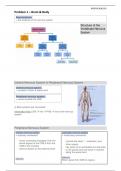
Human Nervous System
It is divided into two: the central nervous system (CNS) and the peripheral nervous system
(PNS).
CNS:
Incudes the nervous system located in the skull and spine.
PNS:
Includes the nervous system not located in the skull and spine.
It is further divided into the somatic and autonomic nervous systems (SNS & ANS).
SNS:
Includes afferent nerves that carry sensory signals from the skin, skeletal muscles, joints, eyes,
ears, etc. to the central nervous system.
Includes efferent nerves that carry motor signals from the central nervous system to the skeletal
muscles.
ANS:
Also includes afferent and efferent nerves. Afferent nerves carry sensory signals from the
internal organs to the CNS while efferent nerves carry motor signals from the CNS to the
internal organs.
So, the ANS is focused on the internal environment of the body.
Afferent = from diff parts to (CNS)
Efferent = from (CNS) to diff parts
The autonomic nervous system (ANS) has two types of efferent nerves:
sympathetic and parasympathetic.
1.Origin and Structure:
- Sympathetic nerves emerge from the lumbar (lower; small of the back) and thoracic (chest
area) regions of the spinal cord.
- Parasympathetic nerves originate in the brain and sacral (lowest) region.
2. Functions:
- Sympathetic nerves mobilize energy for action in threatening situations (associated with
psychological arousal). [fight or flight]
- Parasympathetic nerves conserve energy (linked to psychological relaxation).
, - Each autonomic target organ receives opposing sympathetic and parasympathetic input, and
its activity is thus controlled by relative levels of sympathetic and parasympathetic activity;
3. Exceptions:
- Most peripheral nerves emerge from the spinal cord, except for 12 pairs of cranial nerves,
which project directly from the brain.
The functions of the various cranial nerves are commonly assessed by neurologists as a basis
for diagnosis. Because the functions and locations of the cranial nerves are specific, disruptions
of particular cranial nerve functions provide excellent clues about the location and extent
of tumors and other kinds of brain pathology.
The Three Meninges:
- They are responsible for protecting the brain and spinal cord.
- Dura Mater: outermost meninx (toughest layer)
- Arachnoid Mater: spider-like membrane (middle layer)
- Pia Mater: innermost meninx
- Between the arachnoid mater and the pia mater there is a space called the
subarachnoid space which contains many large blood vessels and cerebrospinal fluid.
,Cerebrospinal Fluid (CSF):
- The CSF also protects the brain.
- The CSF is found in the subarachnoid space, the central canal of the spinal cord, and
the cerebral ventricles of the brain (four large internal chambers of the brain: the two
lateral ventricles, the third ventricle, and the fourth ventricle).
- The subarachnoid space, central canal, and cerebral ventricles are interconnected by a
series of openings and thus form a single reservoir.
- The cerebrospinal fluid supports and cushions the brain. Patients who have had some of
their cerebrospinal fluid drained away often suffer raging headaches and experience
stabbing pain each time they jerk their heads.
Blood-Brain Barrier:
- Many toxic substances that are present in the bloodstream are prohibited from entering
the brain by a mechanism called the blood-brain barrier where cells of cerebral blood
vessel walls are tightly packed, forming a barrier to the passage of large proteins.
- Unlike large toxic molecules, glucose, which is critical for the function of the brain, is
actively transported through the vessel walls.
- Many CNS disorders are associated with impairment of the blood–brain barrier.
, - The degree to which therapeutic or recreational drugs can influence brain activity
depends on the ease with which they penetrate the blood–brain barrier.
Cells of the Nervous System:
- Two types: either neurons or glial cells.
- Anatomy of Neurons
- neurons are cells that are specialized for the reception, conduction, and
transmission of electrochemical signals.
- They have many different shapes and sizes but this is the most common.
Biopsychology, Pinel Chapter 3
Human Nervous System
It is divided into two: the central nervous system (CNS) and the peripheral nervous system
(PNS).
CNS:
Incudes the nervous system located in the skull and spine.
PNS:
Includes the nervous system not located in the skull and spine.
It is further divided into the somatic and autonomic nervous systems (SNS & ANS).
SNS:
Includes afferent nerves that carry sensory signals from the skin, skeletal muscles, joints, eyes,
ears, etc. to the central nervous system.
Includes efferent nerves that carry motor signals from the central nervous system to the skeletal
muscles.
ANS:
Also includes afferent and efferent nerves. Afferent nerves carry sensory signals from the
internal organs to the CNS while efferent nerves carry motor signals from the CNS to the
internal organs.
So, the ANS is focused on the internal environment of the body.
Afferent = from diff parts to (CNS)
Efferent = from (CNS) to diff parts
The autonomic nervous system (ANS) has two types of efferent nerves:
sympathetic and parasympathetic.
1.Origin and Structure:
- Sympathetic nerves emerge from the lumbar (lower; small of the back) and thoracic (chest
area) regions of the spinal cord.
- Parasympathetic nerves originate in the brain and sacral (lowest) region.
2. Functions:
- Sympathetic nerves mobilize energy for action in threatening situations (associated with
psychological arousal). [fight or flight]
- Parasympathetic nerves conserve energy (linked to psychological relaxation).
, - Each autonomic target organ receives opposing sympathetic and parasympathetic input, and
its activity is thus controlled by relative levels of sympathetic and parasympathetic activity;
3. Exceptions:
- Most peripheral nerves emerge from the spinal cord, except for 12 pairs of cranial nerves,
which project directly from the brain.
The functions of the various cranial nerves are commonly assessed by neurologists as a basis
for diagnosis. Because the functions and locations of the cranial nerves are specific, disruptions
of particular cranial nerve functions provide excellent clues about the location and extent
of tumors and other kinds of brain pathology.
The Three Meninges:
- They are responsible for protecting the brain and spinal cord.
- Dura Mater: outermost meninx (toughest layer)
- Arachnoid Mater: spider-like membrane (middle layer)
- Pia Mater: innermost meninx
- Between the arachnoid mater and the pia mater there is a space called the
subarachnoid space which contains many large blood vessels and cerebrospinal fluid.
,Cerebrospinal Fluid (CSF):
- The CSF also protects the brain.
- The CSF is found in the subarachnoid space, the central canal of the spinal cord, and
the cerebral ventricles of the brain (four large internal chambers of the brain: the two
lateral ventricles, the third ventricle, and the fourth ventricle).
- The subarachnoid space, central canal, and cerebral ventricles are interconnected by a
series of openings and thus form a single reservoir.
- The cerebrospinal fluid supports and cushions the brain. Patients who have had some of
their cerebrospinal fluid drained away often suffer raging headaches and experience
stabbing pain each time they jerk their heads.
Blood-Brain Barrier:
- Many toxic substances that are present in the bloodstream are prohibited from entering
the brain by a mechanism called the blood-brain barrier where cells of cerebral blood
vessel walls are tightly packed, forming a barrier to the passage of large proteins.
- Unlike large toxic molecules, glucose, which is critical for the function of the brain, is
actively transported through the vessel walls.
- Many CNS disorders are associated with impairment of the blood–brain barrier.
, - The degree to which therapeutic or recreational drugs can influence brain activity
depends on the ease with which they penetrate the blood–brain barrier.
Cells of the Nervous System:
- Two types: either neurons or glial cells.
- Anatomy of Neurons
- neurons are cells that are specialized for the reception, conduction, and
transmission of electrochemical signals.
- They have many different shapes and sizes but this is the most common.