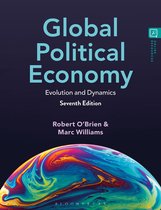
Summary Global Political Economy Evolution and Dynamics Robert O'Brien 7th edition 2024 9781350347892
Summary
Global Political Economy
Evolution and Dynamics
Robert O'Brien
9781350347892
7th edition 2024
+ Test bank 75 questions with answers
+ Top 50 dates explained with events summarized alphabetically (love this one!)
,Summary Global Political Economy Evolution and Dynamics Robert O'Brien 7th edition 2024 9781350347892
,Summary Global Political Economy Evolution and Dynamics Robert O'Brien 7th edition 2024 9781350347892
, Summary Global Political Economy Evolution and Dynamics Robert O'Brien 7th edition 2024 9781350347892
Chapter 1: Theories of Global Political Economy
Interpretations of the Asian financial crisis (1997)
Liberal State power Critical
Causes Crony capitalism (corrupt Overrapid liberalization, Predatory liberalism, power
business practices and reduced state capacity of financial interests, systemic
political to flaws
influence), lack of transparency regulate
Key Corruption, lack of liberal Clash of Anglo-American Human suffering caused by
issue(s) economic practices vs Asian models financial collapse
Lessons Increase transparency and good Limit financial speculation Reform IFS, defend national
practice in developing countries through state policies system
The Economic Nationalist Perspective
- Protection of the national unit (realism)
- Mercantilism (15th century-mid-19th century): limited amount of wealth in the world and each
state must secure its interest by blocking the economic interests of other states ‘zero-sum game’
- Hamilton: founding father of the US – US should protect their manufacturers from
foreign competition to industrialize and increase their power
- List: Germany should industrialize behind trade barriers in order to catch up with the UK
- Contemporary economic nationalist: acknowledgement that states remain at the centre of
power within the GPE and there is an intimate connection between power and wealth
Key actors - State as main actor: two major assumptions
- Inter-state system is anarchical and it is therefore the duty of each state to protect its own
interests
- State remains the preeminent actor in the domestic and international domains (state =
central instrument through which people can fulfil their goals)
Key dynamics
- State’s fate determined by its ability to ensure that its citizens reap advantages from
international production and exchange
- The nature of the global economy reflects the interests of the most powerful states
- Defensive economic nationalists: recognize globalization as a threat and seek to counter its impact
- Sceptical economic nationalists: globalization is largely a myth and that the power of the
states remains undiminished
Conflict and cooperation
- Relations between states are characterized by unending conflict and the pursuit of power
- Production of some good/service within particular national borders (security concerns,
agriculture or cultural products)
- Import of some products pollutes the nation through the introduction of foreign values
- Support the ‘rights’ of local investors over foreigners
Economic nationalism today
- Trade in services (i.e. education and healthcare) sensitive subject that many states are unwilling
to open up to foreign competition
- In pursuit of development; supporting particular industries
Summary
Global Political Economy
Evolution and Dynamics
Robert O'Brien
9781350347892
7th edition 2024
+ Test bank 75 questions with answers
+ Top 50 dates explained with events summarized alphabetically (love this one!)
,Summary Global Political Economy Evolution and Dynamics Robert O'Brien 7th edition 2024 9781350347892
,Summary Global Political Economy Evolution and Dynamics Robert O'Brien 7th edition 2024 9781350347892
, Summary Global Political Economy Evolution and Dynamics Robert O'Brien 7th edition 2024 9781350347892
Chapter 1: Theories of Global Political Economy
Interpretations of the Asian financial crisis (1997)
Liberal State power Critical
Causes Crony capitalism (corrupt Overrapid liberalization, Predatory liberalism, power
business practices and reduced state capacity of financial interests, systemic
political to flaws
influence), lack of transparency regulate
Key Corruption, lack of liberal Clash of Anglo-American Human suffering caused by
issue(s) economic practices vs Asian models financial collapse
Lessons Increase transparency and good Limit financial speculation Reform IFS, defend national
practice in developing countries through state policies system
The Economic Nationalist Perspective
- Protection of the national unit (realism)
- Mercantilism (15th century-mid-19th century): limited amount of wealth in the world and each
state must secure its interest by blocking the economic interests of other states ‘zero-sum game’
- Hamilton: founding father of the US – US should protect their manufacturers from
foreign competition to industrialize and increase their power
- List: Germany should industrialize behind trade barriers in order to catch up with the UK
- Contemporary economic nationalist: acknowledgement that states remain at the centre of
power within the GPE and there is an intimate connection between power and wealth
Key actors - State as main actor: two major assumptions
- Inter-state system is anarchical and it is therefore the duty of each state to protect its own
interests
- State remains the preeminent actor in the domestic and international domains (state =
central instrument through which people can fulfil their goals)
Key dynamics
- State’s fate determined by its ability to ensure that its citizens reap advantages from
international production and exchange
- The nature of the global economy reflects the interests of the most powerful states
- Defensive economic nationalists: recognize globalization as a threat and seek to counter its impact
- Sceptical economic nationalists: globalization is largely a myth and that the power of the
states remains undiminished
Conflict and cooperation
- Relations between states are characterized by unending conflict and the pursuit of power
- Production of some good/service within particular national borders (security concerns,
agriculture or cultural products)
- Import of some products pollutes the nation through the introduction of foreign values
- Support the ‘rights’ of local investors over foreigners
Economic nationalism today
- Trade in services (i.e. education and healthcare) sensitive subject that many states are unwilling
to open up to foreign competition
- In pursuit of development; supporting particular industries