Chapter n n 01 n n –
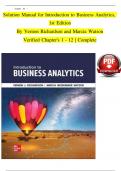
Solution Manual for Introduction to Business Analytics,
po po po po po po po
1st Edition
po
By Vernon Richardson and Marcia Watson
po po po po po
Verified Chapter's 1 - 12 | Complete
po po po po po po
, Chapter n n 01 n n –
TABLE OF CONTENTS n n
Chapter 1: Specifyn n then n Question:n n Usingn n Businessn n Analyticsn n to n n Addressn n Businessn n Questions
Chapter 2: Obtainn n then n Data:n n Ann n Introductionn n to n n Businessn n Datan n Sources
Chapter n n 3:n n Analyzen n then n Data:n n Basicn n Statisticsn n andn n Toolsn n Requiredn n inn n Businessn n Analytics
Chapter n 4:n Analyzen then Data:n Exploratoryn Businessn Analyticsn (Descriptiven Analyticsn andn DiagnosticnAna
lytics)
Chapter n 5:n Analyzen then Data:n Confirmatoryn Businessn Analyticsn (Predictiven Analyticsn andn Prescripti
vn en Analytics)
Chapter 6: Reportn n then n Results:n n Usingn n Datan n Visualization
Chapter 7: Marketingn n Analytics
Chapter 8: Accountingn n Analytics
Chapter 9: Financialn n Analytics
Chapter 10: Operationsn n Analytics
Chapter 11: Advancedn n Businessn n Analytics
Chapter 12: Usingn n then n SOARn n Analyticsn n Modeln n to n n Putn n Itn n Alln n Together:n n Threen n Capstonen n Projects
, Chapter n n 01 n n –
Chapter 1 End-of-Chapter Assignment Solutions
n n n n
Multiple n n Choice n n Questions
1. (LOn 1.1) n An coordinated,n standardizedn setn of n activitiesn conductedn byn bothn peoplen andn equipme n
ntn ton accomplishn an specificn businessn taskn isn called.
a. businessn n processes
b. businessn n analysis
c. businessn n procedure
d. businessn n value
2. (LOn 1.2) n n Accordingn n ton n the n n informationn value n n chain,n n datan n combinedn n withn n contextn n is
a. Information.
b. Knowledge.
c. Insight.
d. Value.
3. (LOn n 1.5) n Whichn phasen ofn then SOARn analyticsn modeln addressesn then propern wayn ton communni
cate n resultsn ton the n decisionn maker?
a. Specifyn n the n n question
b. Obtainn n the n n data
c. Analyze n n the n n data
d. Reportn n the n n results
4. (LOn 1.5) n Whichn phase n ofn then SOARn analyticsn modeln involvesn findingn then mostn appropriate n datan
neededn ton addressn the n businessn question?
a. Specifyn n the n n question
b. Obtainn n the n n data
c. Analyze n n the n n data
d. Reportn n the n n results
5. (LOn n 1.5) n n Whichn n questionsn n seekn n informationn n aboutn n Tesla’sn n salesn n inn n the n n nextn n quarter?
a. Whatn n happened?n n Whatn n isn n happening?
b. Whyn n didn n itn n happen?n n Whatn n are n n the n n causesn n of n n pastn n results?
c. Willn itn happenn inn the n future?n Whatn isn the n probabilityn somethingn willn happen?n Cann
we n forecastn whatn willn happen?
d. Whatn shouldn we n do,n basedn onn whatn we n expectn willn happen?n Hown don we n optimize n ourn
performance n basednonn potentialn constraints?
6. (LOn 1.5) n Whichn questionsn seekn informationn onn the n routingn ofn productsn fromn Queretaro,n Mn
exicon ton Chicago,n Unitedn Statesn inn the n lastn quarter?
a. Whatn n happened?n n Whatn n isn n happening?
b. Whyn n didn n itn n happen?n n Whatn n are n n the n n causesn n of n n pastn n results?
c. Willn itn happenn inn the n future?n n Whatn isn then probabilityn n somethingn willn happen?n Cann w
n e n forecastn whatn willn happen?
d. Whatn shouldn we n do,n basedn onn whatn we n expectn willn happen?n Hown don we n optimize n ourn
performance n basednonn potentialn constraints?
, Chapter n n 01 n n –
7. (LOn 1.5) n Whichn questionsn askn whyn netn income n isn increasingn whenn revenuesn are n decrn
easing,n countern tonexpectations?
a. Whatn n happened?n n Whatn n isn n happening?
b. Whyn n didn n itn n happen?n n Whatn n are n n the n n causesn n ofn n pastn n results?
c. Willn itn happenn inn the n future?n n Whatn isn then probabilityn somethingn willn happen?n Cann w
n e n forecastn whatn willn happen?
d. Whatn shouldn we n do,n basedn onn whatn we n expectn willn happen?n Hown don we n optimize n ourn
performance n basednonn potentialn constraints?
8. (LOn 1.5) n Whichn questionsn helpn managersn understandn hown ton organizen futuren shipmentsn ban
sedn onn expectedndemand?
a. Whatn n happened?n n Whatn n isn n happening?
b. Whyn n didn n itn n happen?n n Whatn n are n n the n n causesn n of n n pastn n results?
c. Willn itn happenn inn the n future?n n Whatn isn then probabilityn n somethingn willn happen?n Cann w
n e n forecastn whatn willn happen?
d. Whatn n shouldn n we n n do,n basedn n onn n whatn n wen expectn n willn n happen?n n Hown n don n wen n optimi
zne n ourn performance n basedn onn potentialn constraints?
9. (LOn n 1.5) n Whichn termn refersn ton then combinedn accuracy,n validity,n andn consistencyn of n datan ston
redn andn usedn overntime?
a. Datan n integrity
b. Datan n overload
c. Datan n value
d. Informationn value
10. (LOn n 1.3) n n An n specialistn n whon n knowsn n hown n ton n workn n with,n n manipulate,n n andn n statisticallyn n testn n datan n isn n a
a. decisionn n maker.
b. datan n scientist.
c. datan n analyst.
d. decisionn n scientist.
11. (LOn n 1.4)n Whichn type n of n analystsn predictsn the n amountn ofn moneyn thatn an companyn willn receiven fnr
omn itsn customersn ton helpn managementn evaluate n future n investmentsn basedn onn expectedn investme nn
tn performance, n suchn asn investmentsn inn equipmentn orn employee n training?
a. Marketingn n analyst
b. Operationsn n analyst
c. Financialn n analyst
d. Accountingn analyst
12. (LOn 1.4) n n Whichn type n n of n analystn n addressesn n questionsn n regardingn n tax n n andn n auditing?
a. Marketingn n analyst
b. Operationsn n analyst
c. Financialn n analyst
d. Accountingn analyst
13. (LOn n 1.5) n Supposen an companyn hasn timelyn productn reviewsn thatn aren available n whenn needed,n
butn the n reviewsn are n biased.n These n productn reviewsn are n whichn type n of n data?
a. Reliable
b. Relevant
c. Curated
d. Consistent
©n McGrawn Hilln LLC.n n Alln rightsn reserved.n Non reproductionn orn n distributionn withoutn then prior n writtenn consentn of n
Mcn Grawn Hilln LLC.
4
Solution Manual for Introduction to Business Analytics,
po po po po po po po
1st Edition
po
By Vernon Richardson and Marcia Watson
po po po po po
Verified Chapter's 1 - 12 | Complete
po po po po po po
, Chapter n n 01 n n –
TABLE OF CONTENTS n n
Chapter 1: Specifyn n then n Question:n n Usingn n Businessn n Analyticsn n to n n Addressn n Businessn n Questions
Chapter 2: Obtainn n then n Data:n n Ann n Introductionn n to n n Businessn n Datan n Sources
Chapter n n 3:n n Analyzen n then n Data:n n Basicn n Statisticsn n andn n Toolsn n Requiredn n inn n Businessn n Analytics
Chapter n 4:n Analyzen then Data:n Exploratoryn Businessn Analyticsn (Descriptiven Analyticsn andn DiagnosticnAna
lytics)
Chapter n 5:n Analyzen then Data:n Confirmatoryn Businessn Analyticsn (Predictiven Analyticsn andn Prescripti
vn en Analytics)
Chapter 6: Reportn n then n Results:n n Usingn n Datan n Visualization
Chapter 7: Marketingn n Analytics
Chapter 8: Accountingn n Analytics
Chapter 9: Financialn n Analytics
Chapter 10: Operationsn n Analytics
Chapter 11: Advancedn n Businessn n Analytics
Chapter 12: Usingn n then n SOARn n Analyticsn n Modeln n to n n Putn n Itn n Alln n Together:n n Threen n Capstonen n Projects
, Chapter n n 01 n n –
Chapter 1 End-of-Chapter Assignment Solutions
n n n n
Multiple n n Choice n n Questions
1. (LOn 1.1) n An coordinated,n standardizedn setn of n activitiesn conductedn byn bothn peoplen andn equipme n
ntn ton accomplishn an specificn businessn taskn isn called.
a. businessn n processes
b. businessn n analysis
c. businessn n procedure
d. businessn n value
2. (LOn 1.2) n n Accordingn n ton n the n n informationn value n n chain,n n datan n combinedn n withn n contextn n is
a. Information.
b. Knowledge.
c. Insight.
d. Value.
3. (LOn n 1.5) n Whichn phasen ofn then SOARn analyticsn modeln addressesn then propern wayn ton communni
cate n resultsn ton the n decisionn maker?
a. Specifyn n the n n question
b. Obtainn n the n n data
c. Analyze n n the n n data
d. Reportn n the n n results
4. (LOn 1.5) n Whichn phase n ofn then SOARn analyticsn modeln involvesn findingn then mostn appropriate n datan
neededn ton addressn the n businessn question?
a. Specifyn n the n n question
b. Obtainn n the n n data
c. Analyze n n the n n data
d. Reportn n the n n results
5. (LOn n 1.5) n n Whichn n questionsn n seekn n informationn n aboutn n Tesla’sn n salesn n inn n the n n nextn n quarter?
a. Whatn n happened?n n Whatn n isn n happening?
b. Whyn n didn n itn n happen?n n Whatn n are n n the n n causesn n of n n pastn n results?
c. Willn itn happenn inn the n future?n Whatn isn the n probabilityn somethingn willn happen?n Cann
we n forecastn whatn willn happen?
d. Whatn shouldn we n do,n basedn onn whatn we n expectn willn happen?n Hown don we n optimize n ourn
performance n basednonn potentialn constraints?
6. (LOn 1.5) n Whichn questionsn seekn informationn onn the n routingn ofn productsn fromn Queretaro,n Mn
exicon ton Chicago,n Unitedn Statesn inn the n lastn quarter?
a. Whatn n happened?n n Whatn n isn n happening?
b. Whyn n didn n itn n happen?n n Whatn n are n n the n n causesn n of n n pastn n results?
c. Willn itn happenn inn the n future?n n Whatn isn then probabilityn n somethingn willn happen?n Cann w
n e n forecastn whatn willn happen?
d. Whatn shouldn we n do,n basedn onn whatn we n expectn willn happen?n Hown don we n optimize n ourn
performance n basednonn potentialn constraints?
, Chapter n n 01 n n –
7. (LOn 1.5) n Whichn questionsn askn whyn netn income n isn increasingn whenn revenuesn are n decrn
easing,n countern tonexpectations?
a. Whatn n happened?n n Whatn n isn n happening?
b. Whyn n didn n itn n happen?n n Whatn n are n n the n n causesn n ofn n pastn n results?
c. Willn itn happenn inn the n future?n n Whatn isn then probabilityn somethingn willn happen?n Cann w
n e n forecastn whatn willn happen?
d. Whatn shouldn we n do,n basedn onn whatn we n expectn willn happen?n Hown don we n optimize n ourn
performance n basednonn potentialn constraints?
8. (LOn 1.5) n Whichn questionsn helpn managersn understandn hown ton organizen futuren shipmentsn ban
sedn onn expectedndemand?
a. Whatn n happened?n n Whatn n isn n happening?
b. Whyn n didn n itn n happen?n n Whatn n are n n the n n causesn n of n n pastn n results?
c. Willn itn happenn inn the n future?n n Whatn isn then probabilityn n somethingn willn happen?n Cann w
n e n forecastn whatn willn happen?
d. Whatn n shouldn n we n n do,n basedn n onn n whatn n wen expectn n willn n happen?n n Hown n don n wen n optimi
zne n ourn performance n basedn onn potentialn constraints?
9. (LOn n 1.5) n Whichn termn refersn ton then combinedn accuracy,n validity,n andn consistencyn of n datan ston
redn andn usedn overntime?
a. Datan n integrity
b. Datan n overload
c. Datan n value
d. Informationn value
10. (LOn n 1.3) n n An n specialistn n whon n knowsn n hown n ton n workn n with,n n manipulate,n n andn n statisticallyn n testn n datan n isn n a
a. decisionn n maker.
b. datan n scientist.
c. datan n analyst.
d. decisionn n scientist.
11. (LOn n 1.4)n Whichn type n of n analystsn predictsn the n amountn ofn moneyn thatn an companyn willn receiven fnr
omn itsn customersn ton helpn managementn evaluate n future n investmentsn basedn onn expectedn investme nn
tn performance, n suchn asn investmentsn inn equipmentn orn employee n training?
a. Marketingn n analyst
b. Operationsn n analyst
c. Financialn n analyst
d. Accountingn analyst
12. (LOn 1.4) n n Whichn type n n of n analystn n addressesn n questionsn n regardingn n tax n n andn n auditing?
a. Marketingn n analyst
b. Operationsn n analyst
c. Financialn n analyst
d. Accountingn analyst
13. (LOn n 1.5) n Supposen an companyn hasn timelyn productn reviewsn thatn aren available n whenn needed,n
butn the n reviewsn are n biased.n These n productn reviewsn are n whichn type n of n data?
a. Reliable
b. Relevant
c. Curated
d. Consistent
©n McGrawn Hilln LLC.n n Alln rightsn reserved.n Non reproductionn orn n distributionn withoutn then prior n writtenn consentn of n
Mcn Grawn Hilln LLC.
4