LECTURE 1: INTRODUCTION
Marketing communication: a course that provides a framework about how to persuade consumers
via various communication channels/platforms, including off- and online tools.
Communication objectives: raising awareness knowledge positive attitude consumer
preferences stimulate purchases.
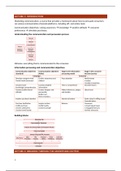
Understanding the communication and persuasion process
Stimulus: everything that is communicated to the consumer.
Information processing and communication objectives
Communication objectives Communication objectives Stage in the information Stage in the consumer
(standard) (Keller) processing model decision journey
Campaign … Consumer …
Develops category need Creates awareness and Pays attention Needs/wants
Create brand awareness salience Is aware
Considers/examines
Creates brand Conveys detailed Tries to comprehend Searches/learns
knowledge/comprehension information
Creates positive brand Creates imagery and Makes inferences, judges, Likes/trusts
attitude personality and decides
Builds trust
Elicits emotions
Inspires purchase intention Intends to behave Seeks value/is willing to pay
Commits/plans
Purchase facilitation Inspires actions Behaves Consumes
Instills purchase Instills loyalty Is loyal/repeat buyer
Creates satisfaction Connects people Is engaged/interacts
Creates brand loyalty Actively advocates
Building blocks
LECTURE 2: BREAKING THROUGH THE ADVERTISING CLUTTER
1
,WHAT IS ATTENTION?
Attention is:
- Limited (you can’t pay attention to everything)
- Selective (focus on things that are important, ignore unimportant things)
- Voluntary (= attention that you allocate to something that is important to you) or involuntary
(= all things that automatically and unconsciously attract attention)
- A precondition for further processing (= you cannot process everything, but if people pay
attention to something they will later on allocate more resources)
More attention = more cognitive capacity = more comprehension = more elaboration.
Levels of processing/involvement
- Pre-attention: little or no capacity required (automatic processing)
- Focal attention: little capacity required (to focus on one message source that is important)
- Comprehension: modest levels of capacity required
- Elaboration: substantial levels of capacity required
Information processing stages focal attention: scanning the environment comprehension: try to
understand why you allocate focal attention to something that is important to you elaboration: if
you allocate a lot of resources to something, if you start thinking deep about important things.
- Pre-attention: visuals
- Focal attention: visuals and understanding that this is an ad for iPod (example)
- Comprehension: understand the sentence and understand that it is a new product
- Elaboration: think about what it means to own this device (pro’s and con’s)
HOW CAMPAIGNS CAN STAND OUT
2
,1: increase attention
2: increase easy of processing
Increase attention (= attention effect)
1. Increasing involuntary attention
Various communication cues can increase an automatic orienting response:
- Saliency: salient, original, and novel stimuli
- Horizontal centrality: centrally located stimuli
o Stimuli in the center receive more attention (and are more likely to be chosen)
- Primacy: stimuli presented first
o Consumers are more attentive (more cognitive resources) to items that are
presented first in a list
- Picture superiority: pictures
o Pictorial information receives more information than textual information
Oftentimes unconscious and unintended
‘’Attractors’’ (they attract attention)
Associated with bottom-up processing (from the actual situation onwards, something attracts
your attention and you allocate more attention to it)
Saliency
- Salient stimuli:
o Perceptually prominent (size, color, contrast)
o Novel, unexpected, and original (novelty: Ikea uses the same information in 3
advertisements in a different way, allocate more attention to the new information)
o Stimuli related to life and death
- These stimuli:
o Stick out and are hard to ignore
o Lead to mild psychological arousal
o Result in focal attention to the source of stimulation (pre-attention becomes focal
attention)
Yerkes-Dodson law: arousal explains the relationship between saliency, focal attention, and
elaboration (if consumers are too happy, then cognitive capacity will roll down)
Picture superiority
3
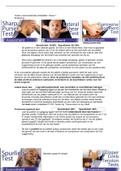
, To what elements do consumers pay most attention? Brand, pictorial, or text? Analysis of 1363 print
ads with eye tracking technology:
- Pictures: attract attention, regardless of size
- Text: the bigger the text, the more attention
- Brand: the bigger the name, the more attention
2. Increasing voluntary attention
- Increase self-relevance
o Personal interest avoids inattentional blindness
Consumers allocate more attention to information that is consistent with
their goals
Information that is not relevant, is often ignored, and will lead to
inattentional blindness (= information automatically unconsciously blocked)
o Self-referencing: attention increases when personalized information is used (second
person wording ‘you’, first names)
o Proximity
- Curiosity
o Unfinished ads
o Mysterious ads
Oftentimes conscious and intended
‘’Magnitizers’’
Associated with top-down processing (start with something that is important and you want to
allocate more attention to it)
Difference between bottom-up and top-down processing
- Bottom-up processing:
o Analysis that begins with sensory processing and feature analysis
o Involves making sense of raw data
- Top-down processing:
o Information processing that is guided by higher mental processing
o Our expectations and experiences shape how we perceive information
Examples personal interest and inattentional blindness
- Exaggerated example: if there is nothing to worry about (being pregnant), then you probably
don’t even see types of commercials about pregnant predictors. Only when you want to
become pregnant or worried about it, then it will draw your attention. There is voluntary
attention allocated to, otherwise there is inattentional blindness
- Banner blindness: completely ignore the advertisements on Google
- Search: Kleenex did a good job in targeting people where Kleenex was of personal interest,
they actually looked at the amount of people that googled symptoms of the flu
Implications for SEA and SEO:
- Organic results generate more attention and traffic because they are immediately relevant
- Sponsored results often suffer from inattentional blindness (= banner blindness)
4
Marketing communication: a course that provides a framework about how to persuade consumers
via various communication channels/platforms, including off- and online tools.
Communication objectives: raising awareness knowledge positive attitude consumer
preferences stimulate purchases.
Understanding the communication and persuasion process
Stimulus: everything that is communicated to the consumer.
Information processing and communication objectives
Communication objectives Communication objectives Stage in the information Stage in the consumer
(standard) (Keller) processing model decision journey
Campaign … Consumer …
Develops category need Creates awareness and Pays attention Needs/wants
Create brand awareness salience Is aware
Considers/examines
Creates brand Conveys detailed Tries to comprehend Searches/learns
knowledge/comprehension information
Creates positive brand Creates imagery and Makes inferences, judges, Likes/trusts
attitude personality and decides
Builds trust
Elicits emotions
Inspires purchase intention Intends to behave Seeks value/is willing to pay
Commits/plans
Purchase facilitation Inspires actions Behaves Consumes
Instills purchase Instills loyalty Is loyal/repeat buyer
Creates satisfaction Connects people Is engaged/interacts
Creates brand loyalty Actively advocates
Building blocks
LECTURE 2: BREAKING THROUGH THE ADVERTISING CLUTTER
1
,WHAT IS ATTENTION?
Attention is:
- Limited (you can’t pay attention to everything)
- Selective (focus on things that are important, ignore unimportant things)
- Voluntary (= attention that you allocate to something that is important to you) or involuntary
(= all things that automatically and unconsciously attract attention)
- A precondition for further processing (= you cannot process everything, but if people pay
attention to something they will later on allocate more resources)
More attention = more cognitive capacity = more comprehension = more elaboration.
Levels of processing/involvement
- Pre-attention: little or no capacity required (automatic processing)
- Focal attention: little capacity required (to focus on one message source that is important)
- Comprehension: modest levels of capacity required
- Elaboration: substantial levels of capacity required
Information processing stages focal attention: scanning the environment comprehension: try to
understand why you allocate focal attention to something that is important to you elaboration: if
you allocate a lot of resources to something, if you start thinking deep about important things.
- Pre-attention: visuals
- Focal attention: visuals and understanding that this is an ad for iPod (example)
- Comprehension: understand the sentence and understand that it is a new product
- Elaboration: think about what it means to own this device (pro’s and con’s)
HOW CAMPAIGNS CAN STAND OUT
2
,1: increase attention
2: increase easy of processing
Increase attention (= attention effect)
1. Increasing involuntary attention
Various communication cues can increase an automatic orienting response:
- Saliency: salient, original, and novel stimuli
- Horizontal centrality: centrally located stimuli
o Stimuli in the center receive more attention (and are more likely to be chosen)
- Primacy: stimuli presented first
o Consumers are more attentive (more cognitive resources) to items that are
presented first in a list
- Picture superiority: pictures
o Pictorial information receives more information than textual information
Oftentimes unconscious and unintended
‘’Attractors’’ (they attract attention)
Associated with bottom-up processing (from the actual situation onwards, something attracts
your attention and you allocate more attention to it)
Saliency
- Salient stimuli:
o Perceptually prominent (size, color, contrast)
o Novel, unexpected, and original (novelty: Ikea uses the same information in 3
advertisements in a different way, allocate more attention to the new information)
o Stimuli related to life and death
- These stimuli:
o Stick out and are hard to ignore
o Lead to mild psychological arousal
o Result in focal attention to the source of stimulation (pre-attention becomes focal
attention)
Yerkes-Dodson law: arousal explains the relationship between saliency, focal attention, and
elaboration (if consumers are too happy, then cognitive capacity will roll down)
Picture superiority
3
, To what elements do consumers pay most attention? Brand, pictorial, or text? Analysis of 1363 print
ads with eye tracking technology:
- Pictures: attract attention, regardless of size
- Text: the bigger the text, the more attention
- Brand: the bigger the name, the more attention
2. Increasing voluntary attention
- Increase self-relevance
o Personal interest avoids inattentional blindness
Consumers allocate more attention to information that is consistent with
their goals
Information that is not relevant, is often ignored, and will lead to
inattentional blindness (= information automatically unconsciously blocked)
o Self-referencing: attention increases when personalized information is used (second
person wording ‘you’, first names)
o Proximity
- Curiosity
o Unfinished ads
o Mysterious ads
Oftentimes conscious and intended
‘’Magnitizers’’
Associated with top-down processing (start with something that is important and you want to
allocate more attention to it)
Difference between bottom-up and top-down processing
- Bottom-up processing:
o Analysis that begins with sensory processing and feature analysis
o Involves making sense of raw data
- Top-down processing:
o Information processing that is guided by higher mental processing
o Our expectations and experiences shape how we perceive information
Examples personal interest and inattentional blindness
- Exaggerated example: if there is nothing to worry about (being pregnant), then you probably
don’t even see types of commercials about pregnant predictors. Only when you want to
become pregnant or worried about it, then it will draw your attention. There is voluntary
attention allocated to, otherwise there is inattentional blindness
- Banner blindness: completely ignore the advertisements on Google
- Search: Kleenex did a good job in targeting people where Kleenex was of personal interest,
they actually looked at the amount of people that googled symptoms of the flu
Implications for SEA and SEO:
- Organic results generate more attention and traffic because they are immediately relevant
- Sponsored results often suffer from inattentional blindness (= banner blindness)
4